Founded in 2021 by Chihiro Yasufuku and Sakurako Jayne Abe, the Hibiki Project is a collective focused on "projects that invite intercultural and interdisciplinary collaboration,” aiming towards “expanding the prominence of Japanese and related musical/cultural works.”
With Reimu 冷夢, they have brought a distinctive vision for multimedia, multi-genre and intercultural performance to Toronto audiences. Reimu 冷夢 presents an absorbing modern reimagining of the Japanese folk legend “Snow Woman,” or “Yuki Onna,” a small-scale black-box show that delivered a deeply touching experience far bigger than the compact performance room.
“Yuki Onna” belongs, as director Mabel Wonnacott writes, to the world of the yōkai, “supernatural beings [who] are born not from human death, but from nature itself.” Like the translucent sheet we passed through to enter the performance space, the veil between dream and reality, living and dead, and different identities is billowing and flexible. Yuki Onna is endlessly variable: she is not a conventional ghost, a soul caught between living and dead. Perhaps a woman travelling on the wind, a vampiric creature or simply a mysterious stranger, Yuki Onna preys on unsuspecting travellers lost in snowstorms and, in some versions, might seduce and even marry men, though such alliances rarely last to happy endings. In this retelling, the creators opted to give more of a voice to Yuki to tell her own story, which traditionally tends to have a male narrator, while exploring overarching themes of love, grief, fate, identity, nature’s duality and power and life’s bittersweet impermanence.
From the blossoming of spring to the stillness of winter, Reimu 冷夢 follows Kanade, a lute maker in the village, as he falls in love with a young, beautiful woman, Yuki, who appears one day amidst driving rains. After some time, Yuki begs Kanade to talk more about the night his father died, and the young man finally relents, revealing the mysterious, quasi-supernatural circumstances under which the Snow Woman was responsible. Soon, however, Kanade realizes the dreadful hidden truth: that Yuki herself is the Snow Woman, and that she had forbidden him from ever speaking of the events of that night.
In the collaborative bilingual libretto, written by the three core members of the Hibiki Project (Kento Stratford, Sakurako Jayne Abe and Chihiro Yasufuku), a fascinating sonic-linguistic division between Japanese and English emerges. For most of the show, spoken narration occurs in English and singing in Japanese. Narration tended to move the plot forward, while sung passages, for both the two protagonists and the ensemble, present more lyrical, poetic verses, ripe with metaphor and abstract imagery. At certain significant dramatic moments, however, Yuki also delivers speeches in Japanese. Bilingualism in Reimu 冷夢 is about more than translation or straightforward bi-cultural dialogue; the ways in which language, speech and song intersect are intimately connected to narrative and dramatic structure.
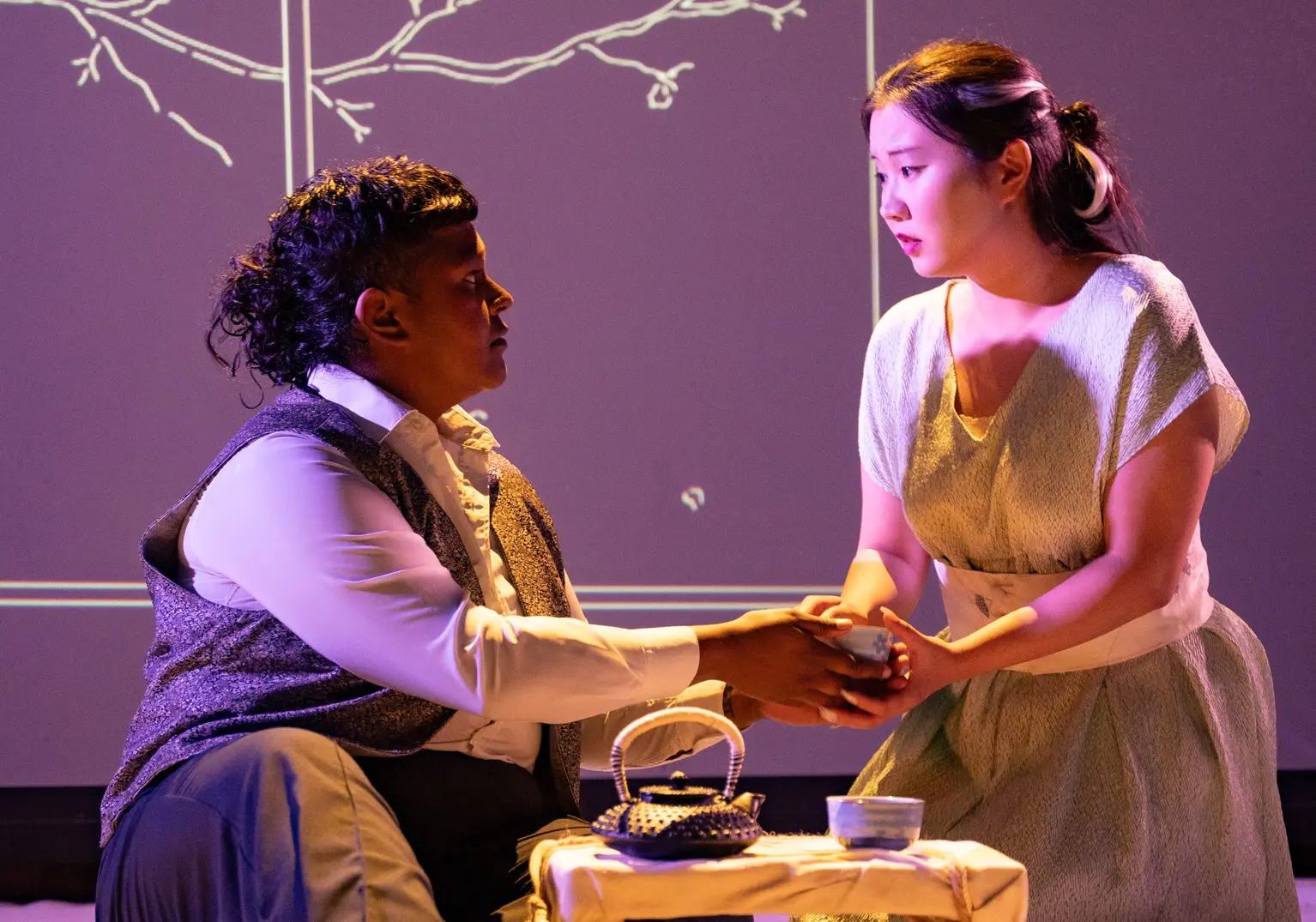
Photo Credit: Thomas Li
Anika Venkatesh (Kanade) and Chihiro Yasufuku (Yuki) in Reimu 冷夢
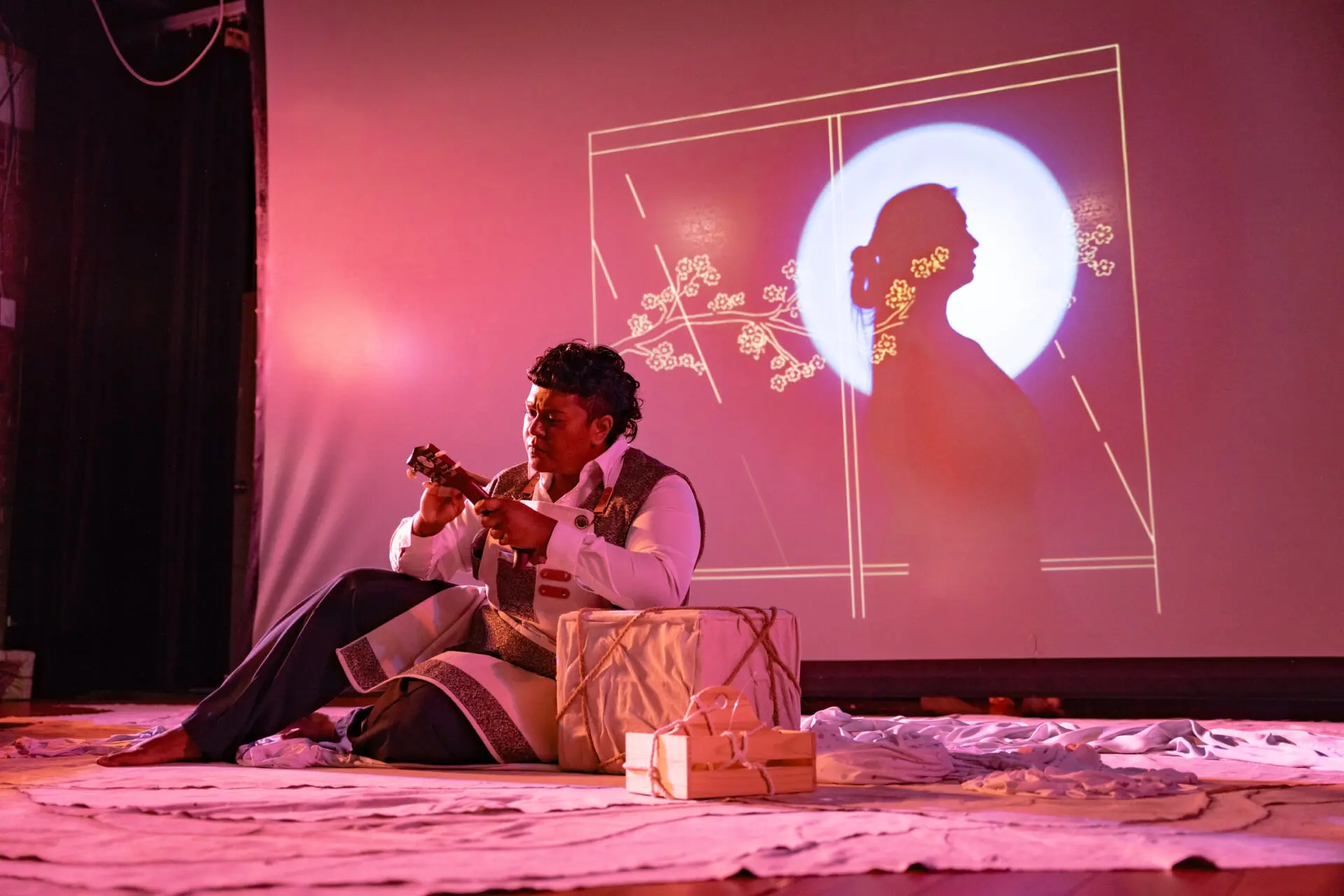
A production like this requires exceptionally versatile singer-actors to embody fluctuating, layered character identities. We saw exactly this in the two lead performers, Anika Venkatesh and Chihiro Yasufuku, both phenomenally talented vocalists who gave heartfelt and technically exceptional performances. Venkatesh’s ability to shift fluidly between narration, speech, song and figurative movement was especially impressive, and both leads brought Kento Stratford’s nuanced and varied score to life with ease. Offering flexibility of tone and focused, luminous singing, members of the babεl ensemble surrounded the audience at the rear, creating an intimate and immersive sound world brilliantly completed by Christine Bae at the piano. Four of the ensemble members doubled as onstage singer-actors, taking on flexible roles from listening villagers to manipulating the set and props.
The staging was relatively minimal, but the show’s overall multimedia design is intentional and meaningful, reflecting a tendency toward suggestion and evocative gestures. White fabric sheets billow and lie rumpled; a layer of large thin translucent plastic, deployed with varying degrees of vigour by ensemble members, could suggest emotional turmoil, the swirling rain and snow, the passing of time or supernatural vibrations. Central to the visual design were captivating animations projected onto a large screen backdrop, created and operated by graphic designer and musician Lachlan Mason. Taking inspiration from Japanese line drawing techniques, fine lines snaked across the screen, sometimes forming a mostly static image, sometimes swirling and converging to conjure snow, wind and rain. Effective use of lighting and shadow, conceived by Sephora N’Kosi and Wonnacott, added further engaging visual enhancements to the drama.
Billed as an “immersive storytelling experience,” Reimu 冷夢 is positioned within an increasingly expansive world of genre-ambiguous music-theatrical projects. New music, immersive theatre, intercultural performance, contemporary classical, chamber opera, multimedia performance – all these categories overlap and are at play here.
Reimu 冷夢 is wonderful as it is: a one-hour, deeply evocative and multifaceted performance, but potential developments are easily imagined, perhaps with light chamber orchestration and an expanded physical space. And, I hope, more from the Hibiki Project, proving to be an exciting rising presence in our musical landscape.
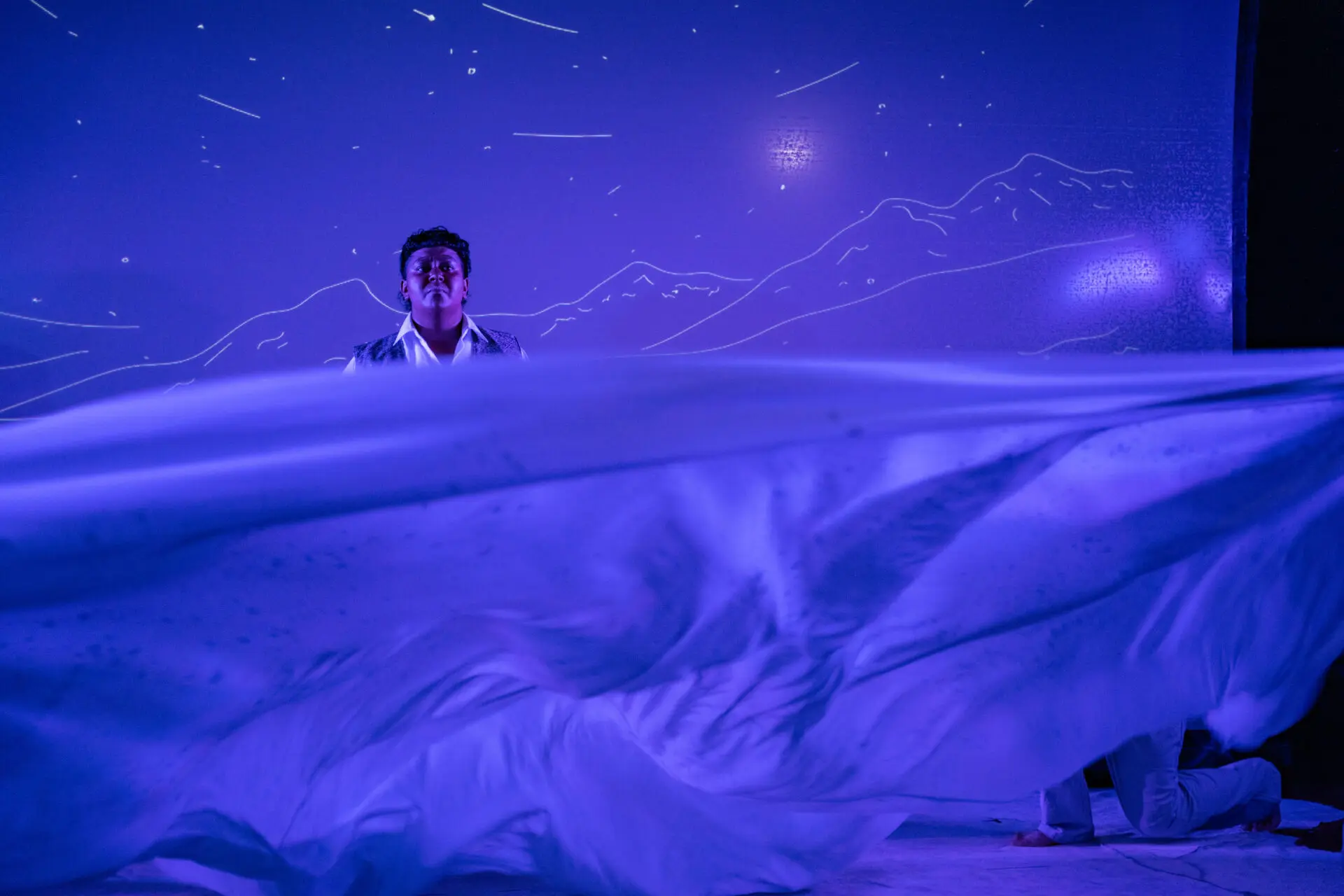
Photo Credit: Thomas Li
White fabric sheets could suggest emotional turmoil or the swirling rain and snow in Reimu 冷夢
Opera Canada depends on the generous contributions of its supporters to bring readers outstanding, in-depth coverage of opera in Canada and beyond. Please consider subscribing or donating today.