The myth of Orpheus has long been an inspiration to composers, which is not surprising, given that it deals with a legendary poet and singer who loses his true love not one but twice – an ideal subject for an opera. Monteverdi’s Orfeo was one of the earliest operas in 1607, Gluck’s Orfeo ed Euridice is probably the most frequently performed setting of the tale, and Offenbach’s Orpheus in the Underworld is probably the silliest.
Until tonight, however, I had never heard Marc-Antoine Charpentier’s setting, La Descente d’Orphée aux enfers, written around 1686. In the house program, co-artistic director Marshall Pynkoski says that, after discovering it, he was “initially disappointed to realize it was only one hour long.” Though he debated what he could pair the work with to create an evening-length program, he decided to allow it to stand on its own, prefacing it only with a new arrangement of the short “Orpheus and his Lyre” by Ralph Vaughan Williams (nicely sung by Measha Brueggergosman-Lee).
Pynkoski’s decision was correct, and Opera Atelier’s production of The Descent of Orpheus was among the most beautiful and moving works ever presented by this acclaimed company.
A great deal of credit belongs to American tenor Daniel McGrew, making his Opera Atelier debut in the title role. McGrew has a spectacular voice with an easy-sounding top range that filled Koerner Hall. He seems to have an innate ability to shape long, legato phrases in a manner that is exciting but never sounds forced. His performance also showed a comfort level with the stylized Baroque movement required of an Opera Atelier production. He is an exceptional find for this company, and I hope that this will be the first of many appearances for him in Toronto.
Mireille Asselin sang well as Eurydice, but Charpentier’s setting of the Orpheus story seems unusual in how little time this character is given onstage. We did not see Orpheus and Eurydice interact at all in the first act, and the fact that we were shown nothing of their relationship made it more challenging for the audience to understand his grief at her passing. In fact, the only time that they appeared alive at the same time was during their ill-fated walk out of the Underworld, where the chorus sang while the two principal characters remained in silence.
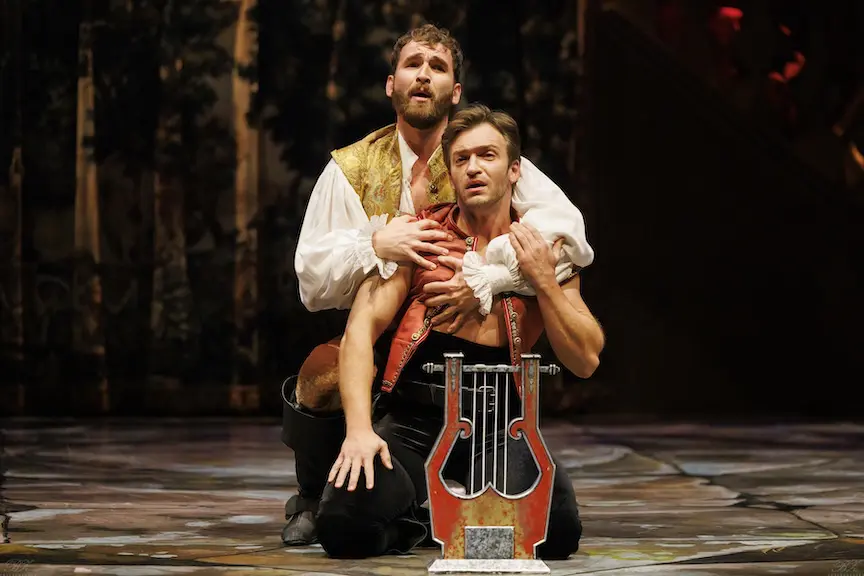
Photo Credit: Bruce Zinger
Olivier Bergeron as Apollo and Daniel McGrew as Orpheus presented a strong father/son relationship at Opera Atelier
The musical high point of the opera was probably the opening of the second act, where three criminals – Ixion, Tityos and Tantalus, played by Alexander Cappellazzo, Olivier Bergeron and Christopher Dunham respectively – sang an exquisite trio while being tortured and all of the souls in the Underworld are then soothed by Orpheus’s singing. The alternation of the men’s trio and solo was poignant and created a sequence that captivated the audience. In the opening act, Bergeron also had a lovely turn as Orpheus’s father, Apollo, who encourages his son to take his lyre down to the Underworld to win back his deceased bride. McGrew and Bergeron presented an honest father/son relationship that brought a pathos that helped establish Orpheus’s grief.
As Pluto and Persephone, the rulers of the Underworld, David Witczak and Mireille Lebel projected strong presence. Lebel, in particular, was very effective, since Charpentier’s music allowed the audience to see her emotional journey as she softened to Orpheus’s arguments. Combined with Lebel’s rich mezzo voice, her work as Persephone became a very brief “star turn” in an opera that, apart from the title character, feels very much like an ensemble piece.
There was ample opportunity for dance – which is not uncommon in French opera – and the artists of the Atelier Ballet felt integral to the piece. There were sections where it felt like the female corps was down by one body – sequences danced by five that might have been more balanced with an extra dancer. (Six women were listed in the program, so it’s possible that one dancer was injured or ill at the performance I saw.) Nonetheless, their unison dancing was very precise, and Jeannette Lajeunesse Zingg’s choreography contributed to the overall storytelling in an impactful manner.
Production elements were gorgeous, as is expected from Opera Atelier. Gerard Gauci’s sets for Koerner Hall are expanding thanks to the generous support of Jerry and Joan Lozinski, but his subtle and intricate two-dimensional painting still manages to be both soothing and provoking, constantly encouraging the audience to gaze deeper and see more things. Michael Gianfrancesco’s costumes fill the stage with rich, saturated colour.
The Tafelmusik Orchestra on period instruments seemed to be in their element, and both the overture and entr’acte music would not have been out of place in a concert performance. Christopher Bagan’s conducting was seamless. He kept the performance moving at a good pace, and all the elements – from orchestra through soloists to the ensemble singing (both from onstage and off) – were marvellously unified.
But finally, praise for Pynkoski, who understood that this “small” work just needed to be placed in the right setting, and then he trusted his collaborators and his artists to present it in a manner that would enthrall the audience. It really was one of the most perfect performances I have seen from this company.
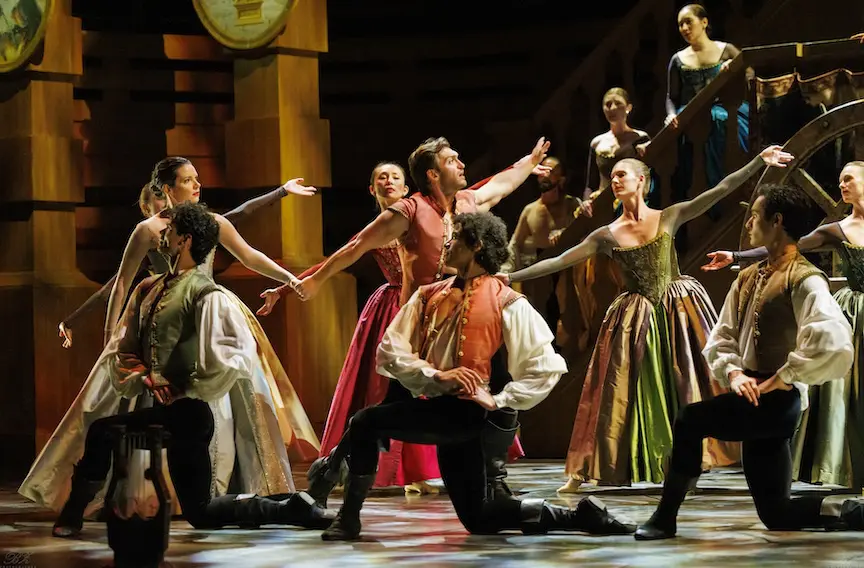
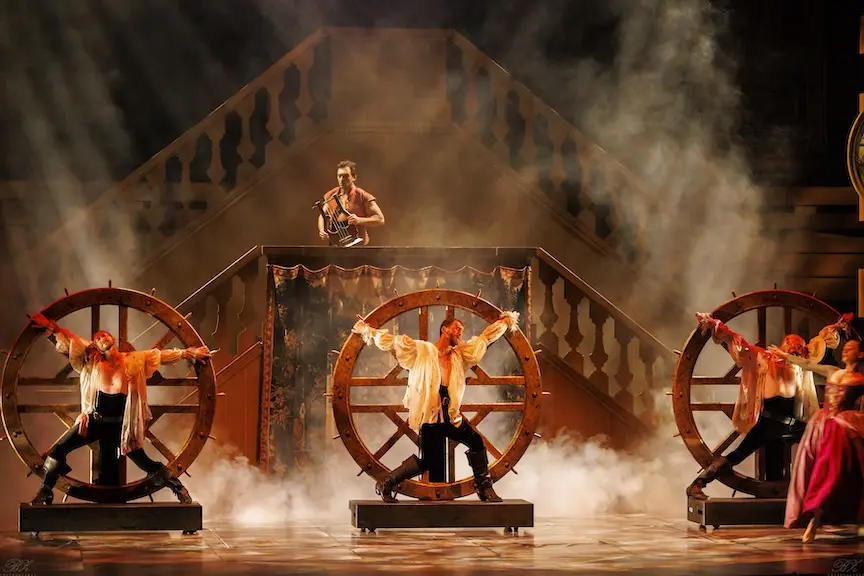
Photo Credit: Bruce Zinger
Without looking back, Orpheus (Daniel McGrew) tries to lead Eurydice (Mireille Asselin) out of the Underworld, passing through the artists of the Atelier Ballet
Opera Canada depends on the generous contributions of its supporters to bring readers outstanding, in-depth coverage of opera in Canada and beyond. Please consider subscribing or donating today.