“Welcome to the opening of operetta season,” Guillermo Silva-Marin, founder and general director of Toronto Operetta Theatre (TOT), greeted the audience at their first performance of La Grande-Duchesse de Gérolstein. It was a fair statement: as the only fully professional Canadian company specializing in the production of operetta, TOT’s opening night will always be the start of operetta season.
Given their mandate, TOT presents works that are seldom heard in Canada. Their upcoming production of Franz Lehar’s Paganini will mark its Canadian premiere, and La Grande-Duchesse de Gérolstein, while it was mounted by the Canadian Opera Company in 1976, is not one of Offenbach’s better-known works. It premiered in 1867 at the Théâtre des Variétés in Paris, where it was rushed to the stage as a follow-up to Offenbach’s La Vie parisienne, still running after opening a year earlier. Based on a libretto by Henri Meilhac and Ludovic Halévy (of Carmen fame), La Grande-Duchesse was presented by TOT in an English translation by Geoffrey Dunn.
It’s an operetta, so it’s not long on intricate plotting, but here’s the play-by-play. The Grand Duchess, who is more than just slightly entitled, is bored, and because she’s enamoured of all things military, her advisors start a war to keep her amused. She’s also quite fond of military men, and she develops a crush on Private Fritz, who she rapidly promotes to Field Marshall in an attempt to gain his favour. This move angers various people, including Fritz’s fiancée, Wanda, and assorted men, including the former leader General Boum and Prince Paul, who is expecting to marry the Grand Duchess. When Fritz unexpectedly wins a major battle (alcohol is involved somehow) and stays true Wanda, the Grand Duchess joins a plot to kill Fritz, but this is quickly forgotten. Fritz marries Wanda, and the Grand Duchess marries Prince Paul.
Given the frivolous nature of the plot – although the idea of an entitled leader starting a war as a distraction might seem timely – a lot comes down to the joy inherent in the performances. In this area, TOT had its audiences well covered.
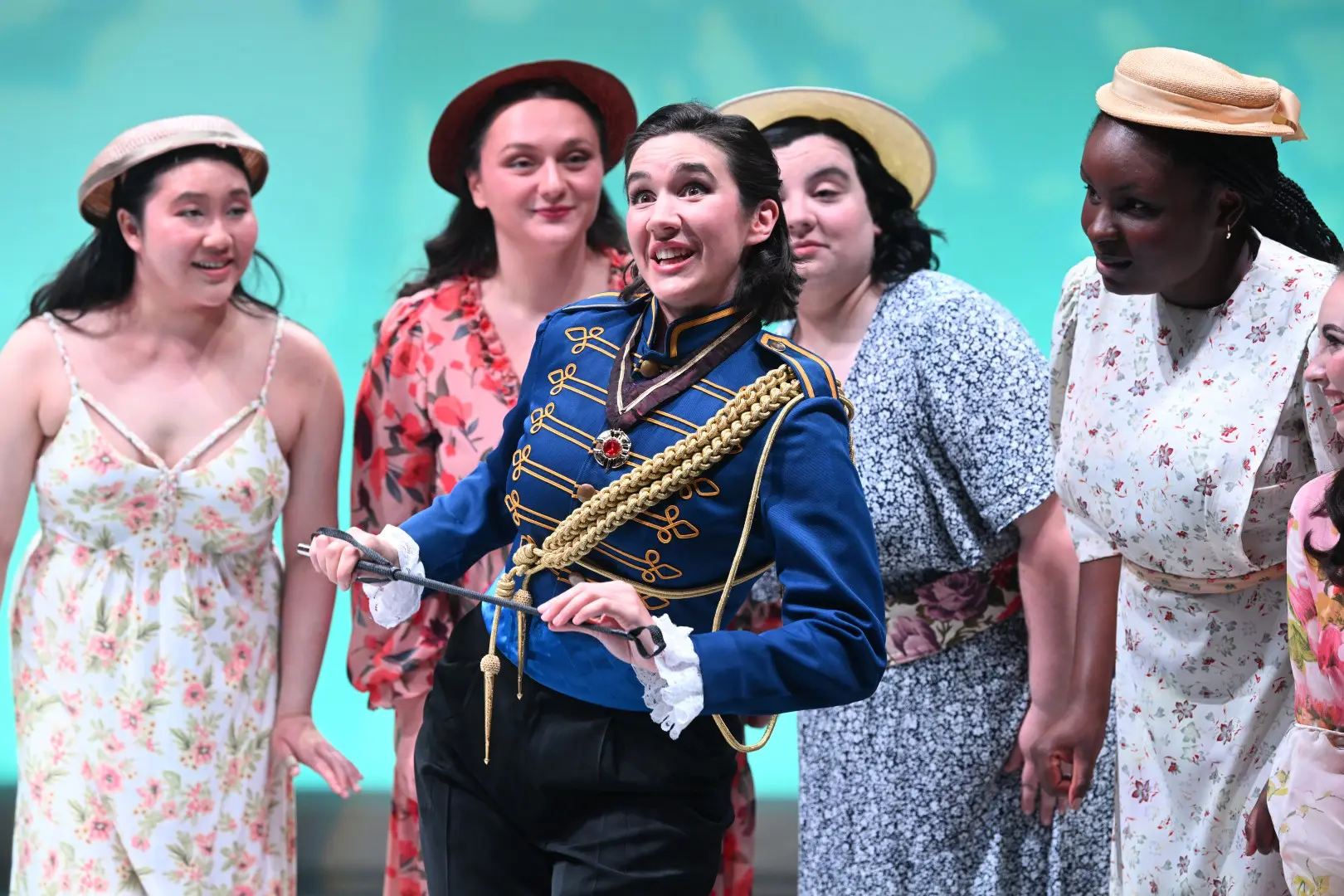
An operetta led by a darker mezzo-soprano voice made for a casting treat with the TOT debut of Adanya Dunn as the Grand Duchess. Her voice is rich and full throughout her range, her diction carried the English text well, and her smile was infectious, bringing a gentle levity to the role. Her opening aria, “I’m in love with the military,” charmed the audience and allowed Dunn to command the stage even though the title character makes her first appearance about 30 minutes into the show. It would have been nice if the libretto had provided even more opportunities for Dunn to engage in the hijinks of the rest of the cast, because this felt like a Grand Duchess with the power to amuse.
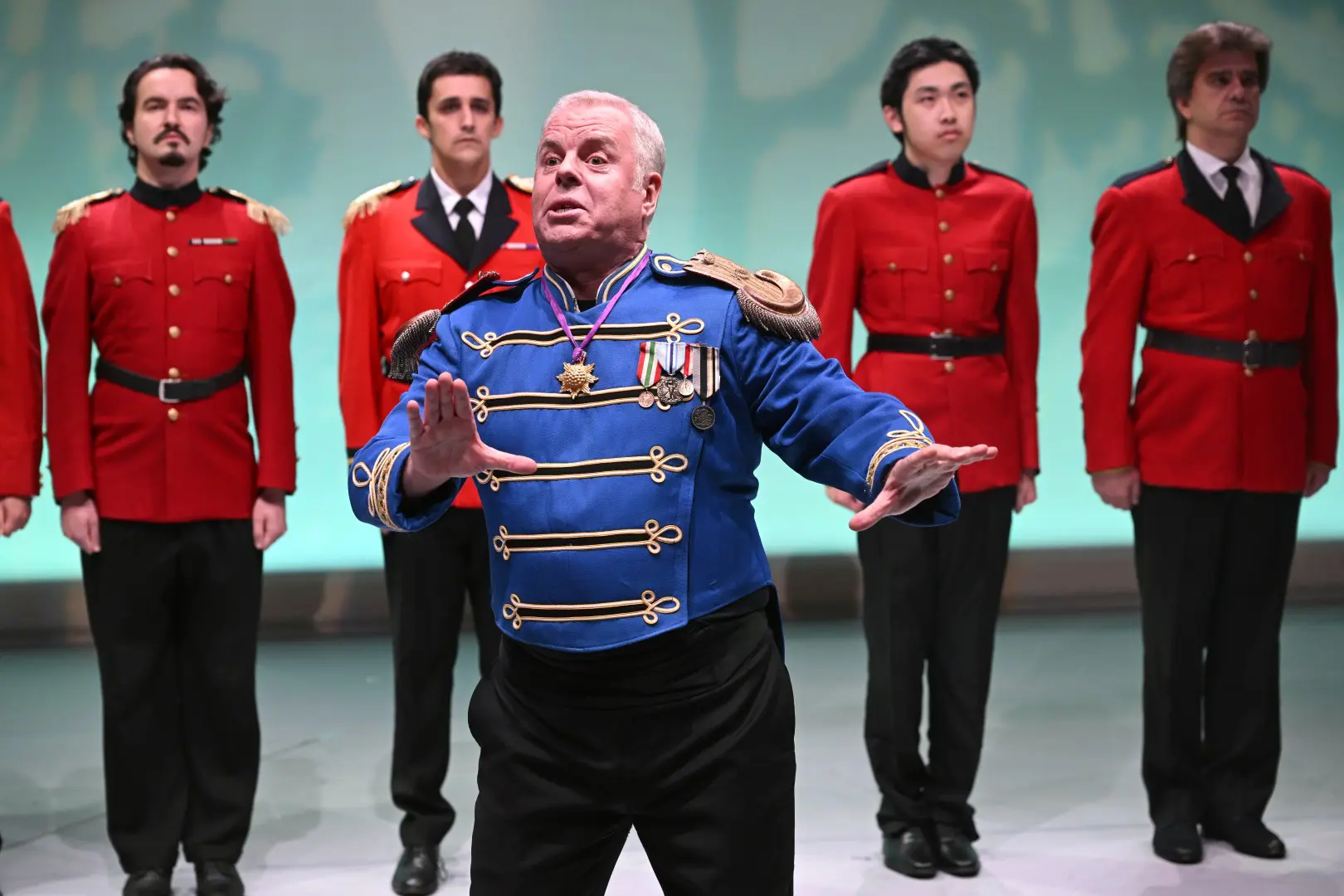
Photo Credit: Gary Beechey (BDS Studios)
Stuart Graham, as General Boum, leads the men’s ensemble in the comic “Piff, Paff, Pouff Song"
The comic highlight of the evening, of course, was Stuart Graham as General Boum, who led the men’s ensemble in the “Piff, Paff, Pouff Song,” one of the best-known selections from the operetta. Graham was ridiculous (in the best way possible), and he and the ensemble executed the choreography with both humour and accuracy. It certainly added to the audience’s enjoyment.
As the young lovers, Fritz and Wanda, Jeffrey Liu and Brooke Mitchell presented well. Liu has a beautiful lyric tenor voice with a nice sense of legato singing and a natural stage presence. As his voice matures, his approach to his high notes (which are already beautiful and ringing) will likely ease, and this will only make the instrument that much more radiant. Brooke Mitchell also has a glorious top range. Occasionally in moments of heightened emotion, she tended to push her lower notes a bit, but she is charming and effervescent onstage, and she showed a strong understanding of operetta performance style. The smaller roles of Prince Paul and Baron Puck were nicely played by Robert Hutson and Joseph Ernst.
Kudos to the small women’s ensemble, most of whom had short solos in the opening chorus of the second act; with multiple performances, each of the women will have had at least one opportunity for a solo part. These moments were beautifully sung and had a nice amount of energy. Praise as well for music director Narmina Afandiyeva, who conducted the 11-piece orchestra with precision and an remarkable sense of balance. Even in the fourth row, seated near the percussion and with the orchestra positioned on the auditorium floor between the audience and stage, the balance, aided by good projection and diction from the singers, was exemplary throughout.
Finally, a word of thanks to Silva-Marin, who is not only TOT’s general director but served as stage director and lighting designer for this production. He has mastered the art of making the limited stage at the Jane Mallett Theatre – no wings, no fly space – work for multi-location productions, and he kept the action moving efficiently while creating beautiful tableaus with the performers. Possibly more importantly, he remains the driving force that allows Toronto audiences to engage with works like La Grande-Duchesse de Gérolstein, and for that we should all be grateful.
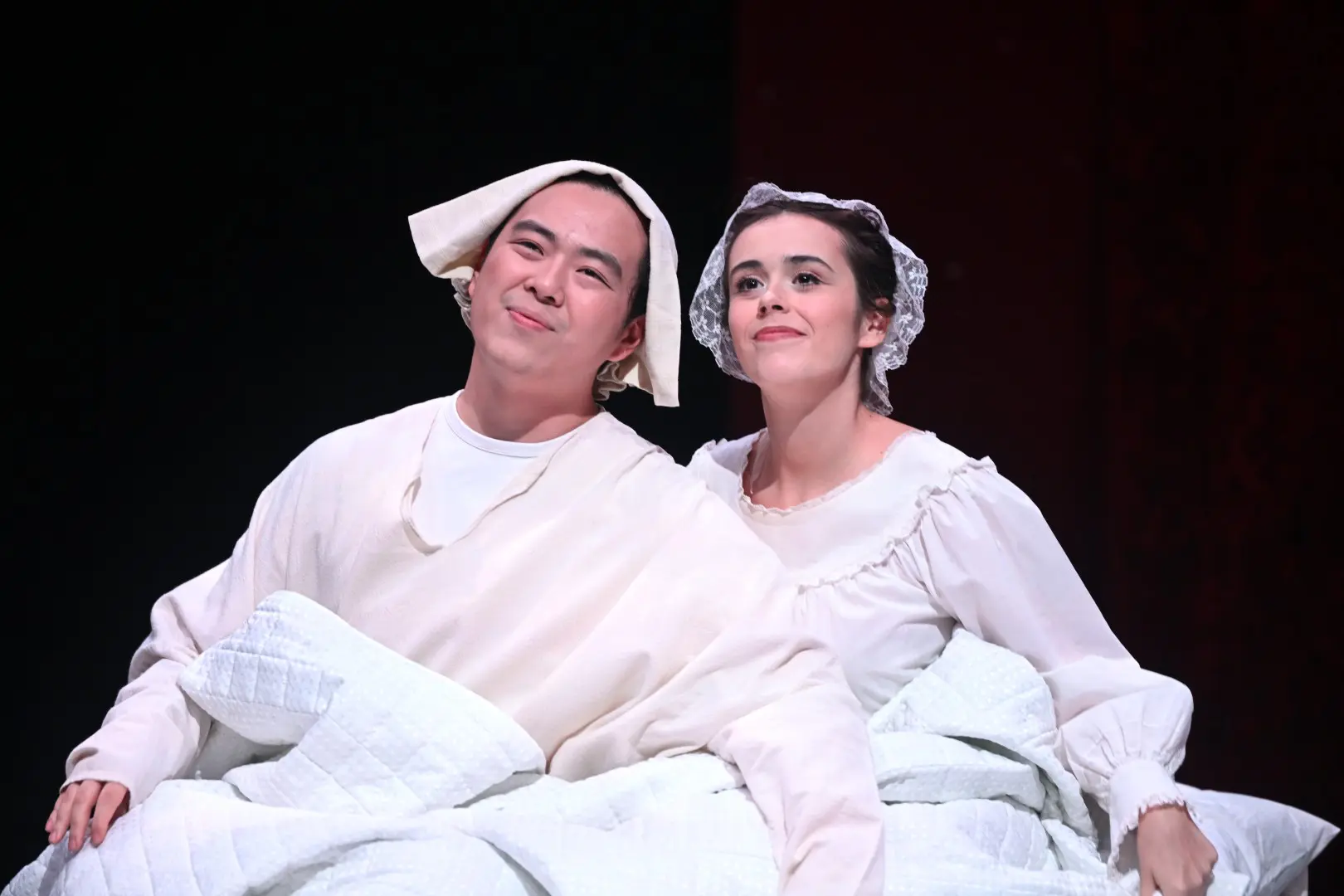
Photo Credit: Gary Beechey (BDS Studios)
Fritz (Jeffrey Liu) and Wanda (Brooke Mitchell) in their bed clothes on their wedding night
Opera Canada depends on the generous contributions of its supporters to bring readers outstanding, in-depth coverage of opera in Canada and beyond. Please consider subscribing or donating today.