As we enter the second week of March, signs of spring are appearing. But for over 100 children, this month will be emblazoned in their memories as March Hare Month. From March 5th to 9th, the Canadian Children’s Opera Company (CCOC) performed Alice in Wonderland eight times. When I attended on opening night, the opera had already charmed over 850 students at special matinee performances.
With music by Errol Gay and libretto by Michael Patrick Albano, the CCOC’s Alice premiered in 2015 and was the final production before Ann Cooper Gay’s retirement as executive artistic director. COVID scuttled a 2020 mainstage reincarnation, but a small-scale outdoor performance was staged in 2022. After much anticipation, the current production was brought to The Fleck at Harbourfront Centre.
The music itself is delightful. Gay guides us through the topsy turvy world of Carroll using a non-stop mix of musical styles. The beautifully lyrical introductory bars are just the beginning of variations including the Cheshire Cat’s doo-wop beat, the Caterpillar’s ethereal music and The Queen of Heart’s hints of Baroque. Coupled with this creative score are Albano’s ingenious lyrics. In the more contemplative passages, Albano speaks of “gossamer threads” and “curious bountiful joy,” while lyrics like “If I can’t scream for loyalty, what is the point of being royalty?” left the audience in stitches.
Leading us through this musical maze was music director Teri Dunn. It takes special talent to work with children, and Dunn’s enthusiasm, precision and artistry clearly overflowed to her musical team. The nine-piece orchestra was energetic and gifted, sliding into the various stylizations with ease. The talented core players supported stunning performances by Laura Chambers (flute/piccolo), Peter Stroll (clarinet/bass clarinet/saxophone) and Micajah Sturgess (horn). I particularly enjoyed Daniel Lalonde on the bass, not only because of his talented playing, but because his smile showed the joy inherent in all the musicians.
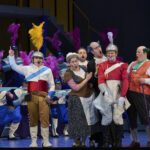
The various choruses (from the youngest Apprentice Chorus to the oldest Young Artist Studio singers) were impeccably trained. Their sound was gorgeous and embraced the beauty of unforced, youthful singing. Whether singing in unison or in well-balanced harmony, the choristers united without affectation, demonstrating their mentorship by musical coaches Dunn, Adine Mintz, Kelsey Taylor and Stéphane Mayer. Small ensembles made up of cooks, children, frogs, Cheshire cats and tea maids all did their parents proud. Whether manipulating a giant cat’s purple tail, dancing up a storm in the Cheshire Cat scenes or acting as tiny prisoners, their cohesiveness put some adult choruses to shame.

Photo Credit: Sam Javanrouh
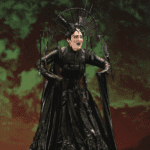
Lee Macerollo-Korzeniowski as the Queen of Hearts for the CCOC
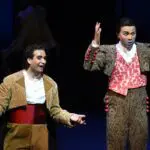
Every singer was totally committed to their role. Bravo to the following opening night soloists: Eve Murray (Charlotte), Sofia Melnyck-Gomez (White Rabbit), Katrin Madoyan (Small Alice), Chloe Naz (March Hare), Monday Earle (King of Hearts), Calista Parkes (Knave of Hearts) and Lucy Akelian (A Dormouse). Amelia Payne was a beautiful Alice with clear diction, a lovely tone and great acting. Joel Glickman Rosen made an exuberant Mad Hatter, demonstrating strong singing and brilliant comic timing. Aviva Marche had a full-voiced tone as The Duchess. Lee Macerollo-Korzeniowski was outstanding as the Queen of Hearts. She not only acted up a storm, but her powerful singing demonstrated her training with mezzo Andrea Ludwig. I couldn’t help but have the “I saw her when…” feeling – this grade eight girl will go far. I simply must mention two roles which were not sung: Vanushka Gupta as the fashion-forward tinsel-skirted mushroom and Summer Holt as the beleaguered hedgehog, who somersaulted her way into stardom in the croquet scene. My only regret was that I saw only one cast of leads.
My Mad Hatter stovetop hat goes off to Chelsea Woolley and her brilliant directing. It takes pure genius to successfully stage a production with 108 participants ranging in age from seven to twenty. The 60 minutes of non-stop action was a celebration of fluid direction using every corner of a relatively small stage plus the stairs and the two-tiered balconies at the back. Where use of giant puppets and shadow puppets could possibly spell disaster, Woolley and her cast made each innovation a triumph.
Costume designer and coordinator Perseus Rebelo created a mirage of colourful magic. Baseball caps were transformed into frog footmen’s heads, sequined dancers pranced onstage, schoolchildren in black and white were transformed into cooks and maids with the addition of aprons, and bright t-shirts made scenes pop visually. Props coordinator and builder Michele Morgan wowed us with objects like cleverly embellished school corkboards on wheels, pop-up book cakes, a beautifully painted table-top lectern with two children acting as the legs. Puppet designers and builders Joey Graff and Emily Neufeld made a seven-person caterpillar an hilarious reality, while Mabel Wonnacott headed up puppetry, which included intricate shadow puppets. Lighting design by Siobhán Sleath was well timed and artistically creative.
My final kudos go out to all the caregivers who made sure the cast members were given this one-of-a-kind opportunity. Without drives to rehearsals and coordinating hectic schedules, this production would not have happened.
“You know what the issue is with this world?” asks Carroll’s Mad Hatter. “Everyone wants some magical solution to their problem, and everyone refuses to believe in magic.” After seeing this CCOC production, my belief in magic is renewed. It transported us into a beautifully surreal Wonderland.
Opera Canada depends on the generous contributions of its supporters to bring readers outstanding, in-depth coverage of opera in Canada and beyond. Please consider subscribing or donating today.