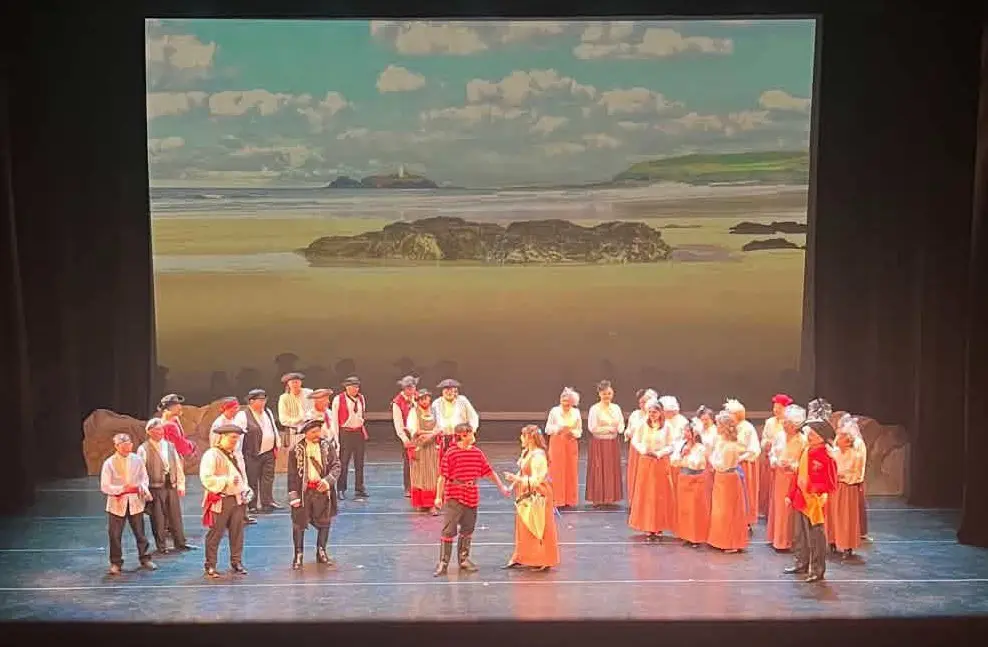
On July 16th and 17th, a motley crew sailed north of Toronto and took over the stage at the Richmond Hill Centre for the Performing Arts. Everywhere you looked there were pirates, but these were no ordinary buccaneers. They were musical marauders.
Last year, Opera York took the plunge into light opera with a July production of HMS Pinafore, and this year they repeated that successful venture with two performances of The Pirates of Penzance. Given the large audiences each evening, it is clear that Opera York is filling a need for some light-hearted summer entertainment.
Premiering in 1879, Gilbert and Sullivan’s The Pirates of Penzance continues to charm audiences with its energetic music, ingenious wordplay and satirical digs at British institutions. The operetta’s title comes from the ridiculous idea that pirates would invade the quiet seaside resort of Penzance, but it was also a not-so-subtle poke at theatrical “pirates” who performed unlicensed productions of HMS Pinafore in the United States. The plot centres on Frederic, a young man apprenticed to pirates until his 21st birthday, whose plan to leave the pirate life is scuttled by a ludicrous leap-year technicality.
Fresh out of his Bachelor of Music in voice performance at the University of Toronto, Luca McCauley was an engaging and well-voiced Frederic. His skilled acting transformed him into an attractive, wide-eyed man-genue with an excellent sense of comic timing. “Oh, is there not one maiden breast” showcased McCauley’s polished lyrical tenor tones, which continued throughout the show’s duets and ensembles. Grace Quinsey played Mabel, Frederic’s headstrong and sweet love interest. While elegantly moving around the stage, Quinsey’s light, agile coloratura made quick work of the rapid runs, trills and exceptionally high notes in the demanding “Poor wand’ring one!”
Mabel’s father, Major-General Stanley, was impeccably portrayed by Marc Potvin. His rapid-fire, comedic “I am the very model of a modern Major-General” was brilliantly executed, living up to its reputation as a G&S showstopper. Potvin’s facial expressions, excellent diction and clear tonality helped shape his character’s well-meaning but inept persona. Karen Usha was a velvety-voiced and poised Ruth. Usha has a flair for delivering one-liners, and her cougar-like interactions with McCauley were hilarious. Her patter in “When Frederic was a little lad” was strongly sung with a perfect balance of comedy and regret.
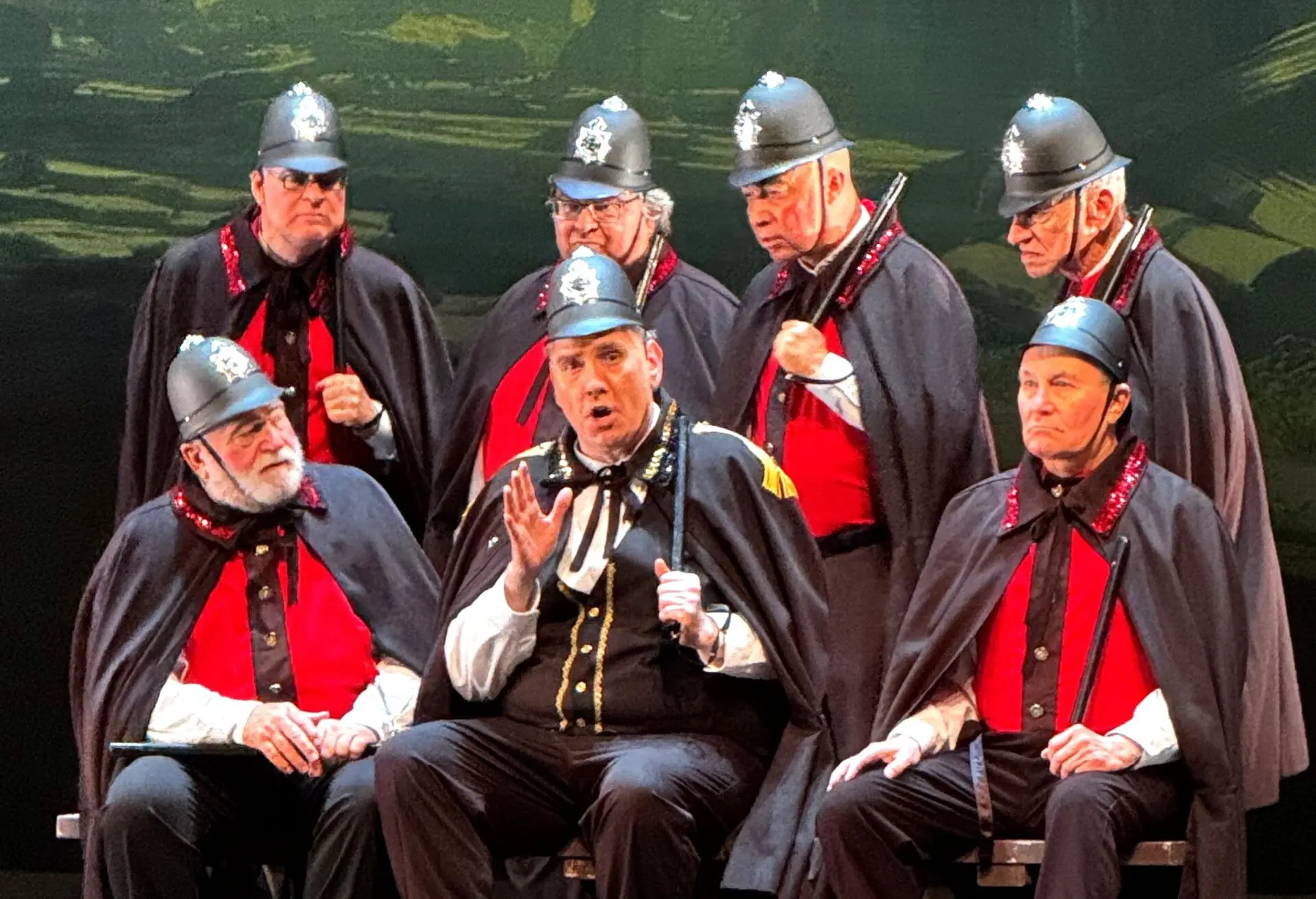
Photo Credit: Robert Kisin
John Holland as the Sergeant of Police with his men at Opera York
Douglas Tranquada was a charismatic and hilarious Pirate King who, despite his blustery behaviour, is a soft-hearted leader. Tranquada’s warm and strong baritone voice, coupled with his gift for swagger, made his “Oh better far to live and die” (better known as “I am a Pirate King”) a visual and vocal treat. While portraying the Sergeant of Police, John Holland incorporated a merry mix of bravado and fear in “When the foeman bares his steel.” Holland has an endearing way of seeming to enjoy every moment onstage, and his excellent diction, strong baritone sound and knack for physical comedy made his Sergeant a G&S archetype.
Simon, played by Mikhail Shemet, got the evening off to a roaring start with his leadership in “Pour, oh, pour the pirate sherry.” As the Pirate King’s hapless sidekick, Shemet’s solid singing in ensembles and brief solos left me wanting to hear more of his rich, baritone voice. Shemet danced enthusiastically with his fellow pirates and exhibited a certain joie de vivre in all his segments. Sara Sofia (Edith), Maddy Cooper (Kate), and Rehleigh Giesl Butler (Isabelle) should be commended for their lively solos, rich harmonies and sylphlike movement throughout the evening. Their leadership in chorus numbers was absolutely essential in keeping the women on track.
Geoffrey Butler is a skilled music director whose mastery of G&S was evident in the tight synchronization between the musicians and the singers and his guidance to singers in the phrasing needed to successfully navigate fast-paced lyrics. Sullivan’s instrumentation is elegantly light and comedic, but his speedy passages and syncopated rhythms are anything but funny and were meticulously performed by the orchestra. Despite some difficulties with diction from the women’s chorus, there was some very nice singing and tight harmony from the community chorus. Kudos to the policemen for their fine singing.
Director Penelope Cookson cleverly positioned the chorus, always making sure to have the strongest singers closest to the audience. She adeptly moved large groups on and off the stage, was creative in her use of simple yet effective choreography and used fluid groupings which were in keeping with the topsy-turvy nature of the music.
Gabriel Cropley’s lighting complemented Amanda Eason’s colourful costumes, and Robert Kisin’s projections added depth to the simple props. I particularly enjoyed the emblazoned Union Jack and the giant Queen Victoria in the final scene, as well as the animated ship comically nodding up and down in the opening maritime projection.
Upon the completion of The Pirates of Penzance, Sullivan wrote to his mother saying, “I think it will be a great success, for it is exquisitely funny, and the music is strikingly tuneful and catching.” Opera York owes its successful Pirates production to Gilbert and Sullivan’s brilliant writing and to a talented group of people who, almost a century and a half later, still revel in the sheer joy of performing these comic masterpieces.
Opera Canada depends on the generous contributions of its supporters to bring readers outstanding, in-depth coverage of opera in Canada and beyond. Please consider subscribing or donating today.