Nebula Performances production of Leoncavallo’s I Pagliacci is a time-travelling triumph that manages to be both ancient and contemporary – faithful to the 19th-century original and newly relevant.
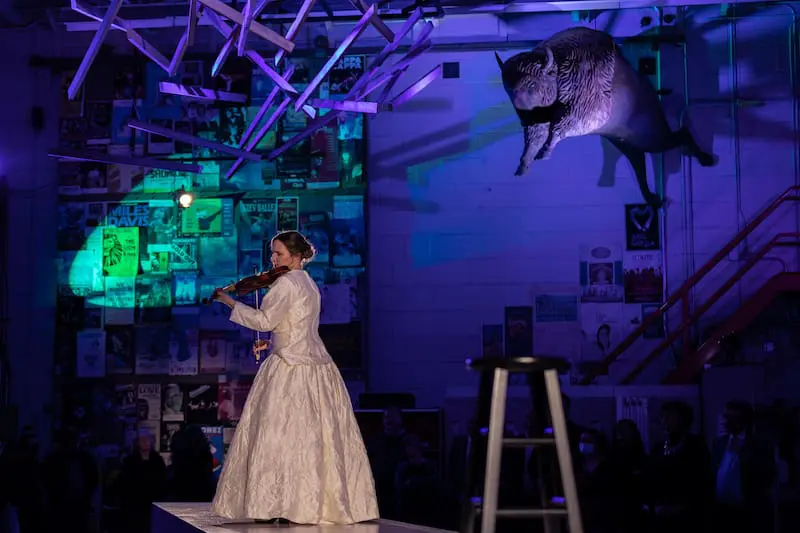
The pared-down, orchestra-less version of the opera verismo, featuring only piano (compellingly played by music director Wenwen Du), was well suited to the theatre carved out of a former warehouse for bathroom supplies across from a distillery next to the Fraser River. The production’s minimalism was its strength and helped reveal the opera’s emotional truth. The industrial riverfront vibe of the unassuming Nebula Performances space always seemed to me like the perfect place for a murder or at the very least a production of The Threepenny Opera, and I Pagliacci was an inspired choice for the fledgling company’s second full opera production.
Director David Walsh has transposed the setting from 1892 to post-war Italy – neatly pairing the gritty essence of opera verismo with the Italian neo-realism many associate with the opera in the classic 1948 film version starring Gina Lollobrigida (who could forget the scene where she whips Tonio?), not to mention the violence and desperation of almost everywhere at the moment.
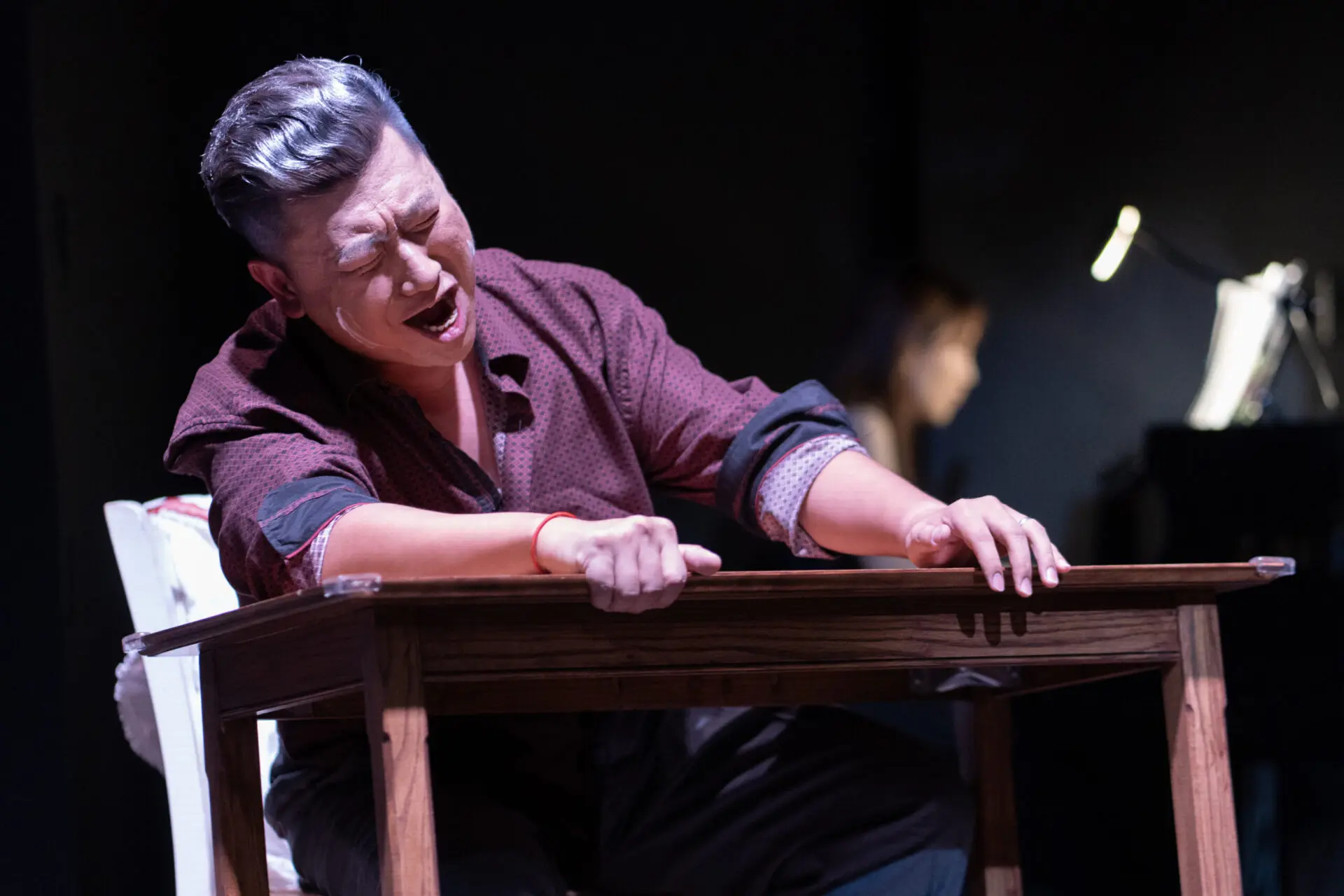
Like the adapted version of Peter Brook’s La Tragédie de Carmen that marked the company’s debut last year, this opera – performed in Vancouver for the first time since 2007 – is about yet another femicide committed by a man trapped by his own rage, impotence and toxic masculinity. And fittingly, internationally performing company member Wanshuai Yu (a lovely fellow in real life!), who played Don José last year, stars as another homicidal jealous guy, this time the tortured Canio, the leader of a commedia dell’arte troupe who murders his wife Nedda in a macabre play within a play. The tenor’s opening night rendition of “Vesti la giubba,” sung by Canio when he must put on his clown costume and laugh despite discovering his wife's infidelity, was a musically and emotionally powerful portrait of a man ensnared by his own ego.
And yet, as directed by David Walsh, everyone is trapped – especially poor Nedda – played and sung admirably by Hannah Ernst on opening night (she also appeared August 30 and will sing September 3, alternating with Holly Chaplin who sang August 28 and will appear September 1 and 5). Walsh takes a tiny liberty with the libretto to emphasize the fact that Silvio, Nedda’s ardent lover played in this cast of mixed experience by the celebrated opera singer Alexander Dobson, is endangering her life with his passion – quite literally. Dobson manages to exude both the charm and sleaze of Silvio with his fluid baritone.
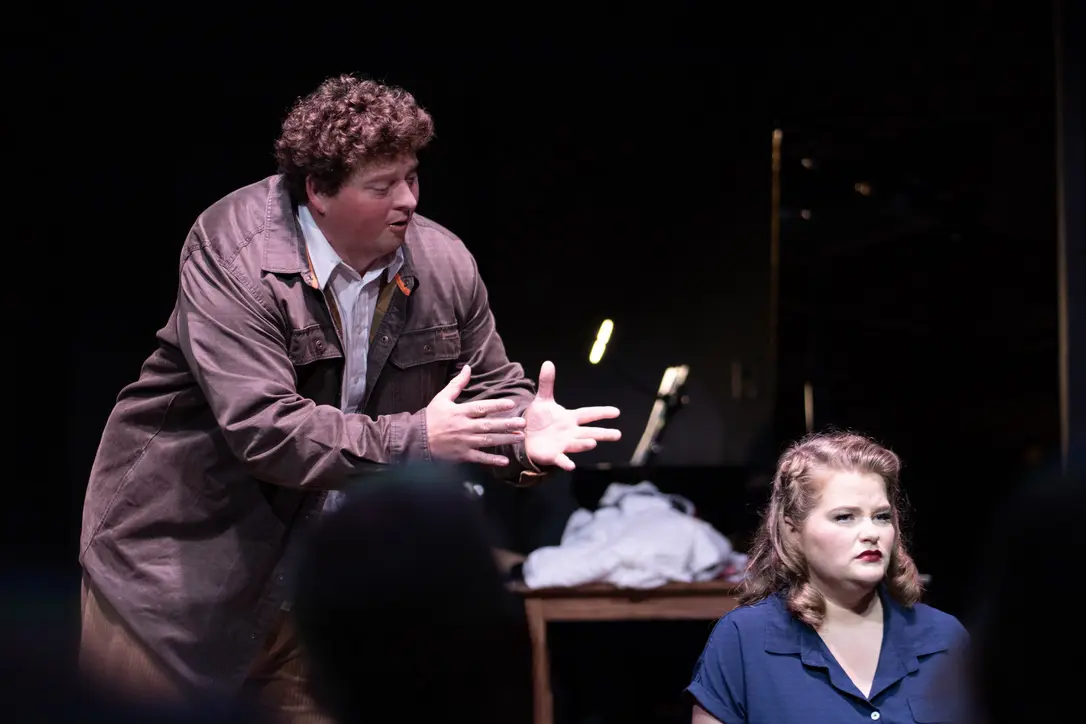
Photo Credit: Murat Atlan
Liam Robertson (Tonio) and Nedda (Hannah Ernst) in Nebula Performances’ I Pagliacci
When Ernst sang the lovely aria “Stridono lassù” as Nedda listens to the birds and contemplates her desire for freedom and her fear of Canio, her gorgeous soprano and dramatic chops beautifully conveyed both her character’s strength and vulnerability. This scene in I Pagliacci has always reminded me of the card reading sequence in Bizet’s Carmen, where her demise is revealed in not-so-subtle foreshadowing, and it was well performed on opening night.
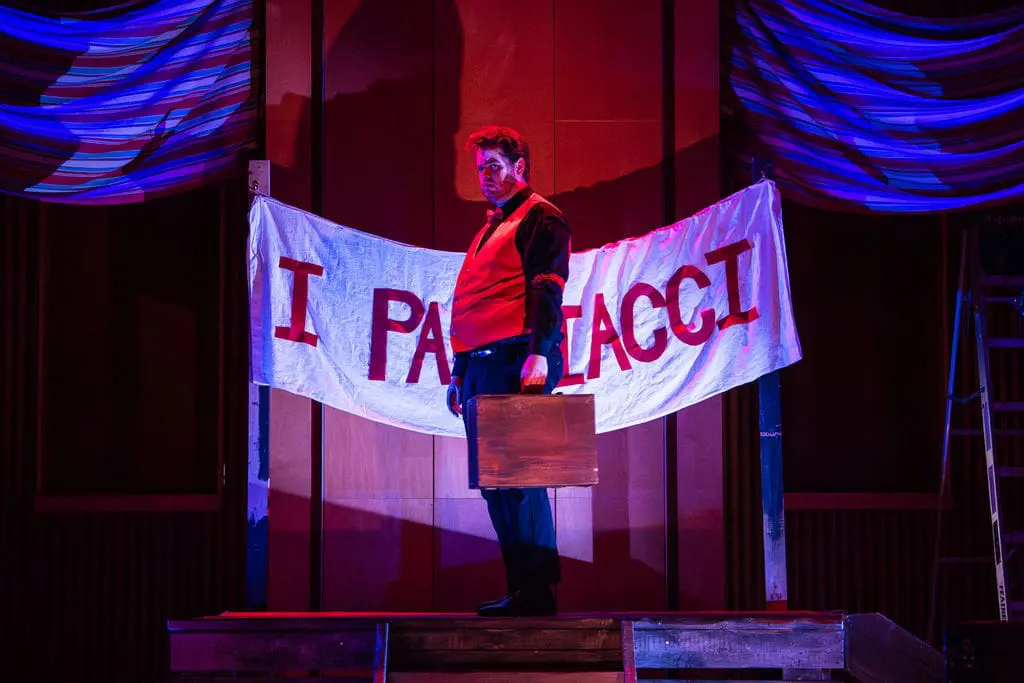
And of course, the hunchback Tonio (played convincingly by Liam Robertson, channelling the charisma of a young Orson Welles and impressing with his expressive baritone) is also caught –between his self-loathing fuelled by the ableism of others and his thwarted love for Nedda, which ultimately leads to his betrayal and her demise. As Robertson performed the introduction as Prologue (the link to ancient theatre was further augmented by slides of the Teatro Olimpico in Vicenza, which inspired Andreas Palladio’s design), he poignantly evoked the plight of the artist as misunderstood outsider.
But in the production, the audience is equally trapped and complicit. Just as the opera – the masterwork both written and composed by Ruggero Leoncavallo – blurs the line between art and life, Nebula’s version involves and implicates its spectators. The house lights are left on throughout the two-act opera and during the entr’acte intermission (as we collectively stretched our bodies in temporary relief from the very pared-down chairs we were all confined to), and we became part of the performance.
The line between audience and performer was further fused by the fact that the tiny 50-seat theatre brought spectators within inches of the cast. As Wanshuai Yu sang his final terrifying aria “No! Pagliaccio non son!” during the play-within-a-play, when reality and fiction blurred and his “performance” was charged with murderous rage – we joined the terrified crowd of spectators (well played and sung by a youthful chorus) in their concern for Nedda, trapped behind her happy go lucky commedia dell'arte character of la Colombina as a passive clown yet cognizant of what was about to unfold. Like the “audience” watching on stage, we lacked the agency to intervene.
And after Robertson’s Tonio darkly declared “La commedia è finita!” as the bodies of Nedda and Silvio lay slumped on the stage, we all returned home to doom scroll through livestreamed genocides and disasters as disengaged, sleepwalking voyeurs. But not before we applauded this excellent sophomore effort of what is quickly becoming a Vancouver gem of an opera company.
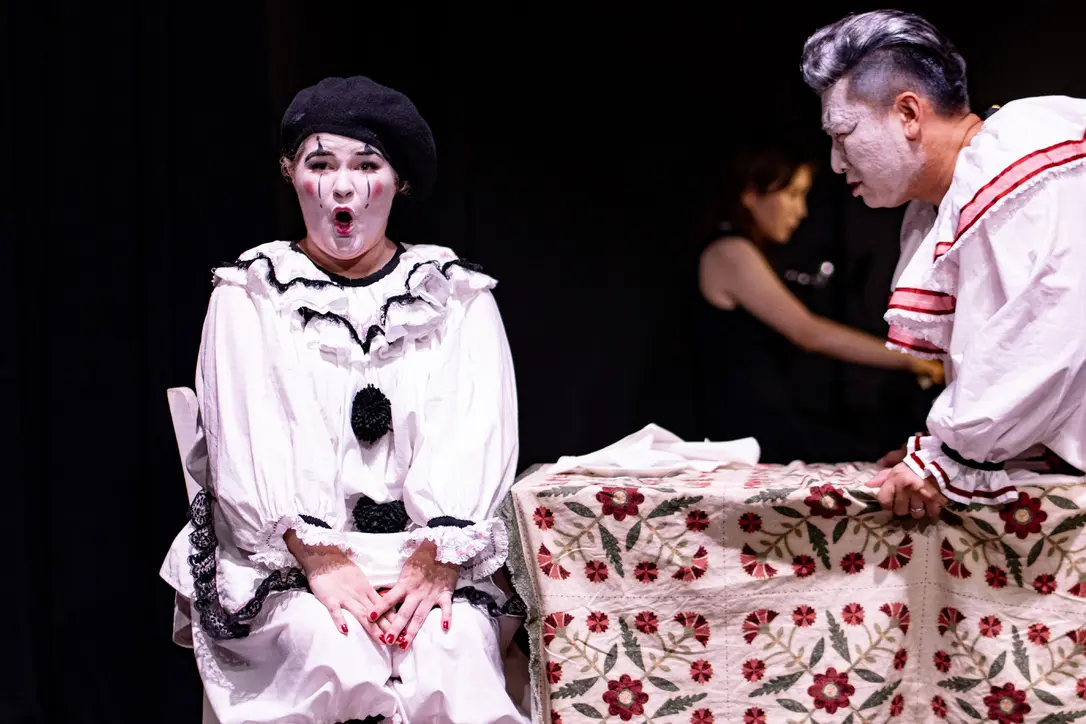
Photo Credit: Murat Atlan
Hannah Ernst and Wanshuai Yu face off in the play within a play
Opera Canada depends on the generous contributions of its supporters to bring readers outstanding, in-depth coverage of opera in Canada and beyond. Please consider subscribing or donating today.