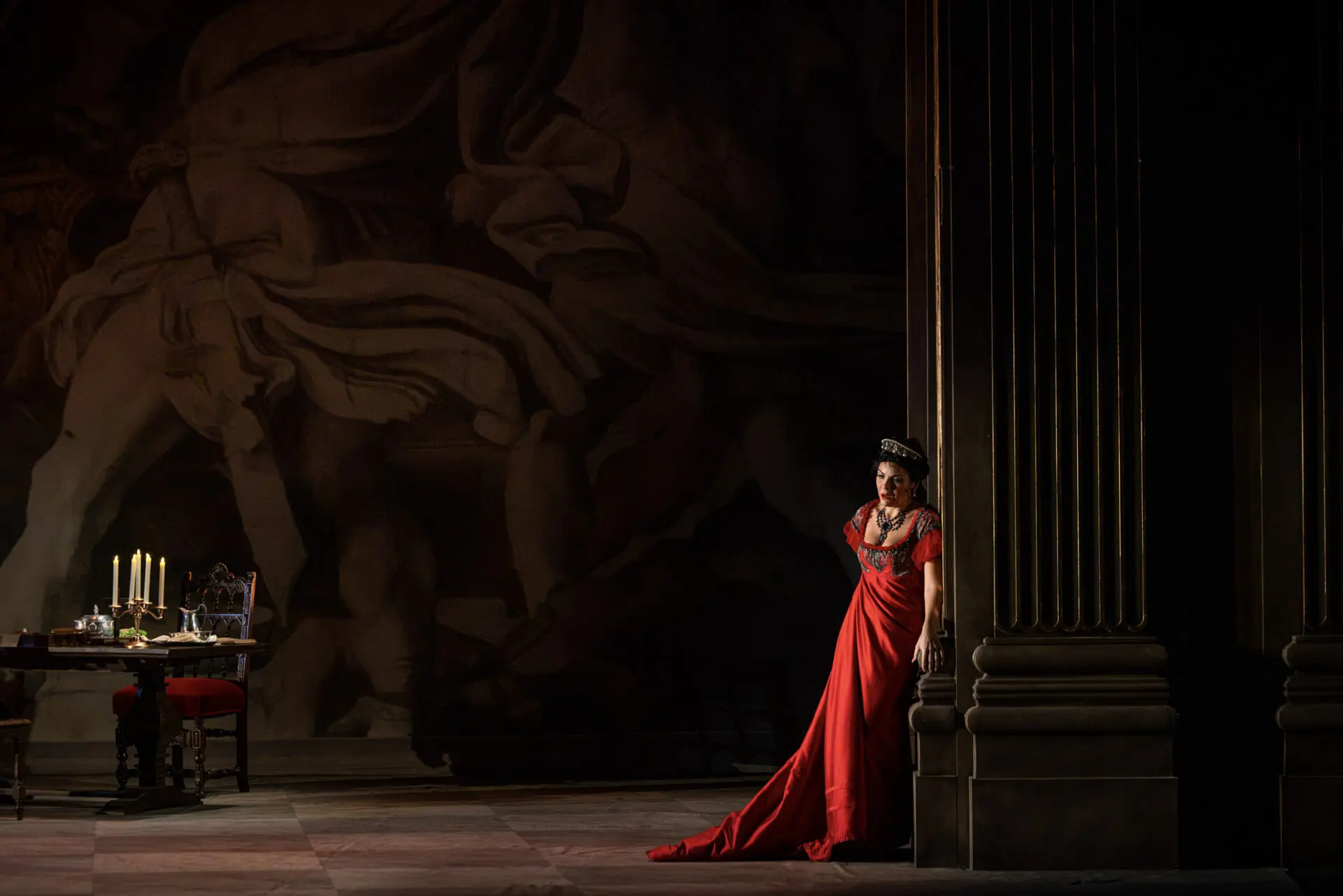
Puccini’s Tosca was the first opera of Calgary Opera’s new season. It was the company’s fourth production of the opera, in the most-performed group with La bohéme, Madama Butterfly, The Barber of Seville and Carmen. Historically then, this is a popular opera with Calgary management and audiences. But this time, the first-night audience was smaller than usual, and for no particularly evident reason. It gives one to ponder over the eternal question of opera today – audiences, operas being presented and changing taste. No useful punditry from this quarter.
The sets for Tosca came from Des Moines Opera, the production including sensible stage direction by Joshua Borths plus two first-class singers. Together with some excellent singing, the production included excellent playing by the Calgary Philharmonic Orchestra under Jonathan Brandani, the pathos of the music well to the fore, with the roughness of Scarpia’s music leavened by the sweetness of the love duets. Often the orchestra can seem invisible, but in Puccini, especially, it carries much of the musical burden. When conductor and orchestra are at top of their game, there is a sense of health and comfortability in the flow of the music. That was the case here.
Tosca is known for its three famous arias, expressive duets and especially for the second act with Scarpia’s monologue, duet with Tosca and the torture scene. The arias fared the best. The two main protagonists, making their Calgary debuts, delivered their set pieces with real aplomb.
The strongest of the performers was Maria Natale as Tosca. Her voice had the perfect Puccini sound, ample and with both a fine top register and a strong lower register, much needed in the second act. She admirably conveyed the inner sensibility of a woman on the edge, caught in a set of impossible circumstances. She was entirely convincing as the jealous, suspicious diva, but she was also a woman who possessed the vulnerability necessary to make the pathos of her demise credible. Her “Vissi d’arte” was the showstopper of the evening. In all, this was a very fine debut with the company.
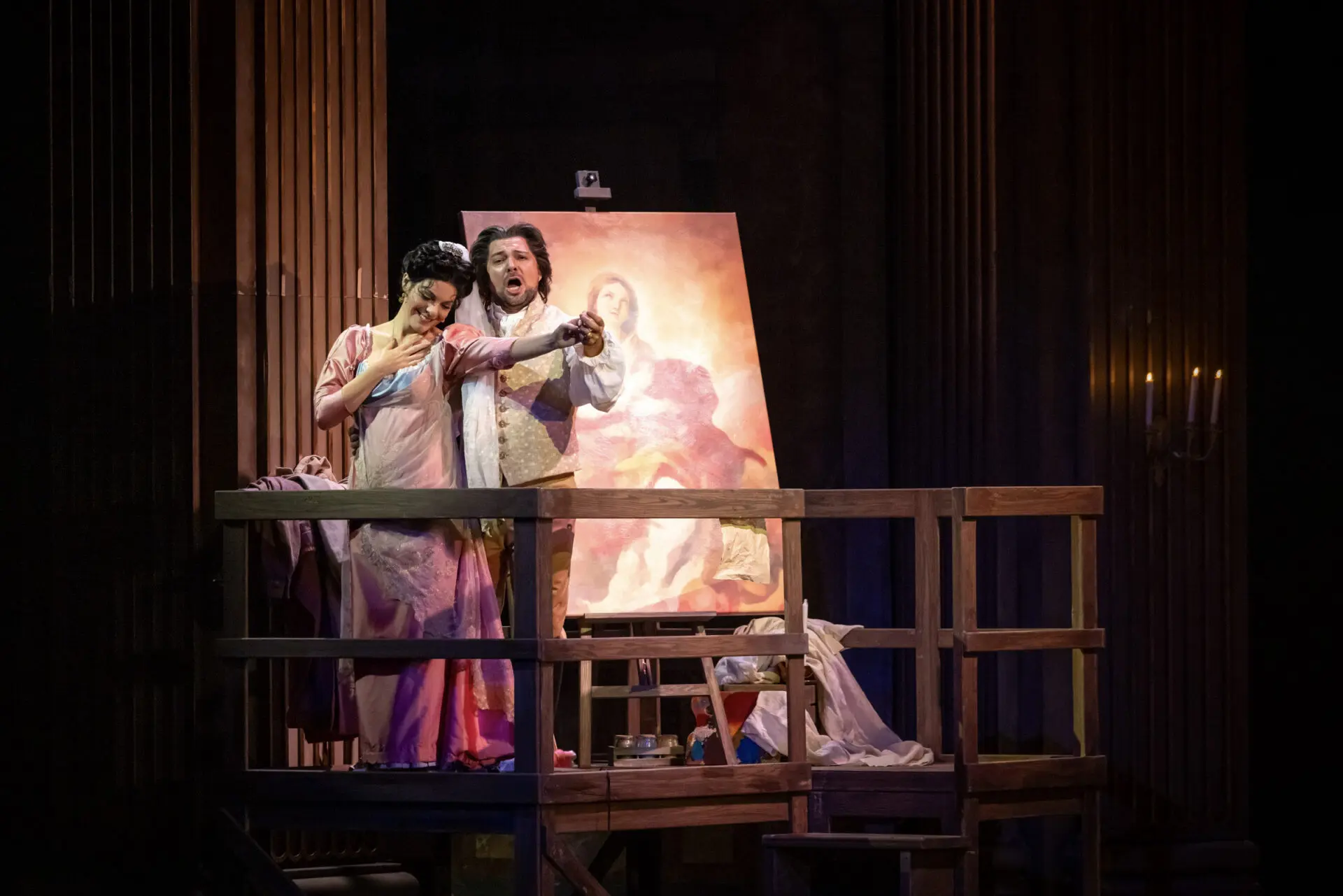
Photo Credit: Felipe Jasso
Maria Natale and David Esteban were “well-matched” as Floria Tosca and Mario Cavadarossi
She was well-matched with David Esteban as Cavaradossi, Tosca’s lover. His two arias are among the most familiar in opera, and he made the most of them, his ringing top register serving him well. He was also a good vocal companion to Tosca in the duets in the first and third acts. Comfortable on stage, he played Cavaradossi in a slightly more familiar way than sometimes, leaving Tosca to project the image of a higher-class thought and action. With a voice of this amplitude and quality, this is a career that is sure to flourish.
Boaz Daniel as Scarpia was on a lower plane as an actor and singer, but he was still fully adequate for the part. His role in the end of the Act One “Te Deum” came across very well, and if he was not the most sinister of Scarpias, everyone was happy to see him die from Tosca’s dagger. Vocally not quite on the same plane as the two principal singers, he nevertheless was a credible Scarpia.
The Calgary Opera Chorus was in fine voice for the “Te Deum,” bringing down the curtain of the first act with authority. The secondary roles, cast mostly from the company’s McPhee Artist Development Program, gave solid performances. Gabriel Sanchez-Ortega was a particularly good Angelotti, singing with a strong, full voice with good bass resonance and quite natural on stage. Matthew Bermudez as Spoletta, Scarpia’s henchman, was a trifle muted compared to some Spolettas I have seen, less slimy and more morally equivocal in the performance of his role. Vocally, Dion Mazerolle sang well as the Sacristan, but he lacked the comic antics of some in this part. Two little shepherds were cast, and both Georgia Noel-MacKay and Lillian Stewart sang together on opening night. They were clear-toned and accurate in their folk-like opening to the third act.
In all, this was a yeoman performance of this opera. The singing of the two principal singers was top-notch, and the orchestra was conducted and performed extremely well. The stage direction by Joshua Borths was clear and unfussy, with a fine attention to detail and the delineation of character. Even the marching of the soldiers was attended to with care and style. This was a worthy production, and no one went away short changed, even if it was not a performance for the memory books.
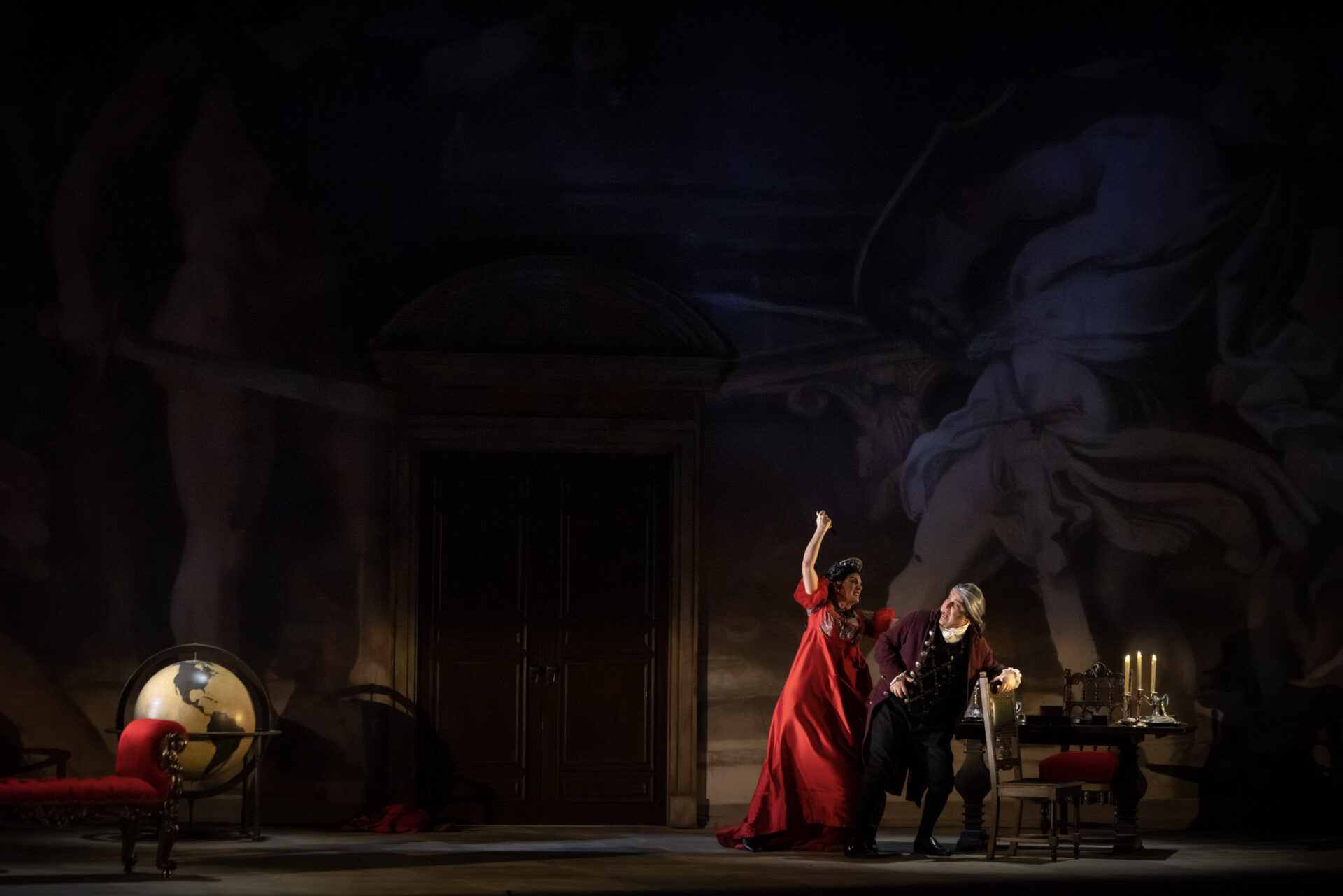
Photo Credit: Felipe Jasso
Baron Scarpia (Boaz Daniel) meets his fate at the hands of Tosca (Maria Natale)
Opera Canada depends on the generous contributions of its supporters to bring readers outstanding, in-depth coverage of opera in Canada and beyond. Please consider subscribing or donating today.