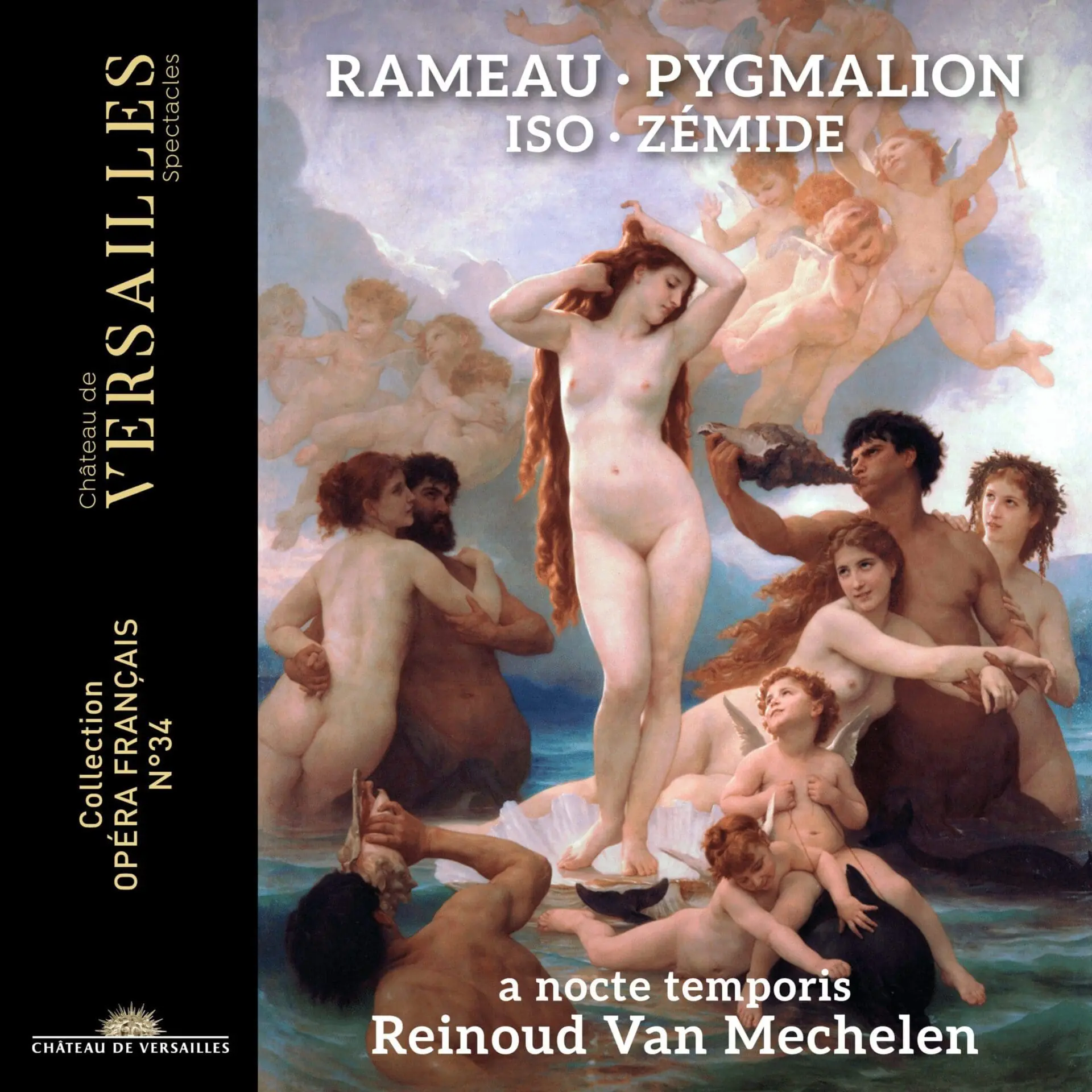
Round about the middle of the 18th century, a fashion developed in Paris/Versailles of creating an evening’s entertainment by combining scenes or acts from different opera/ballets, preferably resulting in a more dance-heavy balance than even French operas of the period provided. Eventually, composers started to produce one-act pieces specifically for this purpose, and this Château de Versailles Spectacle CD showcases two of them.
The first is Jean-Philippe Rameau’s Pygmalion of 1748. It’s based on Ovid, of course, and tells the story of a sculptor who falls in love with a statue. He moans about this to his erstwhile love Céphise, who is unimpressed, but L’Amour takes pity on him and animates the statue, which promptly falls in love with him. This results in a lot of celebratory dancing by the statue, which was originally played by the only singer of the time considered to be a good enough dancer – 13-year-old Mlle Puvignée, who went on to complete her obligatory 15 years’ service with l’Opéra Royale and retire at the ripe old age of 25. Fortunately, such precocious versatility is not required for an audio recording!
In this recording, Pygmalion is sung by Reinoud Van Mechelen, who also directs the period ensemble a nocte temporis which he co-founded. The role is a tour-de-force for haute-contre and Van Mechelen navigates it with great skill. He’s well supported by three contrasting female voices. Macedonian-Canadian Ema Nikolovska sings the small part of Céphise and does so with hauteur and some really pleasant smoky mezzo timbre. By contrast, Virginie Thomas as the statue and Gwendoline Blondeel as L’Amour are lighter and brighter, especially the former.
Most of the singing happens in the first half of the piece with a long succession of dance numbers making up most of the last two scenes. Many of these are presented very briefly; just 15-20 seconds of the main theme, which makes me think that an 18th-century performance would likely have run far longer than the 40 minutes taken here. The dances show off the excellent band to advantage. They are sprightly and rhythmically on point.
The second piece, Pierre Iso’s Zémide of 1759, is structurally similar with the plot pretty much over by the midpoint followed by lots of celebratory dancing. Here the story concerns Zémide, queen of Scyros, who is determined not to fall in love and is protected from L’Amour’s arrows by a shield given to her by Pallas. This is unfortunate for Phasis who is madly in love with her. L’Amour decides to help Phasis, and they hatch a cunning plan to outwit Zémide. The plot succeeds, Zémide falls in love with Phasis, and the happy populace (literally) has a ball.
Here, lower voices predominate with Ema Nikolovska as the queen and baritone Philippe Estèphe as her lover. Gwendoline Blondeel is once more L’Amour. I don’t think this piece is as skilfully composed as the Rameau, but it has its moments. Nikolovska is especially touching in the scene where she finally feels L’Amour’s arrow, and the lovers have a very pleasing duet, “Reçois nos voeux, Dieu que j’adore,” where both of them sing quite beautifully. Once again, there are lots of dances, and one feels that these have been sensibly cut for the recording.
The recording was made in December 2024 at the Grand Manège – Namur Concert Hall. It’s very clear and detailed, and it shows singers and band to good advantage, at least on the 96kHz/24bit digital version I listened to. It’s also available as a physical CD, MP3 and in standard resolution digital. As with all CVS releases, there’s extremely fulsome documentation for both physical and digital versions.
Opera Canada depends on the generous contributions of its supporters to bring readers outstanding, in-depth coverage of opera in Canada and beyond. Please consider subscribing or donating today.