Early Music Vancouver’s production of Monteverdi’s Orfeo was a true delight.
The 1607 classic, while not technically considered the first opera (that honour goes to Jacopo Peri’s Dafne, with the earliest surviving opera being Peri's Euridice), is the earliest that is still regularly performed. Based on the tale from Ovid’s Metamorphoses of musician and poet Orpheus, his love for his dead bride Euridice and his journey to the underworld to reclaim her, Orfeo, with libretto by Alesandro Striggio, was first performed in the early 17th century as a kind of favola in musica or musical fable.
The favola, emerging during the birth of opera in late Renaissance and early Baroque as a revival of ancient Greek theatrical traditions, was a dramatic stage work rooted in mythology, legendary tales or pastoral poetry. As director Guillaume Bernardi pointed out in a pre-show talk on opening night, the favola was one of several competing forms of entertainment at the time. It was an evolution of the traditional intermedio, a musical sequence between the acts of a play, and Orfeo provided the first fully developed example of the new genre.
After its first performance in 1607, it was staged in Mantua a handful of times, but after the composer’s death in 1643 it went unperformed for many years, only being revived in the late 19th century and again in 2007, the quartercentenary of the premiere, when it was performed internationally. EMV’s Orfeo is the first fully staged version with period instruments in Vancouver since their inaugural production in 2000, and it was worth the wait.
While many musicologists note similarities between early music and contemporary because of shared structural elements like complex polyphony and an absence of common practice tonal rules, under Bernardi’s direction and Alexander Weimann’s musical direction, this Orfeo managed to be both faithful to the original and uncannily modern.
While Bernardi gives a nod to Jean Cocteau’s 1950 film Orpheus, there is something very au courant to this staging of the iconic myth at a time when we are collectively staring into an abyss that seems to grow deeper every day. Coincidentally – or not – as Iran is bombed and world-heritage sites in Lebanon and Palestine are being decimated, Euridice was played by Iranian-Canadian soprano Bahareh Poureslami (who infused all 12 lines with great vocal and theatrical expression) and the roles of Pastore and Spirito well sung and played by Lebanese-Palestinian Canadian tenor Haitham Haidar.
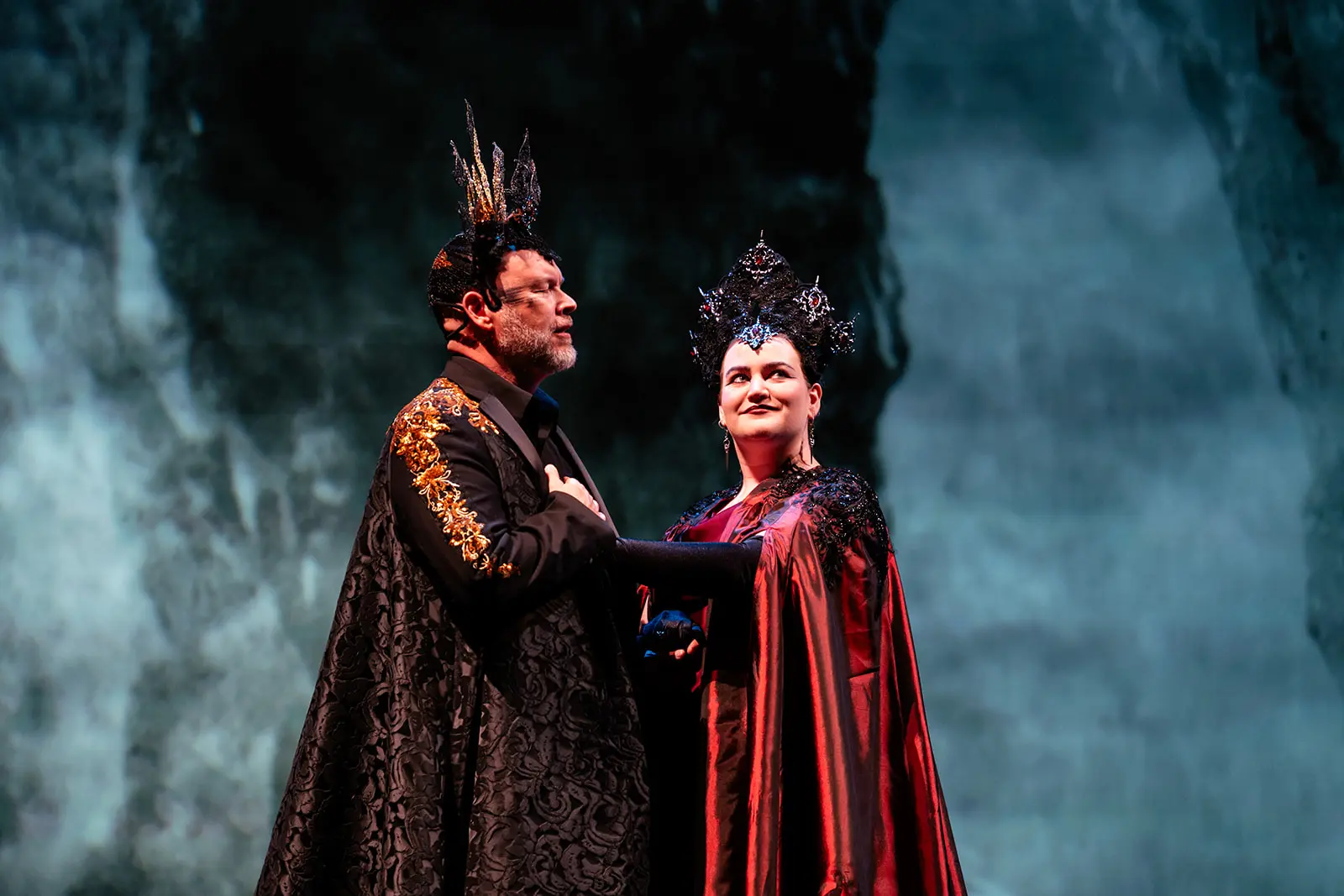
Photo Credit: Jess MacAleese
Tyler Duncan and Len Torrie in Alaia Hamer’s jewel-encrusted costumes for Plutone and Proserpina
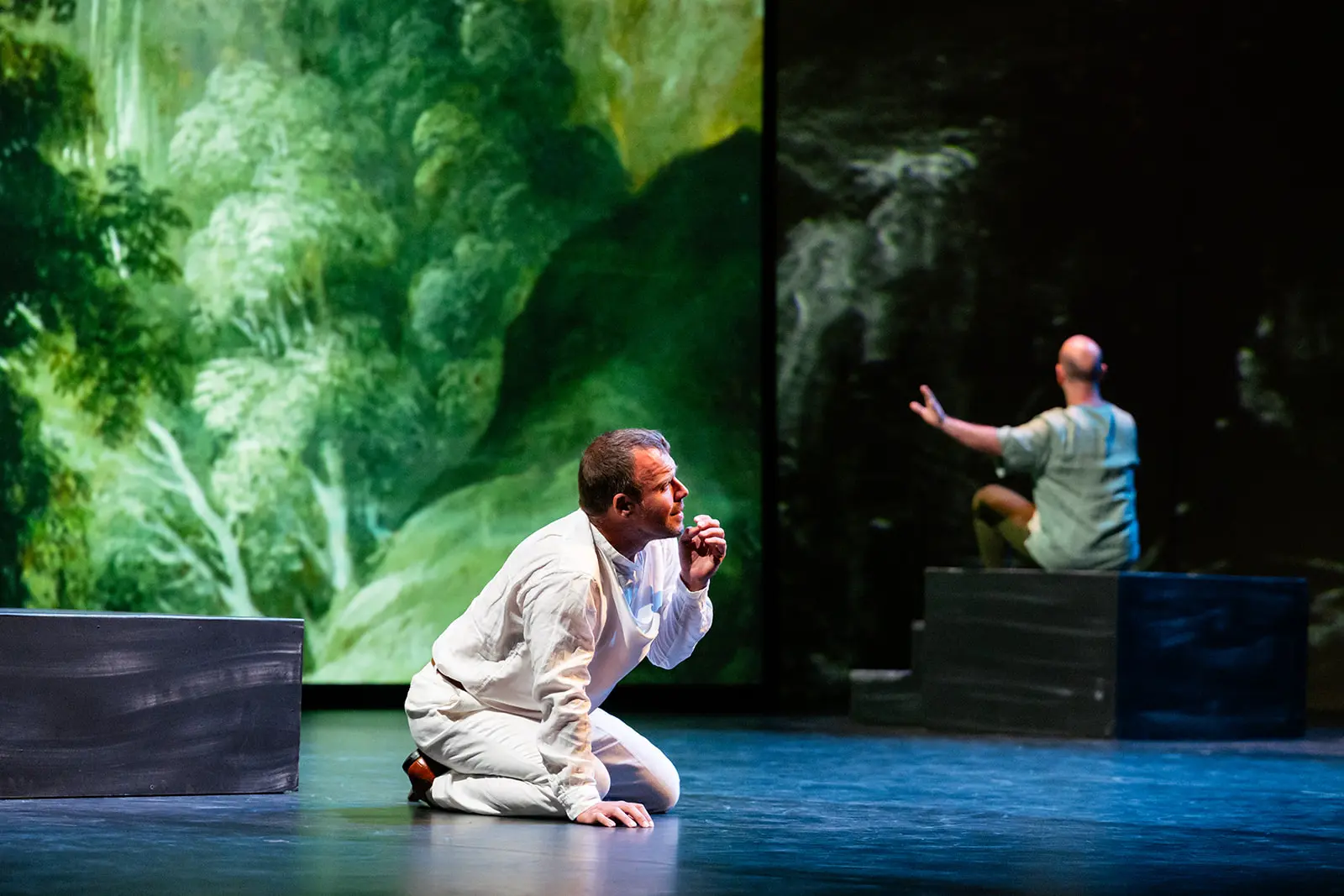
In fact, the cast was truly international. Thanks to the support of the L’Institut Francais and the generosity of Vancouver-based singer Mark de Silva, French baritone-tenor Marc Mauillon, EMV’s 2026 artist-in-residence, played the role of Orfeo. In his opening night performance, he incarnated Orfeo, leaning into the role with every fibre of his being. His vocal and dramatic range were remarkable, embodying both the joy and the sorrow of his character. His articulation in Italian was spot-on from his first utterance to his last. Intriguingly, his fifth act laments were surprisingly modern feeling, and he sang them with the passion of a Baroque rock star. (Luckily, Vancouverites can still catch Mauillon in a different performance at the festival on August 6th.)
Myriam Leblanc brought great pathos and power to her role as La Messagiera who brings news of Euridice’s untimely demise to Orfeo. Len Torrie as Proserpina/Ninfa more than lived up to their bio description with their “crystalline tone, expressive versatility and storytelling depth,” and with great gravitas and presence, bass William Kraushaar stole the third act as Caronte, the guardian boatsman who refuses Orfeo entry into Hades until he is lulled to sleep by his music.
In a neat visual delineation between gods and mortals, the costume design by Alaia Hamer featured simple, timeless clothing for the nymphs and shepherds and ornate, jewel-encrusted garments for the likes of Plutone, lord of the underworld, and his wife Prosperina. Projection designer Camilla Tassi’s haunting images of Arcadian landscapes, peeling off layers as tragedy ensues and integrating the face of Euridice, elegantly bridged worlds and eras.
The choral work was seamless and the spirit of comedia dell’arte infused Bernardi’s direction, with a playful morisca (a Renaissance battle dance) at the end. The characters of Orfeo and Euridice ultimately lose their individuality and blend into the chorus (somehow this moment was reminiscent of the last scene in Norman Jewison’s film version of Jesus Christ Superstar when Mary Magdalene and Jesus get back on the bus), expressing both a mythic hero’s journey and a sense of the everyman’s struggle to make sense of loss and mortality.
In many ways, the Pacific Baroque Orchestra were the real stars of the show, playing a pitch-perfect score on early instruments. Under Weimann’s musical direction, both singers and orchestra were of a piece, and it was hard to tell when a vocal line ended and an orchestral flourish began. Other highlights were EMV’s own artistic and executive director Suzie Leblanc, eminently well-cast as La Musica, whose lilting soprano established the scene in the prologue, singing of the power of music to overcome all.
And for a moment, it did just that. Transcending the televisual abyss of grief that we scroll through daily, this performance delivered us from evil through the magic of Monteverdi
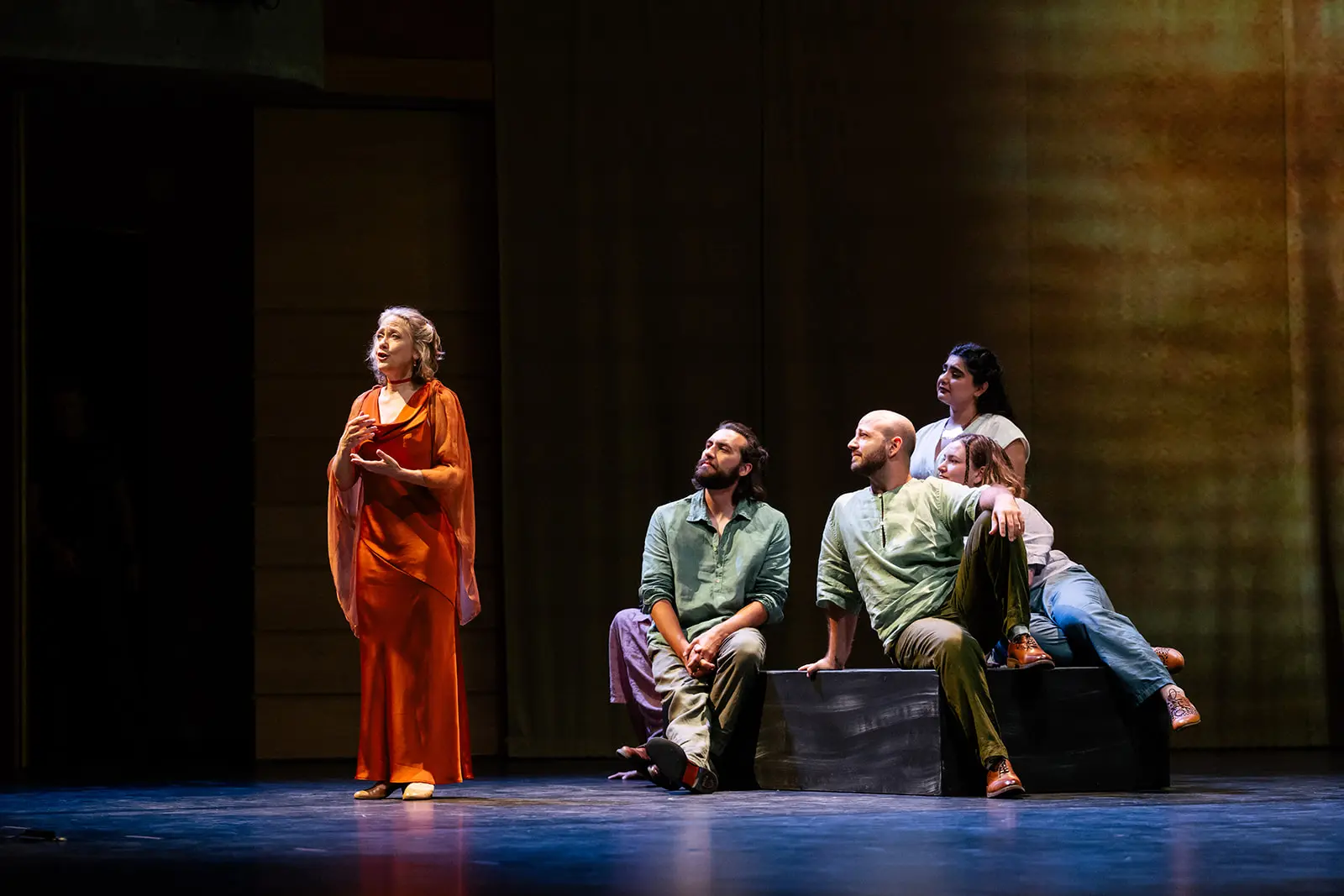
Photo Credit: Jess MacAleese
EMV’s artistic and executive director Suzie Leblanc as La Musica in Orfeo
Opera Canada depends on the generous contributions of its supporters to bring readers outstanding, in-depth coverage of opera in Canada and beyond. Please consider subscribing or donating today.