The most anticipated moment of the 14th Festival d’opéra de Québec was certainly Bizet‘s Carmen, performed on the 150th anniversary of its creation and the death of its composer. Presented in its original version with spoken dialogue, this opéra comique provided audiences a change from the rest of the festival’s presentations.
The staging, by Nicola Berloffa who in 2023 had directed an original French Lucie de Lammermoor in Québec, transposed Carmen to the 1940s/50s in a kind of imaginary far west – the “middle of nowhere.” Eliminating any picturesque allusion to Spain, Berloffa focused on the characters and the love triangle that ends in femicide: Carmen is both a ruthless seductress and sincerely in love for the duration of her passion.
From the second act, Don José gave glimpses of his violent tendencies. The gentle Micaëla was not lacking in temperament, and the characters around them created a festive, colourful and noisy presence. In the third act, I found two possible interpretations: well-dressed men, women and children with their luggage reminded me of the French who, during the Second World War, marched towards the free zone. Closer to home, how can we not see “smugglers” escorting migrants through the mountains?
Michele Taborelli‘s set and Valerio Tiberi‘s lighting reflected Berloffa’s intentions. Everything looked like a black-and-white film, bathed in a sinister fog but confined, for all four acts, to a railway track crossing a road. In the third act, huge white curtains, poorly hung, take the place of the mountain that the smugglers and their human “merchandise” cross. Visually, Québec deserves better than that!
The francophone cast brought together singers from France and Quebec, many of whom have already performed with Opéra de Québec. The French tenor Christophe Berry, the remarkable Manrico (Il trovatore) of last May, was a superb Don José. His voice is powerful, balanced in all registers. Starting from a certain romanticism in the intense “La fleur que tu m’avais jetée” and in his affectionate duets with Micaëla, he climbs the ladder of despair in the third act to explode in the finale. Impressive!

Photo Credit: Jessica Latouche
Christophe Berry and Stéphanie d’Oustrac in Carmen
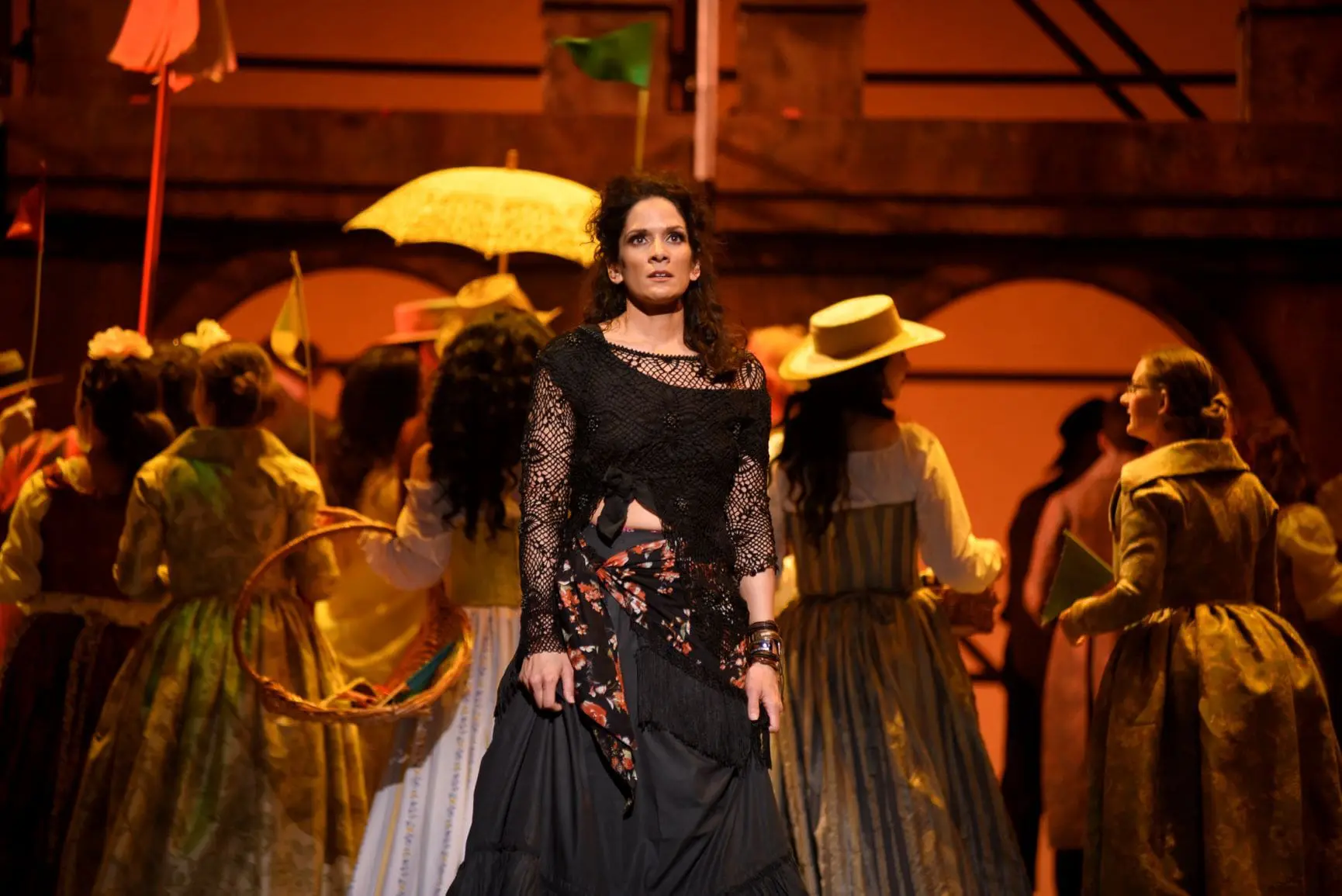
French mezzo-soprano Stéphanie d’Oustrac was a very good choice to play the insolent and rebellious Carmen. She has a temperament, and she uses her body as well as her voice to seduce and humiliate Don José or to swoon over Escamillo. Having sung with William Christie‘s Les Arts Florissants and long associated with baroque music, she has retained a natural flexibility and a sense of phrasing that allows her to succeed in less comfortable passages of the lower register. I particularly appreciated her bohemian dance in the second act, her explosive anger towards Don José (“Ta ra ta ta! C’est le clairon qui sonne!”) and her fierce and courageous resistance in the final act.
Christophe Gay, another Frenchman, who was seen at Festival d’opéra in 2023 in Roméo et Juliette and in 2024’s La vie parisienne, was not the ideal Escamillo. Despite beautiful diction and interesting acting, his rather light baritone struggled to impose itself in the lower register, especially in the famous Toreador Song.
My favorite performer of the evening was Quebec soprano Carole-Anne Roussel, one of the winners of the Queen Elisabeth of Belgium Competition 2023. Roussel has the gift of getting into the skin of every character with great naturalness and demonstrates extreme mastery over her vocal technique. She was an ideal Micaëla, both fragile and determined to bring Don José back to his dying mother.
Solid Quebec singers completed the cast: Jean-Philippe Mc Clish (Zuniga); Geoffroy Salvas (le Dancaïre) and Emmanuel Hasler (le Remendado), the two smugglers on whom the passage of goods – or migrants – rests; and Carmen’s two friends, soprano Odéi Bilodeau (Frasquita) and mezzo-soprano Florence Bourget (Mercedes). They shone in high-calibre quintets and trios.
The Opéra de Québec chorus, joined by children, was very well prepared by Catherine-Élisabeth Loiselle. Everyone had a lot to do, both vocally and in stage business, between the hysterical workers, the soldiers, the kids, the smugglers and the delirious crowd throwing themselves at Escamillo like groupies at Elvis! In the second act, the company delivered a grandiose final hymn to freedom.
Conducted with flexibility and authority by Jacques Lacombe, the Orchestre symphonique de Québec highlighted the qualities of its soloists, particularly in the flute and harp prelude to Act Three.
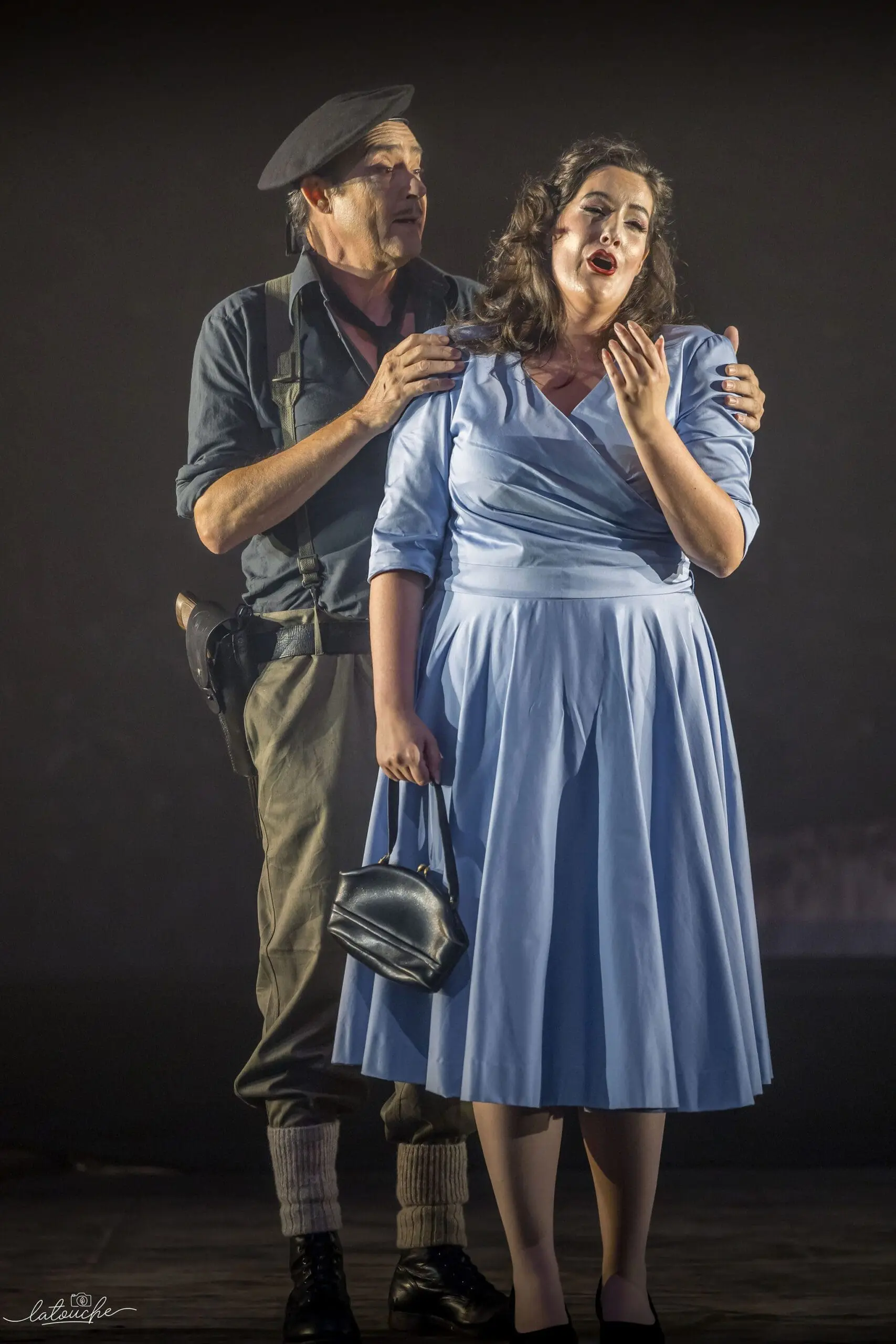
Photo Credit: Jessica Latouche
Don José and Micaëla (Christophe Berry and Carole-Anne Roussel) sing the first-act duet at Festival d’opéra de Québec
Opera Canada depends on the generous contributions of its supporters to bring readers outstanding, in-depth coverage of opera in Canada and beyond. Please consider subscribing or donating today.