For his first program as artistic director of the Festival d'opéra de Québec, Jean-Marie Zeitouni has opted for audacity by choosing one of the most important operatic works of the 20th century: Francis Poulenc's Dialogues des Carmélites. While this opera has been sung several times at Université Laval’s opera workshop, including just last March, this is the first time it has been performed on the stage of the Grand Théâtre de Québec.
This co-production between the Théâtre des Champs-Élysées in Paris, the Théâtre Royal de La Monnaie in Brussels and the Festival d'opéra de Québec introduced the public to Olivier Py's fascinating staging (2013) revived by Daniel Izzo. It shows immense respect for Poulenc’s music and for the work of Georges Bernanos, author of the screenplay originally intended for a film on which Poulenc based his libretto. The work tells the story of the last years of the Carmélites of Compiègne, victims of the French Revolution and the Reign of Terror, who were expelled from their monastery and sentenced to death in 1794.
Far from trying to reconstruct a historical setting, Pierre-André Weitz's set and costumes opt for simplicity and neutrality. Apart from a few picturesque accessories evoking monastic life – the Annunciation, the Nativity, the Last Supper (reminiscent of Leonardo da Vinci's) and the crucifixion – everything relies on black sliding panels which in turn become the castle of the Marquis de la Force and the Carmelite monastery.
In this monochrome universe, the costumes remain mainly in shades of grey except for the immaculate white of the two young novices, Constance and Blanche, and the costumes for all of the nuns in the final scene. By renouncing historical reconstruction, Olivier Py gives the opera a universal scope and reminds us that no era is safe from violence, fanaticism and rigged trials.
In this simple setting, attention is naturally drawn to the voices and the acting of the performers. With the exception of the first prioress, the chaplain and the Marquis de la Force, the cast was comprised of Quebec singers, many of whom have brilliant international careers. Hélène Guilmette, always at ease in French repertoire, is a convincing Blanche de la Force, dominated by fear until she joins her sisters in death. Her generous and supple voice accurately reflects the different emotions of the character.
Through her vivacity, both vocal and staged, the soprano Florie Valiquette set the right tone for the other novice, the touching and spontaneous Soeur Constance. We smile with her when she evokes her youth, sketches dance steps and blows soap bubbles at the monastery, we are sensitive to her reflections on death and during her duets with Blanche.
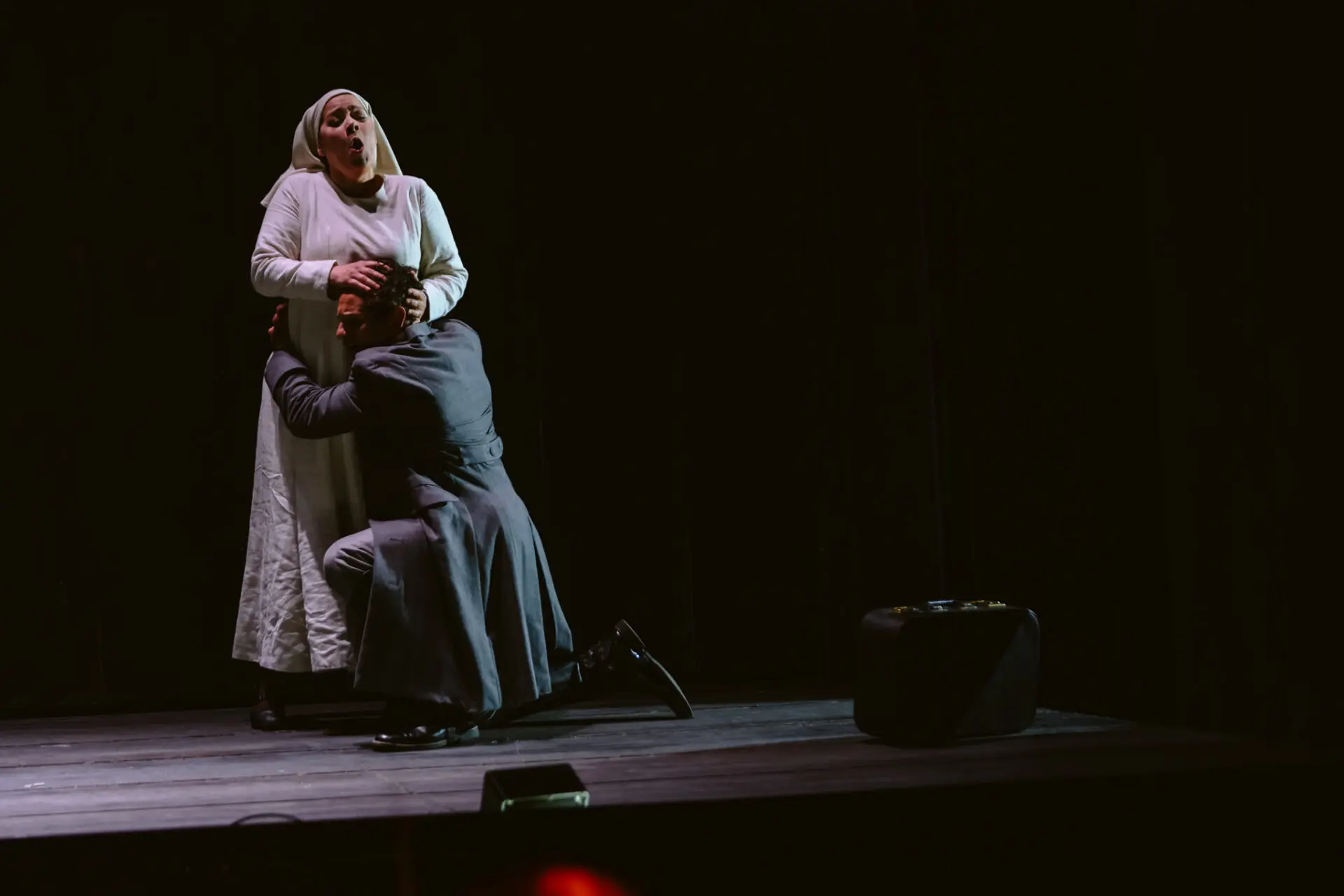
Photo Credit: Stéphane Bourgeois
Hélène Guilmette as Soeur Blanche with her brother, the Marquis de la Force, played by Frédéric Antoun
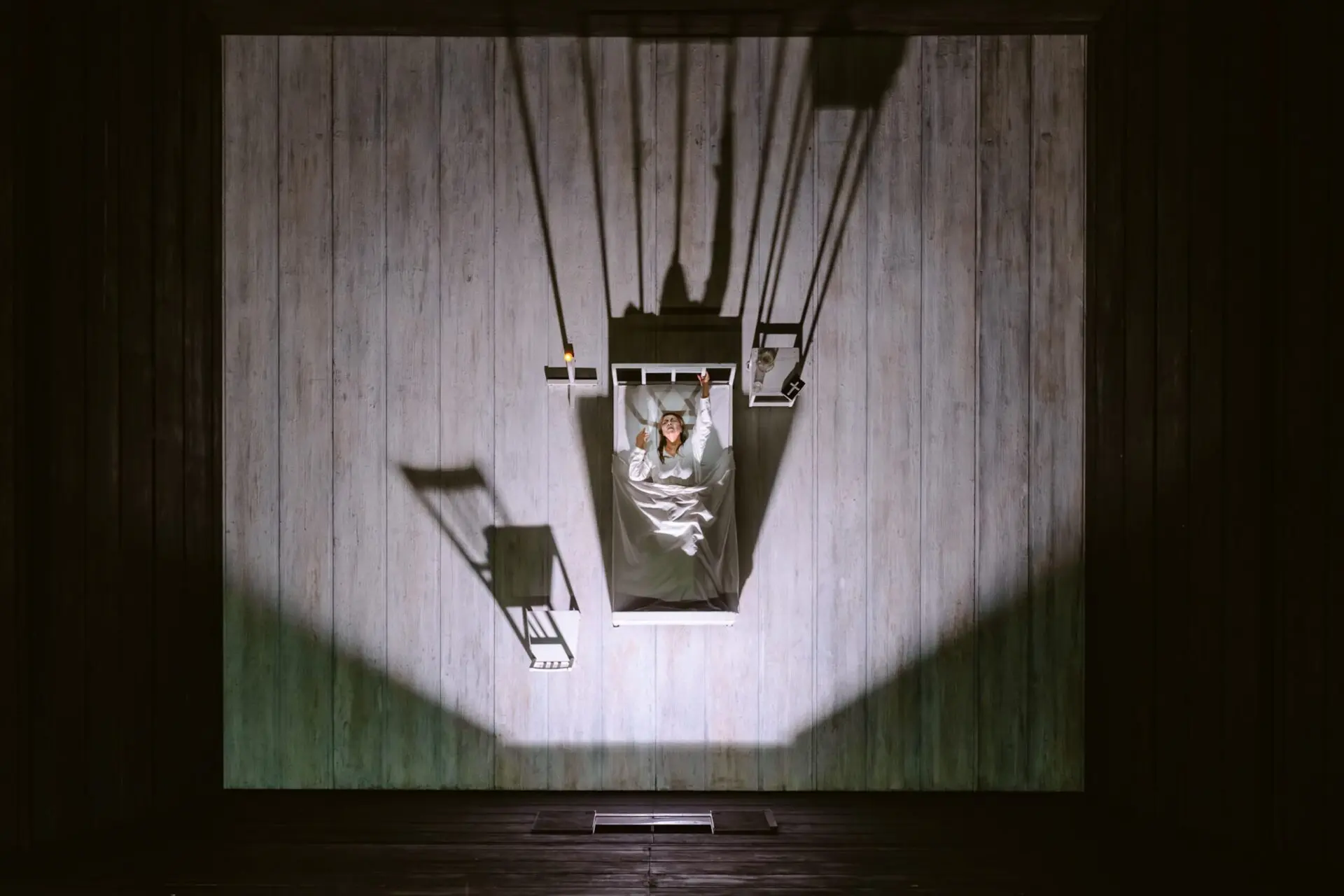
In contrast to these two young novices, the first prioress, Madame de Croissy, is seen in the final moments of her life. Although the role was written for a contralto, the French mezzo-soprano Sylvie Brunet-Grupposo gives the role all the necessary intensity. The scene of her death, one of the great moments of the opera, shows her room seen from above. This staging, which places the singer on her feet, allows strong vocal projection and emphasizes the power of her revolt against God and death.
The soprano Guylaine Girard sang the role of the new prioress, the serene and reassuring Madame Lidoine, with great lyricism. In the role of Mother Marie of the Incarnation, historically the only survivor of the monastery and witness to the tragic events of 1794, mezzo-soprano Julie Boulianne stood out for the richness of her timbre and for very eloquent acting, making her complex relationship with Blanche and her dilemma in the face of the death of her companions tangible. Finally, I would like to highlight the brief but effective interventions of mezzo-sopranos Marie-Andrée Mathieu and Rachèle Tremblay in the roles of Soeur Mathilde and Mère Jeanne.
Of the men, Belgian bass Patrick Bolleire, a regular at the Festival who sang Mephisto in 2022 and Frère Laurent in 2023, showed sensitivity and depth in the role of the Marquis de la Force. Frédéric Antoun, very comfortable in the role of Chevalier de la Force, was full of passion in his duet with Blanche. The Swiss tenor François Piolino, with impeccable diction, delivered a beautiful performance as a chaplain. Hugo Laporte, who played several characters, brilliantly and ferociously told the nuns of their death sentence, while the tenor Emmanuel Hasler was imposing as first commissioner.
The chorus of revolutionaries and the crowd, well-prepared by Catherine-Élisabeth Loiselle, was placed either in the dress circle or at the front of the stage, as if to separate the convent from the outside world. Thanks to the precise and reassuring direction of Jean-Marie Zeitouni, the 70 or so instrumentalists of the Orchestre symphonique de Québec showcased Poulenc's orchestral clarity and the shattering tutti evoking the violence of the Terror.
This dramatic tension of the piece culminates in its famous final scene. On a starry background, the 16 nuns, motionless and facing the audience, sang the “Salve Regina” until the fateful moments of their deaths, then leave the stage one by one. When Blanche joins Constance, who remains alone, the emotion reaches a shattering intensity – her song, interrupted by the guillotine, gives the impression that time has stopaped. It was a moment of eternity to remain in our memories for a long time.
A sure sign of the hold that this opera exerts on the audience? The almost religious silence that reigned throughout the evening until the final explosion of applause.
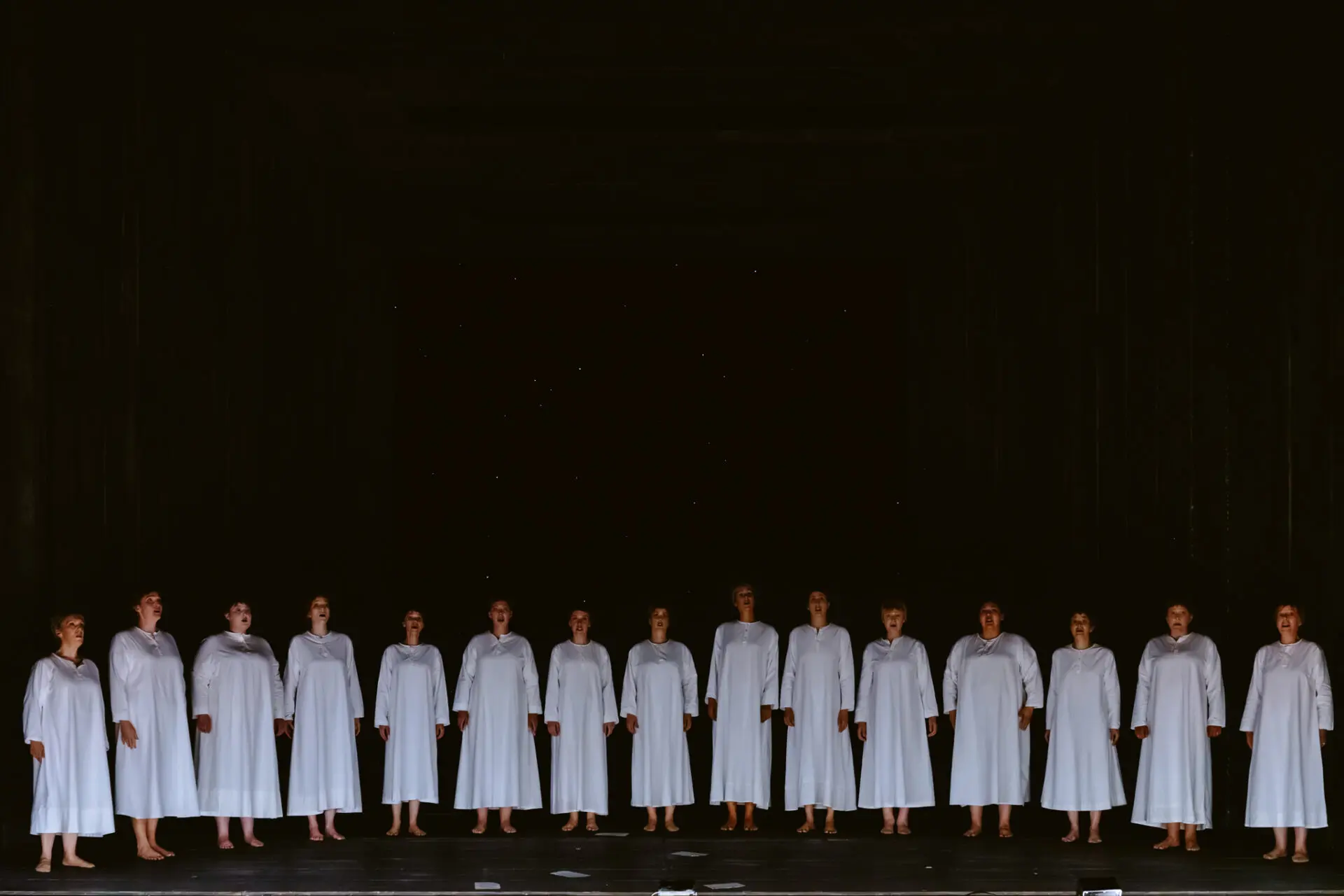
Photo Credit: Stéphane Bourgeois
At the Festival d’opéra de Québec, the Carmelite nuns await their execution dressed in angelic white
Opera Canada depends on the generous contributions of its supporters to bring readers outstanding, in-depth coverage of opera in Canada and beyond. Please consider subscribing or donating today.