For its fall chamber opera program, the Glenn Gould School’s opera division presented a double bill of two short American operas from the 1950s: A Hand of Bridge (Samuel Barber, libretto by Gian Carlo Menotti) and Trouble in Tahiti (music and libretto by Leonard Bernstein).
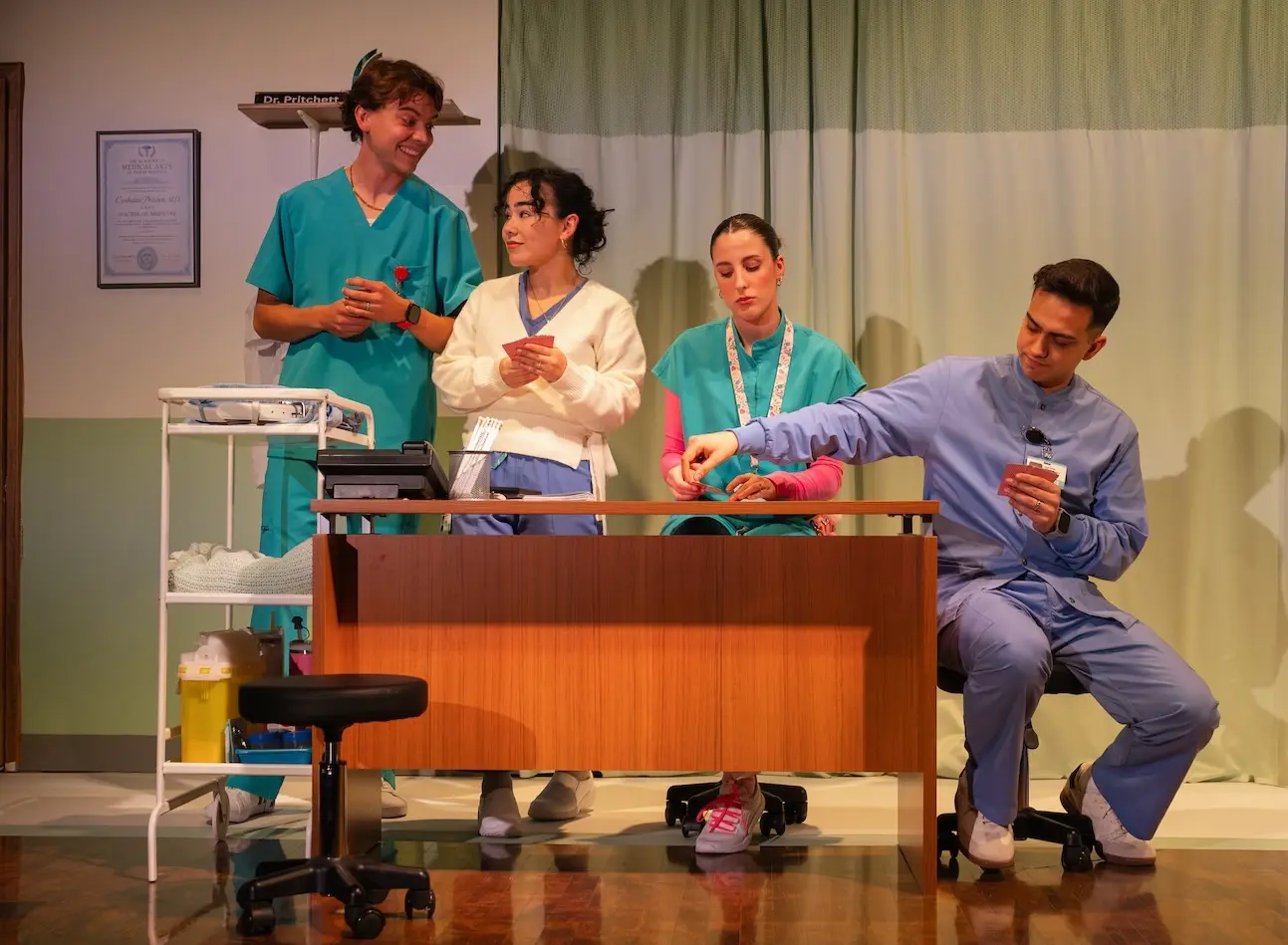
It is an interesting pairing, since both operas deal with the repression of suburban life of that era seen through the lens of unhappy marriages. In combining the two pieces, director Mario Pacheco takes inspiration from the idea that people “are very good at finding things to do when [they] don’t know what to do with [their] pain.” He chooses to set the pieces in the shared space of the hospital waiting room. The two couples in the Barber become hospital staff, and the couple at the centre of the Bernstein become a pair waiting for some kind of marital therapy from “Dr. Pritchett,” a character who traditionally doesn’t appear in either piece, although David, one of the husbands in A Hand of Bridge, works for a much-loathed Mr. Pritchett in the original libretto.
It is a concept that both works and doesn’t work. Sections of the stage, hidden by hospital curtains, create an ideal area for shadow plays featuring characters that are traditionally only imagined. The hospital setting also adds depth to the relationship explored in the Bernstein work, and it emphasizes some concerns about possible domestic violence that might have been more subtle in the original. It is, however, contrary to the libretto, since Dinah talks about going to therapy and invites Sam to join her; here, they are both preparing for sessions with Dr. Pritchett. It’s also probably more successful for Trouble in Tahiti than for A Hand of Bridge.
Barber’s A Hand of Bridge is an unusual opera. At only ten minutes’ duration, it is not often performed, but it is a very well-written character study of four distinct people. Unfortunately, transposing the two suburban married couples into four hospital workers made it more difficult for the young performers to establish distinct characters. The singers were onstage for about ten minutes before the show began, going about their work in the hospital. Stage business was natural and easy to watch, but the personalities presented during the preshow didn’t match the characters that they would become in the opera. This was particularly true of the two women, Geraldine (Ana Sofía Castro Barrios, alternating with Mariana Iguavita), a repressed woman fearing the loss of her ailing mother, and Sally (Emma Cloutier), the more frivolous wife pining for a hat she saw earlier in the shops. Each of the four characters moved through quite similar blocking, too, during their individual fantasy sequences, which homogenized them further.
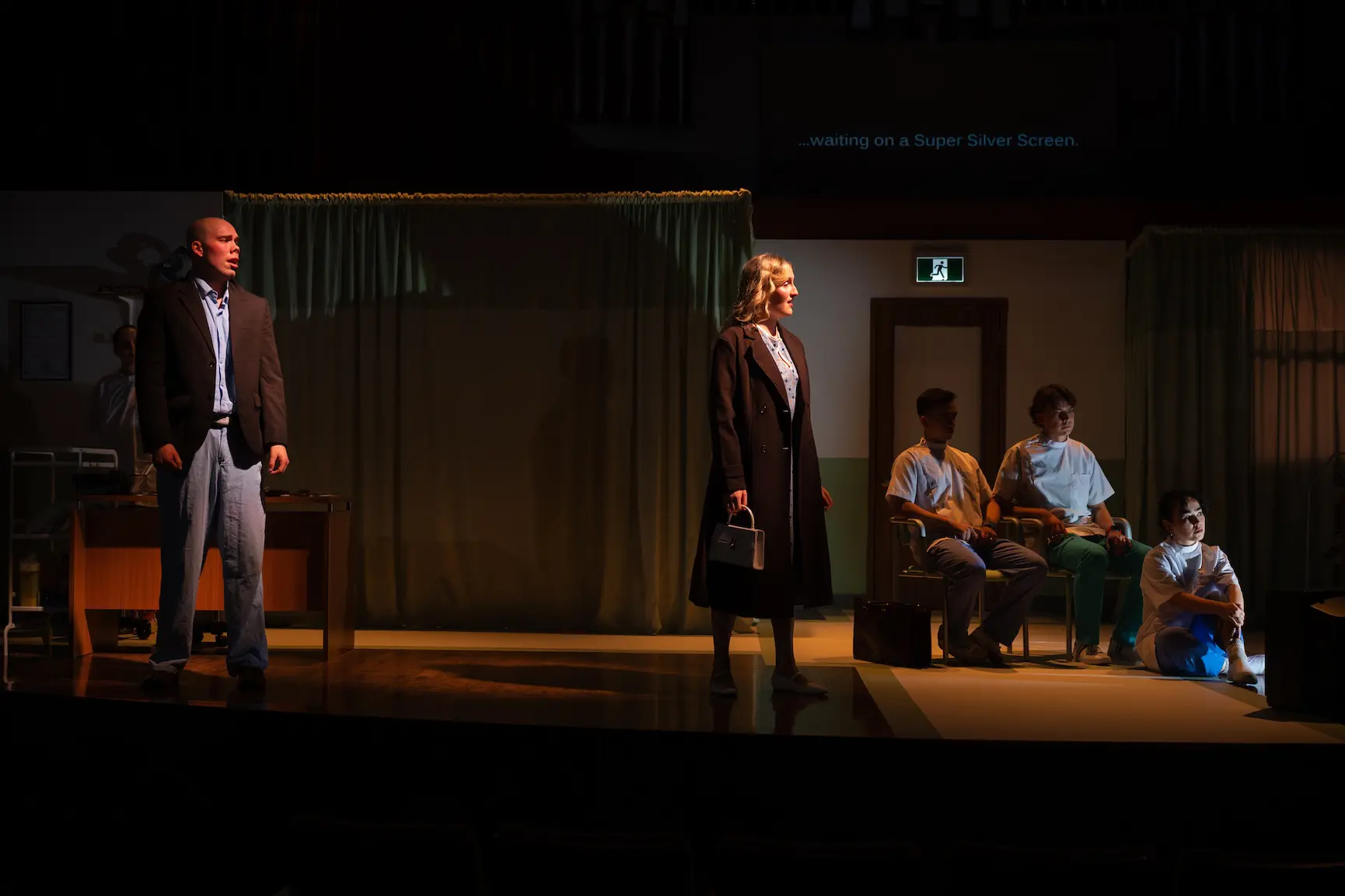
Photo Credit: Gaetz Photography
The company of Trouble in Tahiti at the Glenn Gould School
Of the four, vocal honours went to tenor Gabriel Klassen, who has a clear lyric tenor with well-connected high notes that rang through the hall, and to Castro Barrios, who exhibited strong control over the soft, sustained high notes at the end of her solo sequence. Castro Barrios, Klassen and baritone Matthew Black went on to become the background jazz trio for Trouble in Tahiti, where their tight-knit ensemble singing and choreography were buoyant and enjoyable.
As Sam, the husband at the centre of the troubled couple in the Bernstein, bass-baritone Owen Phillipson sang well. He has a very large voice, clear and resonant, and he uses the diction well as an acting tool. At times, it would have been nice to hear him explore the softer side of his dynamic range, but he has a commanding instrument that holds promise of a solid career ahead.
As Sam’s wife Dinah, mezzo-soprano Jada Alexiou struggled more with Bernstein’s music. It felt as though the combination of the composer’s classical and music theatre / pop traditions created some challenges for the young singer; her voice occasionally sounded “pushed,” and her words weren’t always intelligible. She did do some beautiful singing at the top of her range, however, during the scene in the office of Dinah’s analyst, and she demonstrated a good understanding of both the pathos and the comedy of this very challenging character.
Lighting for this production (designed by Emilie Trimbee) may have suffered from a limited number of instruments in Mazzoleni Concert Hall, and performers frequently seemed to be just slightly outside of the area that could be lit or were in shadows created by lighting a scene only from one side. Kudos to set, costume and prop designer Andrew Nasturzio, however, who created a business suit and day dress for Sam and Dinah that mimicked both traditional 1950s clothing in silhouette and hospital gowns in fabric weight, colour and pattern.
Congratulations, as well, to conductor Jennifer Tung, with her nine-member chamber ensemble, who kept the proceedings moving well and showed a good understanding of the distinct musical styles of the two pieces.
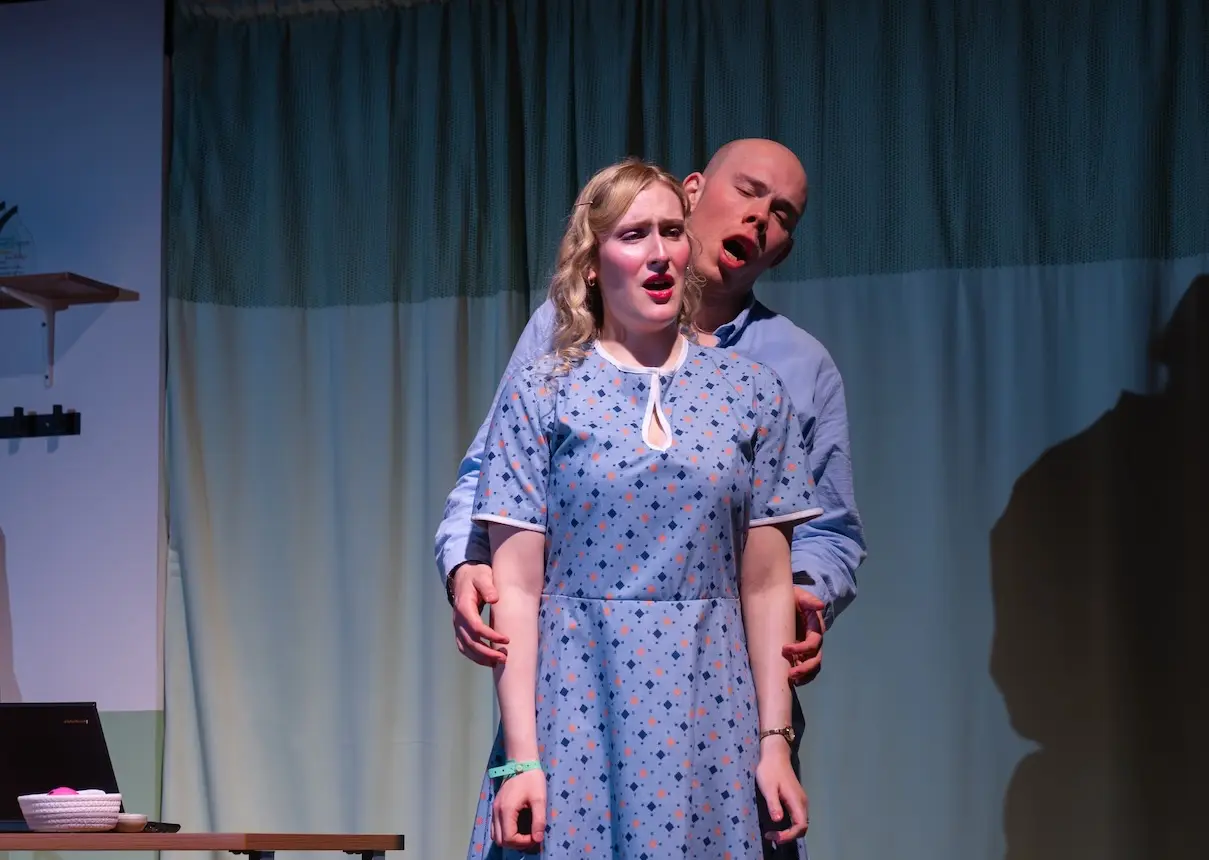
Photo Credit: Gaetz Photography
Owen Phillipson and Jada Alexiou as Sam and Dinah in Trouble in Tahiti
Opera Canada depends on the generous contributions of its supporters to bring readers outstanding, in-depth coverage of opera in Canada and beyond. Please consider subscribing or donating today.