With its gorgeous grounds in the rolling south downs of Sussex and lush gardens, Glyndebourne is a magical place, seemingly a bubble protected from the realities of the outside world by beauty, grace and 150-pound cashmere pashminas sold at the irresistible shop. But is it really? This season’s three new operas and three revivals push the envelope with some daring reinterpretations of classics.
As a right-wing march planned for nearby Brighton was foiled by an antifascist carnival and another “peace deal” hammered out between Iran and America, I took in two of the new productions: Tosca, directed by American Ted Huffman as an impassioned hyper-relevant cry against fascism, and the premiere of L’Orfeo, directed by William Kentridge as an often overwhelmingly multimedia take on the chaos of contemporary existence and the power of love and beauty within it.
Tosca’s lighting designer is Canadian D.M. Wood, and Canadian-raised soprano Henna Mun made her role debut as Ninfa in L’Orfeo. The third opera in this CanCon triptych is a revival of Billy Budd (first performed at the Royal Opera House in December 1951 and first performed at Glyndebourne in May 2010) opening next week and featuring Canadian baritone Daniel Okulitch as Lieutenant Ratcliffe.
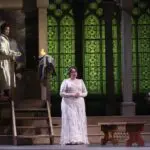
While Huffman’s take on Tosca seemed to ruffle the feathers of a few purists, it won a standing ovation and three curtain calls from an enthusiastic crowd. This reviewer was also won over by his direction, inspired, he says, by Rossellini’s Roma città aperta, that took a Romantic melodrama set in Mussolini’s Italy and made it very much of the moment. The pacing was tight and the staging well-choreographed, holding audience attention throughout and never missing a beat.
Vladislav Sulimsky’s Scarpia exuded satanic charisma and gave the arch-villain some contemporary twists. In the first act, he played up the Italian fascist angle, inflicting casual brutality on a Black prisoner with echoes of ICE detention centres hovering nearby, while Wood’s lighting design bathed the gorgeous set by Nadja Sofie Eller in a cinematic glow.
In the second act, set in a restaurant that somehow channeled both late 30s Gio Ponti style and mercenary corporate America, he momentarily incarnates the president and evokes contemporary Trumpian terrors as he triumphantly pumps ketchup onto a hamburger whilst singing about his bloody torture techniques.
Caitlin Gotimer embodied Tosca’s fiery passion and courage with her compelling soprano, alternately velvety in the lower range and clarion in the higher, and excellent acting chops. While Matteo Lippi’s Cavaradossi took a while to warm, his final aria was achingly poignant, evoking the hopes of the hopeless and ultimately the triumph of the human spirit and of love over brutality.
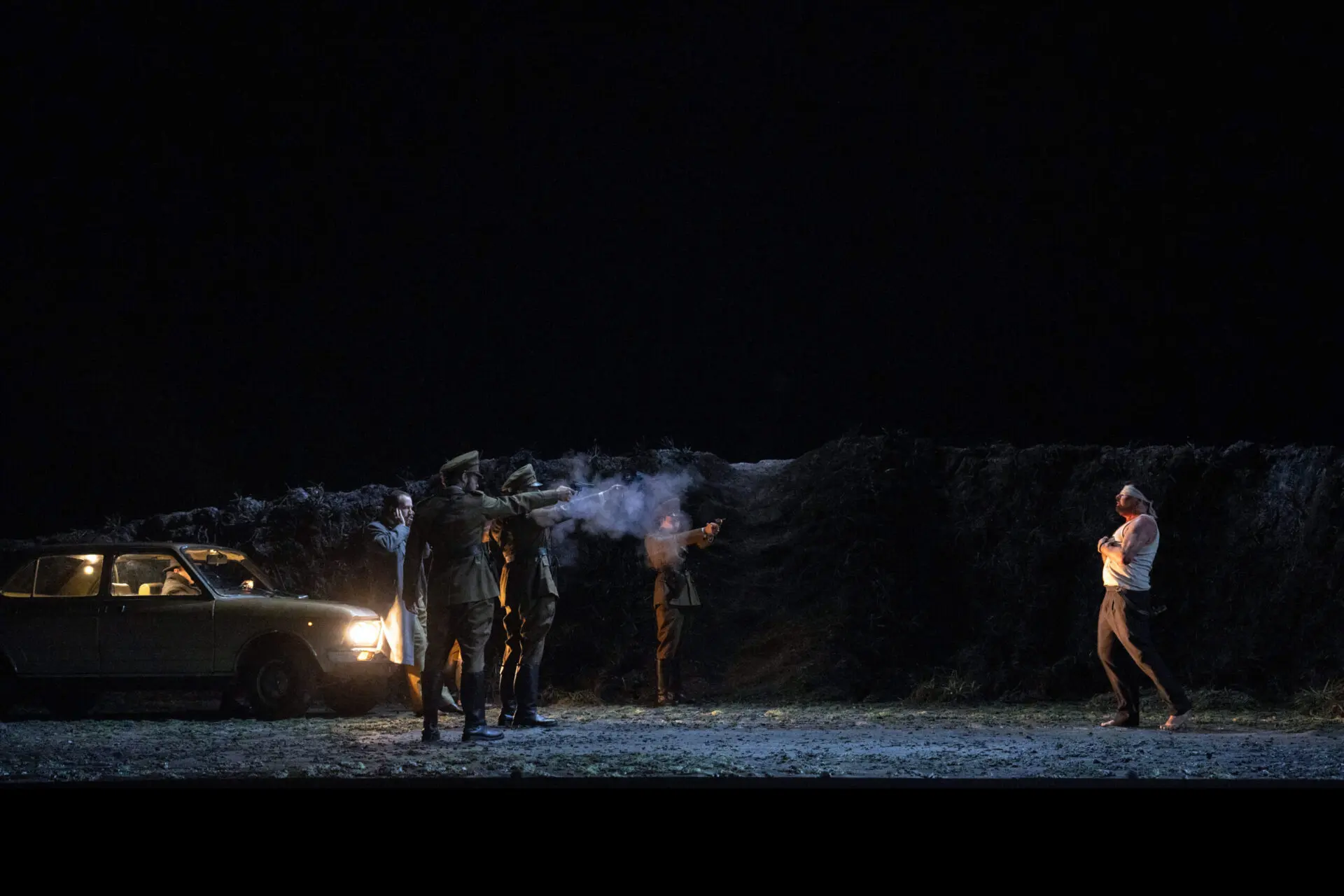
Photo Credit: Richard Hubert Smith
Canadian lighting designer D.M. Wood’s work gave Ted Huffman’s Tosca “a cinematic glow”
The next afternoon, after a post-concussion trip on an unlit narrow English stairwell at my lodgings made me wonder if I had fallen into some kind of Sussexian underworld, I took in the premiere of L’Orfeo as conceived and directed by William Kentridge.
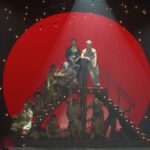
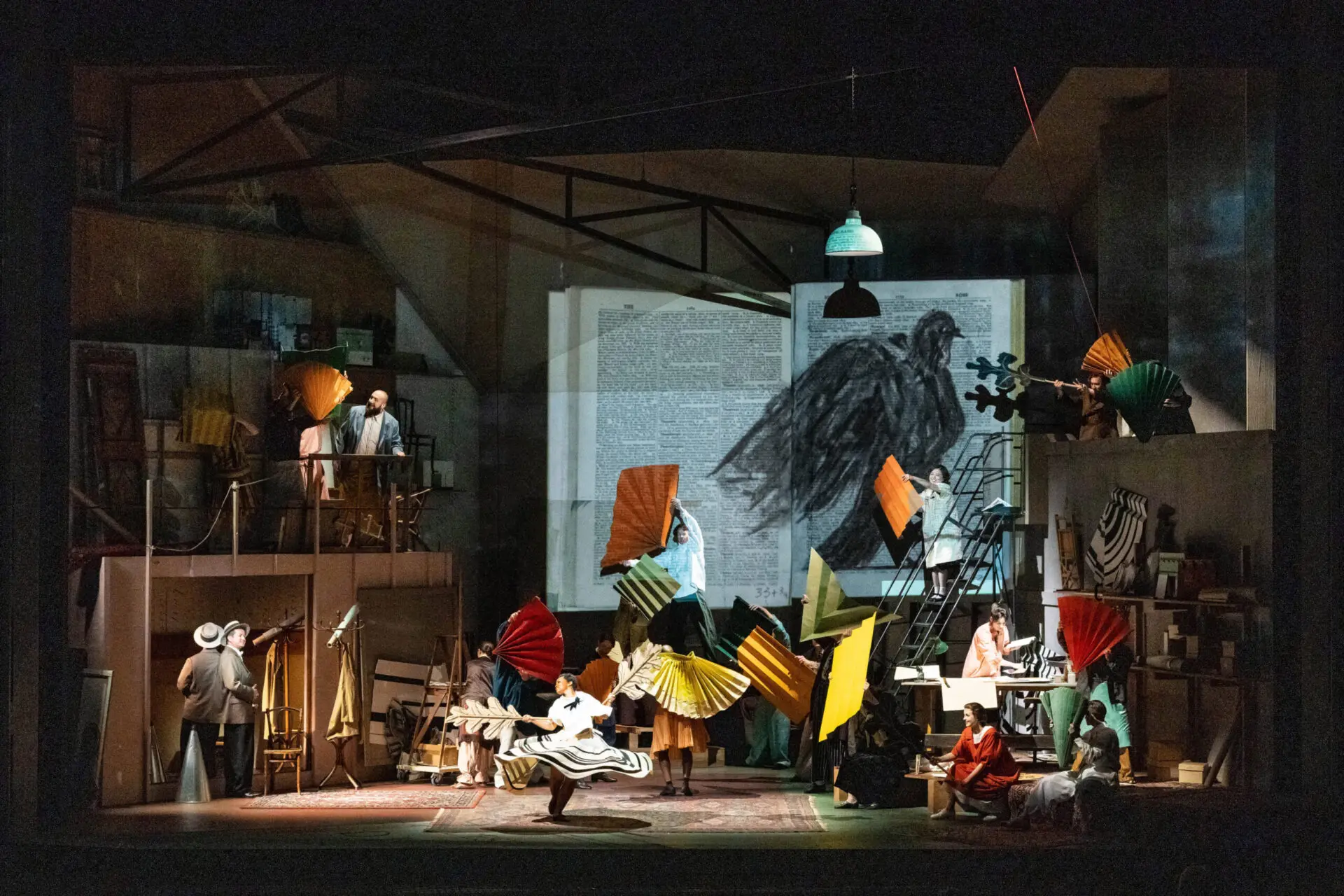
The acclaimed South African artist turned opera director’s vision of Monteverdi’s classic, a gorgeous interpretation of the tale from Ovid’s Metamorphoses, was a dizzying multimedia affair that felt rather like being inside Kentridge’s brain. He conceived La Musica (well sung by Francesca Aspromonte who doubles as the voice of Euridice) as an artist in what appeared to be a combination of his South African studio and a 1920s Paris atelier. Through a series of sketches, she conjures a whole world containing and transcending the opera. The drawings and slides of images, which included what appeared to be the collapsed buildings of war zones among other contemporary and historic architecture, flickered at great speed across a screen and included text (or possibly “texts”) about creativity out of the void and other meme-like concepts that competed with the surtitles.
Between the African-influenced choreography lending a certain agency to the “voiceless” Euridice and the use of masks and fans as dramatic props, it would be an understatement to say that there was a lot going on. Kentridge referred to his concept as expressing the “fourth dimension,” but it was often just extraneous visual noise that took away from the beautiful purity of Monteverdi’s sublime music, well played by the Orchestra of the Age of Enlightenment, led by Kati Debretzeni but conducted here by Jonathan Cohen, with kudos especially to the horn section.
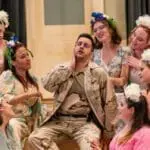
Orfeo was well played and sung by Krystian Adam, and Xenia Puskarz Thomas’s Messaggera was excellent. Henna Mun’s bright and sweet soprano was a highlight, as was the chorus in general.
In certain scenes, like the approach to the underworld along the river Styx, it all came together in a perfect multimedia moment. After individual calls for conductor, orchestra, Kentridge and the creatives, there were three full company curtain calls in spite of the fact that the audience was distracted by the absence of trains back to London due to a rail accident.
As this reviewer, channelling Persephone, managed to catch a ride with opera lovers into South London and ran through a series of almost missed tube trains in full evening dress whilst carrying a guitar in a quest to reach lodging in a haunted masonic farm in Chorleywood, the distance between under and over worlds slowly disappeared into a gorgeous memory of Monteverdi’s music and the phrase “I am Orfeo” on the lips. As Theodor Adorno wrote, “All opera is Orpheus.”
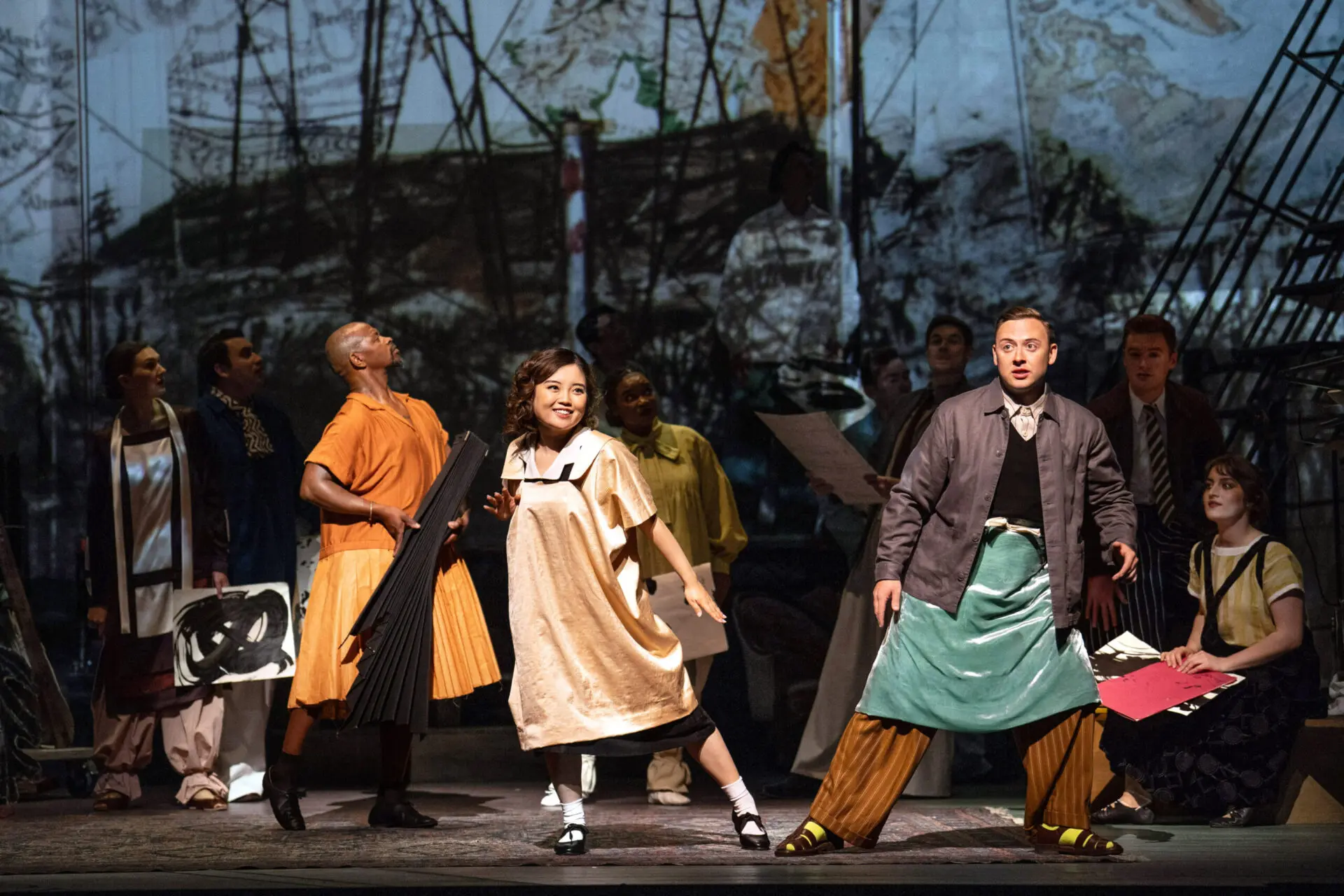
Photo Credit: Richard Hubert Smith
Canadian-raised soprano Henna Man as Ninfa in L’Orfeo, with Kieron-Connor Valentine as Shepherd/Spirit
Opera Canada depends on the generous contributions of its supporters to bring readers outstanding, in-depth coverage of opera in Canada and beyond. Please consider subscribing or donating today.