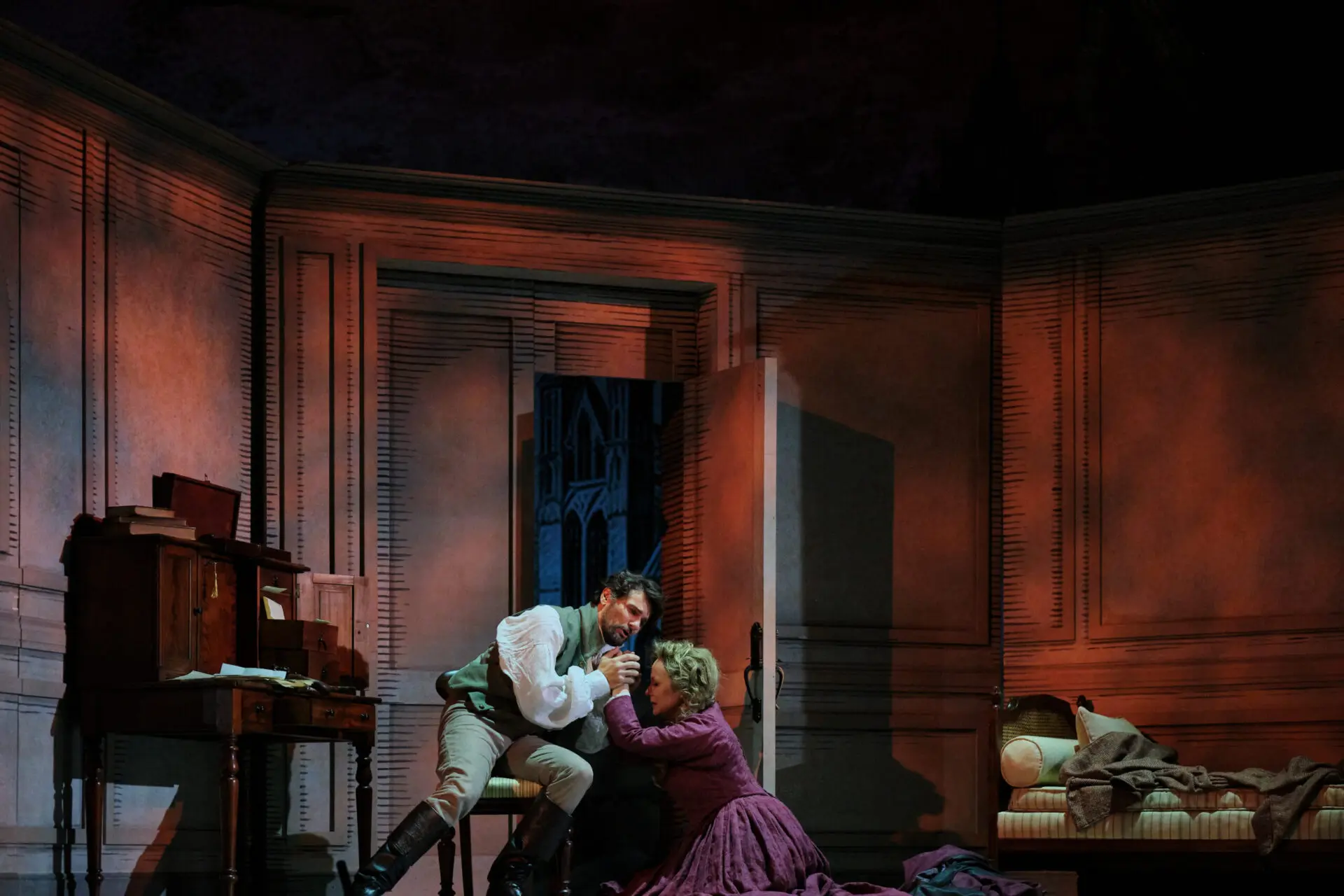
Werther opened at the Opéra de Montréal on November 10. It’s a classic period production of a classic ultra-Romantic opera. Go for the beautiful singing, depictions of familial love and strong display of Canadian talent, but don’t expect to come away liking the title character.
Werther is played by French tenor Julien Dran, whose generous sound has a warm, focused centre. The broad, melancholy phrases of “Pourquoi me reveiller ?” sounded as natural as the agile passages of “Un autre est son époux.” Some of Dran’s high notes didn’t carry over the orchestra enough to be truly climactic, but I didn’t mind: his nuanced and expressive delivery, together with his beautiful middle register, was more than enough to bring the music across.
Acting-wise, Dran was very believable as a depressed young poet – depressed and deeply self-centred. Apparently, Werther’s intense poetic emotions don’t include empathy. In Act One, Charlotte sings poignantly about how she and the children miss their late mother, and Werther’s immediate response is “Rêve! Extase! Bonheur!” (“Dream! Ecstasy! Joy!”). The jarring contrast drew giggles from several people in my row.
In his director’s note, Alain Gauthier invokes themes of mental health and emotional isolation, calling Werther “a hypersensitive being … struggling to adapt to the world around him.” That may be true, but when “struggling to adapt” means “demanding to kiss an actively protesting married woman,” it’s hard to sympathize.
To me, the opera’s most moving scenes revolve around Charlotte, played here by Quebec mezzo-soprano Julie Boulianne. Boulianne has the kind of stage presence that makes you forget she’s singing: she’s just Charlotte, an imperfect, loving, profoundly conflicted young woman. Her dark, rich, ringing voice navigated the music with ease and power, in perfect sync with Jacques Lacombe’s Orchestre Métropolitain. It was a flawless performance.
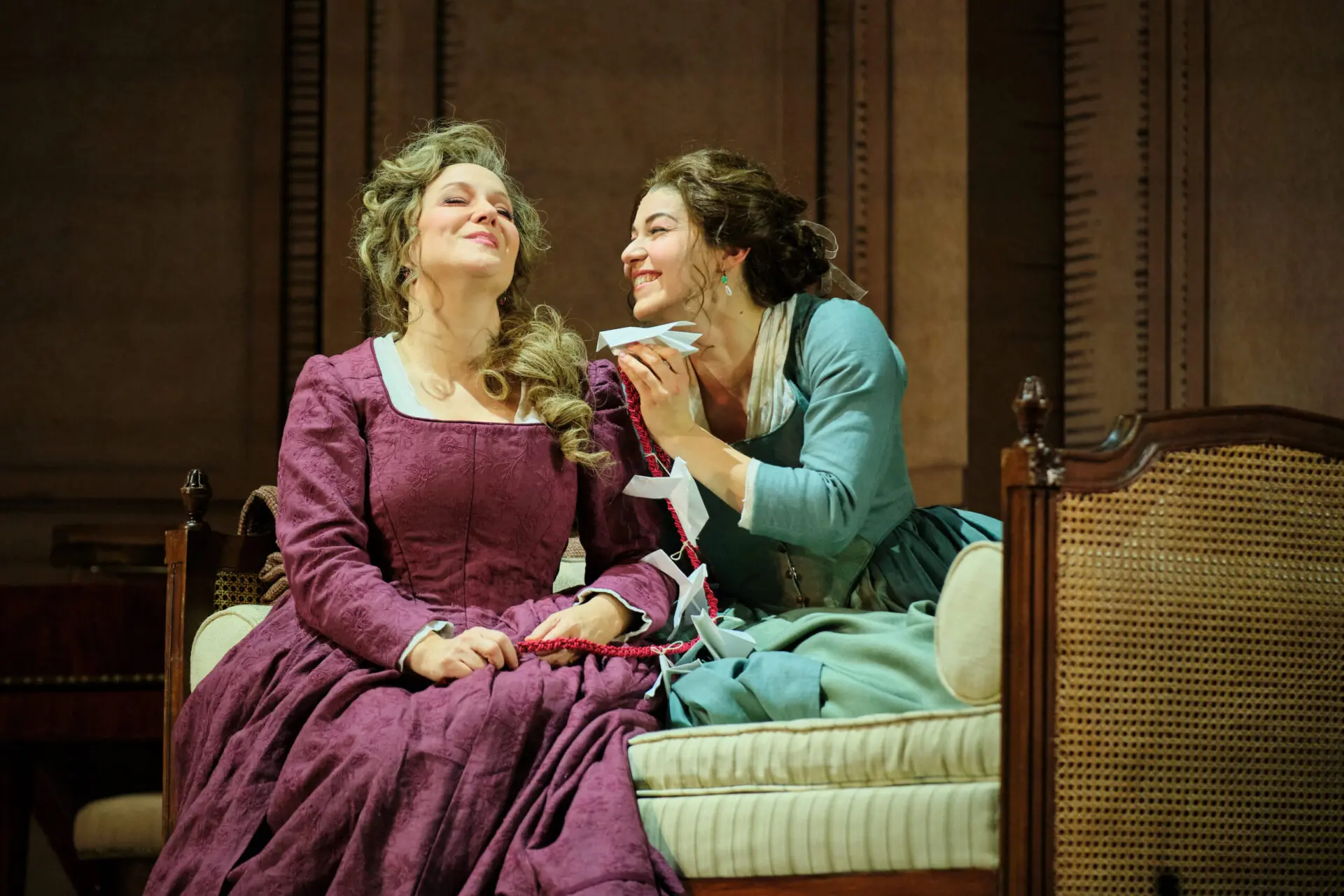
Photo Credit: Vivien Gaumand
Julie Boulianne (Charlotte) and Sophie Naubert (Sophie) "were wonderful together"
Quebec soprano Sophie Naubert, a relatively recent Atelier lyrique graduate, played Charlotte’s teenage sister Sophie. With her bright and lovely coloratura, Naubert delivered some of the opera’s catchiest tunes, making her character’s cheerfulness seem natural and genuine.
Naubert and Boulianne were wonderful together, both in the first act, as they look after the rest of their family, and in the third, as they share a moment of bittersweet sisterly love. You wouldn’t know it from the title, but this opera passes the Bechdel test – that is, two women talk to each other about something besides a man – and this production brings the sisters’ close bond to life. “Va! Laisse couler mes larmes,” which Charlotte sings to Sophie, was the highlight of the evening.
Baritone Hugo Laporte, another Quebec artist, sang Albert with elegance and conviction. His voice and physical presence were compelling embodiments of an honourable person who has reached a breaking point by Act Three.
Werther has several roles that appear only in the first two acts. Of these, Tomislav Lavoie as Le Bailli stood out with his rich bass, clear diction, and clear affection for his children (Charlotte, Sophie and their younger siblings). Atelier lyrique members Jeremy Scinocca and Dante Mullin Santone played the barflies Schmidt and Johann, adding some colour to the village; the bit parts Brühlmann and Käthchen were well executed by Élie Lefebvre-Pellegrino and Pascale Brigitte Boilard.
This is a lovely evening at the opera, a chance to sit back and enjoy some gorgeous voices – many of them homegrown. And if Werther gets on your nerves, just pretend the opera is called Charlotte.
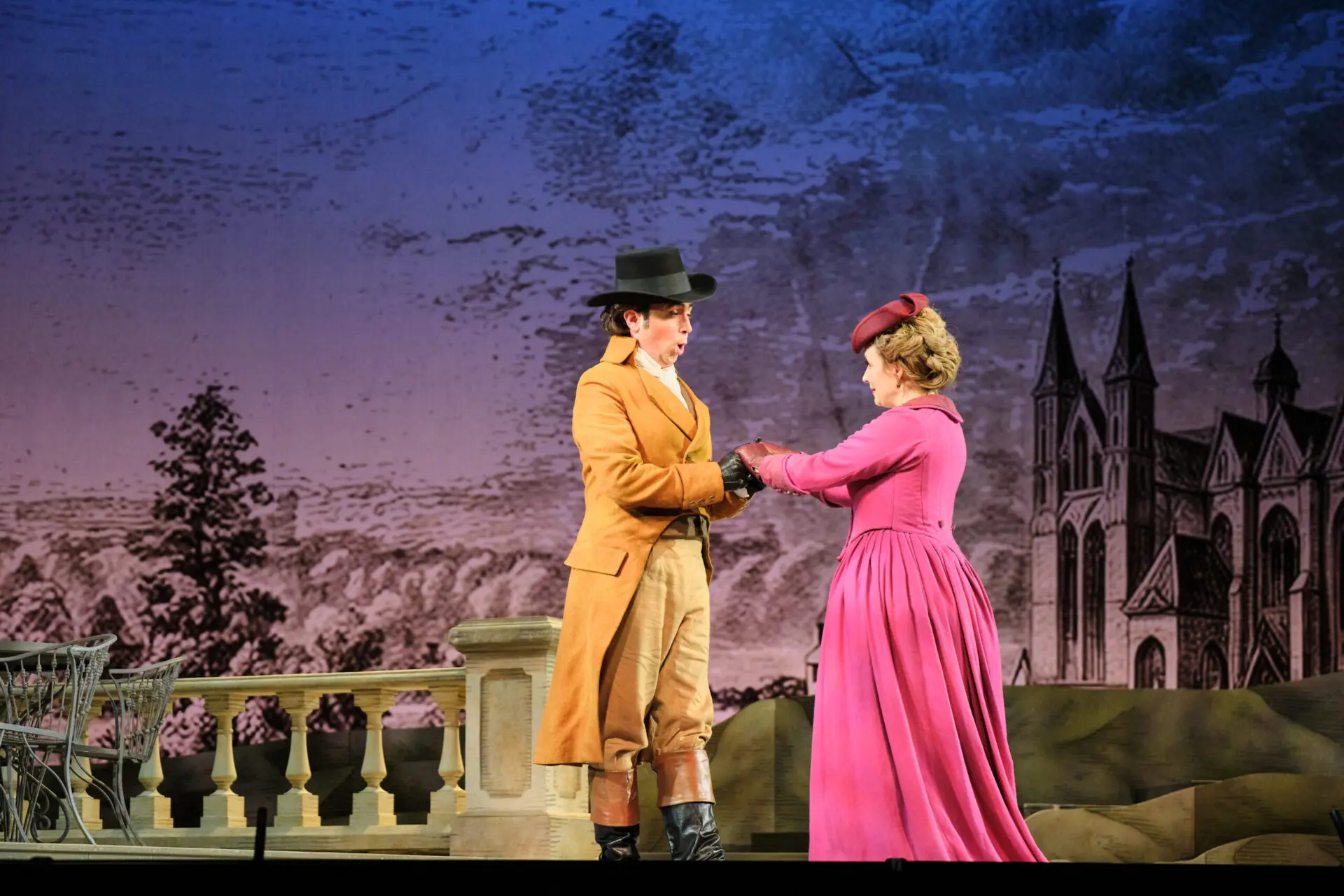
Photo Credit: Vivien Gaumand
Hugo Laporte sang Albert, Charlotte’s husband, in Opéra de Montréal’s Werther
Opera Canada depends on the generous contributions of its supporters to bring readers outstanding, in-depth coverage of opera in Canada and beyond. Please consider subscribing or donating today.