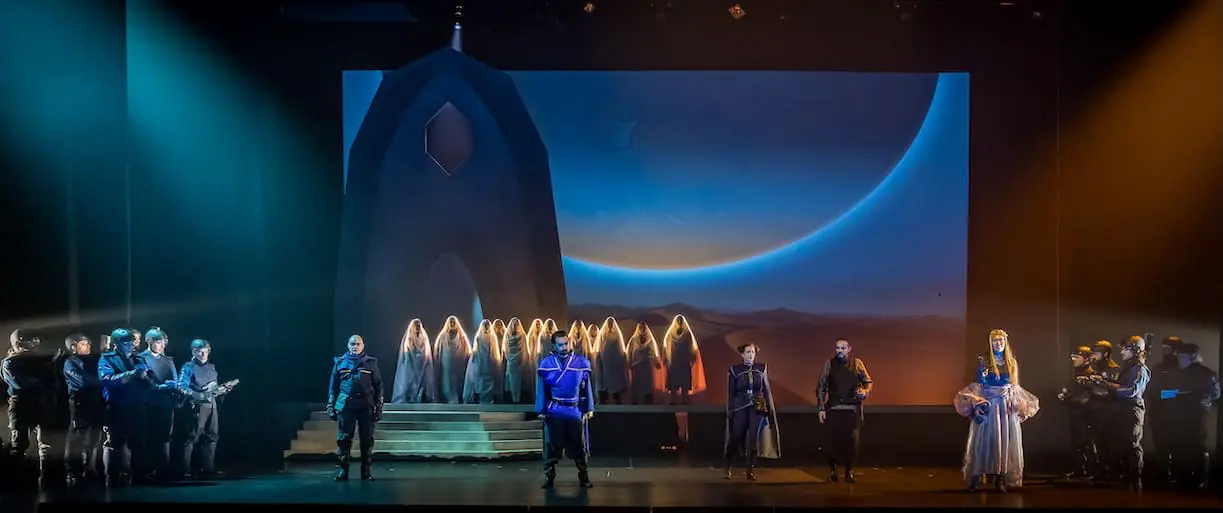
Fifteen years after its only presentation by Opéra de Québec and to celebrate the company's 40th anniversary, Il trovatore returned to the Grand Théâtre de Québec in a bold and unexpected version by Jean-Sébastien Ouellette, an actor and stage director from Québec. In 2022, he transported Donizetti's Don Pasquale to 1967 – the year of the Montreal Expo – now, he sends Verdi into an imaginary galaxy inspired by American blockbusters.
Should we cry sacrilege? Even though I'm rather conservative when it comes to staging, I admit that I enjoyed seeing how Ouellette managed to make characters from 15th-century Spain evolve into a science fiction universe, keeping the action understandable thanks to the projection of brief explanations.
Unlike other Verdi operas, like Rigoletto and La traviata composed at the same time, Il trovatore has its basis in violent events that took place more than 20 years before the curtain rose. Transporting the story to another galaxy allows the spectator to stay on the edge of their seats and forget that the singers, most of the time dealing with the vocal and emotional demands of their roles, remain frozen on stage like statues. What was more questionable, in my opinion, was changing the conclusion of the opera. Normally before she dies, Azucena takes revenge by revealing to Conte di Luna that he has just killed his own brother, leaving him with his despair. In this production, she kills him with a sword blow which unfortunately borders on caricature.
Julie Morel's costumes were inspired by science fiction cinematography, especially in the case of Azucena who, with her shoulder pads, her red-light halo headdress and her tapered fingers, looked like an imposing alien magician. The soldiers and nuns seemed timeless, and only the colorful gypsies of the second act reminded us of a more human universe. Christian Fontaine designed modular sets that are particularly austere, even minimalist: a few steps, shapes that could suggest a convent or a fortress, all against a blue or orange background through projections designed by Keven Dubois.
Verdi's work received high-calibre treatment from the wonderful cast of singers. French tenor Christophe Berry, who will return this summer to play Don José in Carmen at Opéra de Québec’s Festival d’opéra, shone in the role of the troubadour Manrico. He has a full, well-controlled voice that projects strongly, beautiful diction and a convincing presence, which were heard in both the Act Three duet with Leonora and in the aria “Di quella pira,” which he sang brilliantly, dominating the chorus.
The role of Conte di Luna, Manrico's ruthless rival, was entrusted to the Quebec baritone Hugo Laporte. It was both his first di Luna and his first Verdi opera, but he showed beautiful confidence, generosity of melodic lines and a great lyrical moment in the aria “Il balen del suo sorriso.” His scenes with Azucena and Manrico were also beautifully felt.
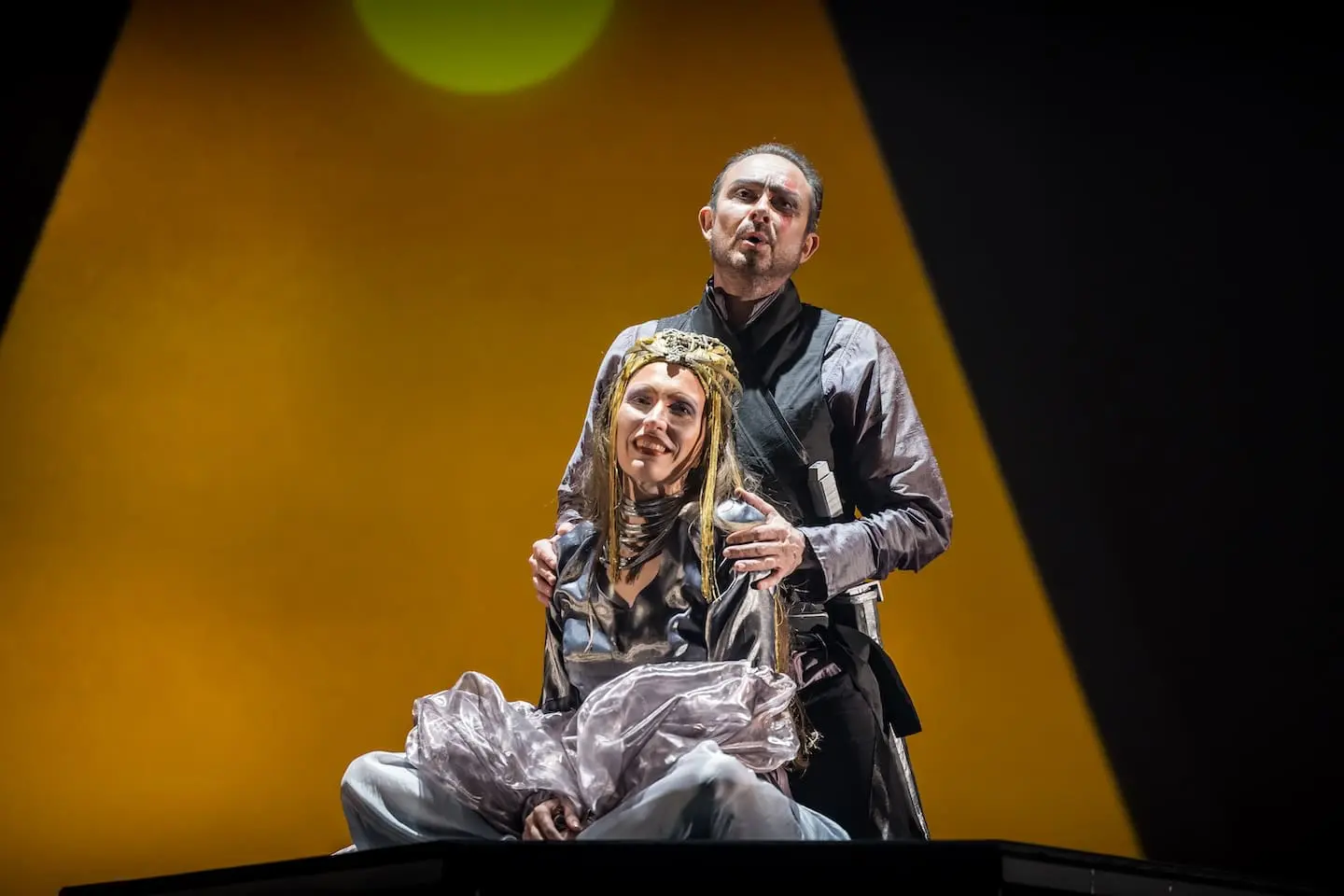
Photo Credit: Jessica Latouche
Irina Stopina (Leonora) and Christophe Berry (Manrico) in Il travatore
French bass Frédéric Caton, who was a good Arkel in 2018’s Pelléas et Mélisande (Festival d’Opéra de Québec), distinguished himself in the role of Ferrando, who first describes the infanticide committed by Azucena. Baritone Michel Desbiens effectively completed the male cast as Ruiz.
Of the women, the French lyrico-spinto soprano Irina Stopina gave Leonora both fragility and strength of character as Manrico's lover. The voice is beautiful, pure and agile, as she demonstrated in “Tacea la notte” and in her ensembles with Manrico and di Luna. She had some difficulty, however, supporting her high notes.
Franco-Russian mezzo-soprano Elena Gabouri was a breathtaking Azucena, triumphing over the many vocal challenges posed by the role, which constantly makes her navigate between high and low registers, although sometimes seemed a little hoarse. What emotions and what presence in both “Stride la vampa” and the story she tells Manrico of his murderous act.
A special mention to Quebec soprano Émilie Baillargeon for her role as Ines, Leonora's servant, her voice blending perfectly with that of her partner.
The chorus, prepared by Catherine-Élisabeth Loiselle, were up to the task, both on the male side for the warrior chorus and on the female side for the religious choir. They offered us two strong moments: in the second act “Anvil Chorus” and in the final act, with the “Miserere” sung over Leonora's laments and Manrico's love song. From the very first notes, the Italian conductor Federico Tibone showed his prowess, conducting the Orchestre symphonique de Québec with flexibility and passion, always in communion with the singers, attentive to their slightest rubato and bringing out the beautiful instrumental passages of Verdi's score.
Notably, this production bears the signature of Jean-François Lapointe, who left the Opéra de Québec last January.
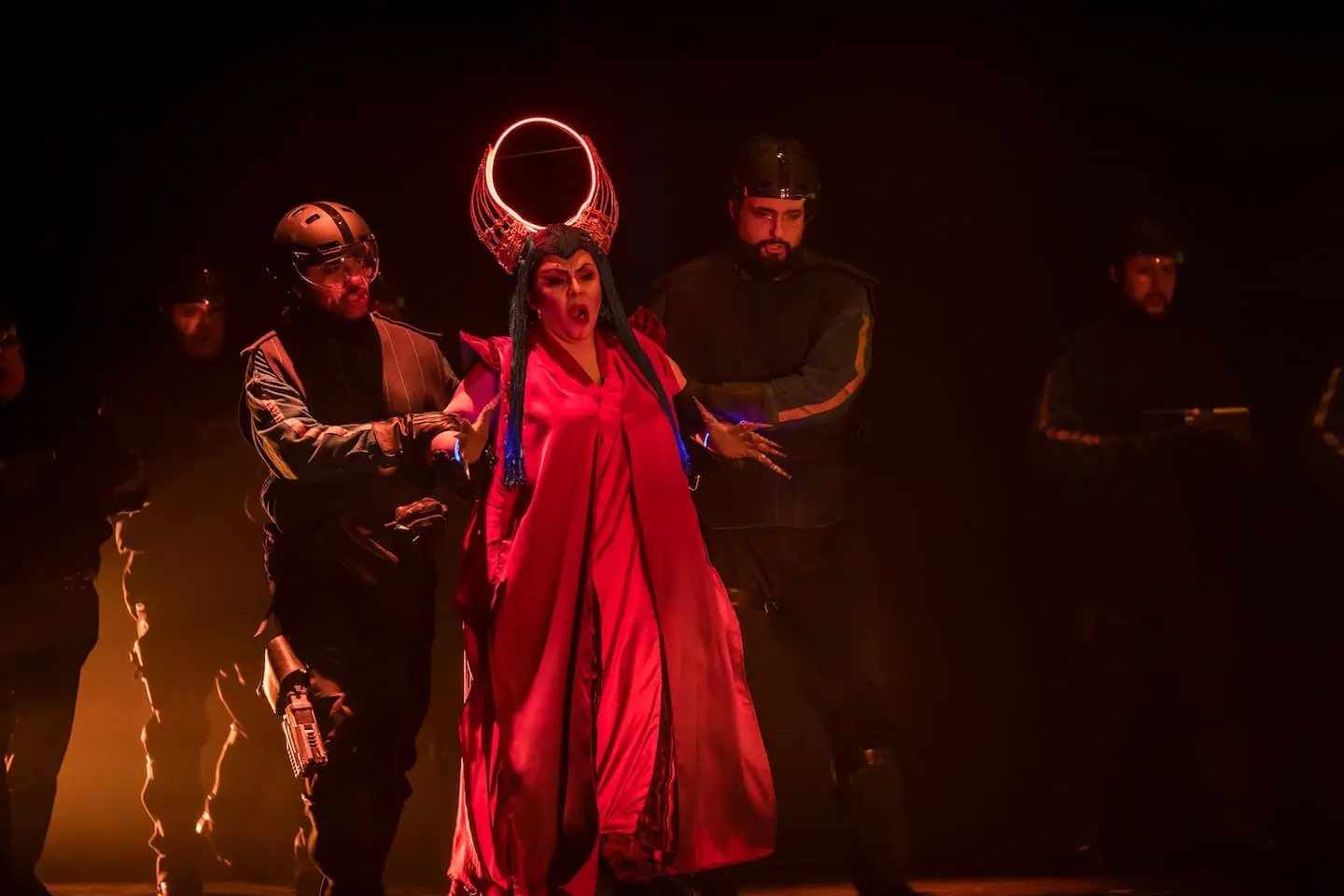
Photo Credit: Jessica Latouche
A futuristic Azucena (Elena Gabouri) in her red-light halo headdress
Opera Canada depends on the generous contributions of its supporters to bring readers outstanding, in-depth coverage of opera in Canada and beyond. Please consider subscribing or donating today.