The opening-night crowd grew positively raucous as it became clearer and clearer that Pacific Opera Victoria’s production of Verdi’s Il trovatore was packed with fabulous singing talent in each and every role.
Bass Adam Lau as Ferrando, who helps guide us through this convoluted tale of lust, death, war and revenge, opened the opera with rock-solid assurance and a stunningly rich voice. Perhaps others in the audience reacted to him as I did: I started to smile with the sense that, “Oh boy, this is going to be good.” With that kind of promise from the first minute, who cares that the story is a bit of a mess and gruesome – a witch burned at the stake, a baby thrown on a fire, a woman self-poisoned, her lover beheaded. Fortunately, the rest of the cast – and the chorus – lived up to Lau.
Next up, we moved from Ferrando, explaining to a group of soldiers the sad back story of the Conte di Luna, their leader in a civil war against the rebels, to the lovely Leonora, lady-in-waiting to the Princess of Aragon. Leonora, untroubled as yet by the war that surrounds her, is focused on the man she loves, a mysterious troubadour named Manrico. As sung by fast-rising Canadian soprano Kirsten LeBlanc, Leonora was believably young and naive at the outset. When Leonora tells her maid Inez (Jennifer Turner, a very capable last-minute replacement) about a “love that words can scarcely describe,” Leblanc brought the character’s youthful joy to the forefront, but her biggest triumph came later. In the devastatingly sad bel canto lullaby “D’amor sull’ali rosee,” LeBlanc transitioned into her upper vocal range without losing power or flexibility or beauty, and the audience responded accordingly.
As it turns out, Leonora’s beloved, the dashing Manrico, is not a troubadour at all but, rather, the leader of the rebels, fighting against Ferdinand I’s royal army. Tenor Marcelo Puente, lauded for Puccini roles like Pinkerton in Madama Butterfly, handled the swagger and sadness of this Verdi character just as well. In Manrico’s “De quella pira” aria (almost as famous as the rousing Anvil Chorus, which POV’s gang of gypsies sang brilliantly), delivered after he learned his mother was about to be burned at the stake, Puente was passionate and convincing, with comfortably secure and attractive high notes.
Baritone Grant Youngblood brought his full star power to the role of bad guy Conte di Luna, the second of the two men vying for the favour of the lovely Leonora. His voice contains a pathos that somehow renders even a villain sympathetic. In Youngblood’s hands, the Count subverts the law and his duty and orders his rival Manrico beheaded, yet it was hard to hate him – probably because, before the worst of the carnage, his show-stopper aria “Il balen del suo sorriso” really did stop the show. Who can hate a man who can sing like that?
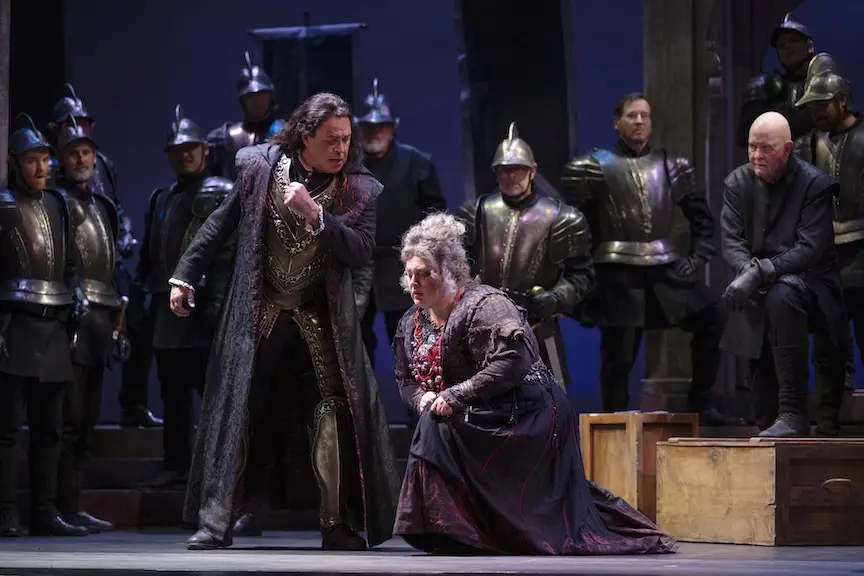
Photo Credit: Michael Cooper Photography
The Conte di Luna (Grant Youngblood) confronts the gypsy Azucena (Simona Genga)
Finally, we come to the last member of the central quartet of singers: Italian-Canadian mezzo Simona Genga. As the gypsy Azucena, whose mother was the woman burned at the stake by the Count’s father and who herself threw that infamous baby into the fire, Genga was magnificent. With a deep, round tone and a mature and expressive voice beyond her years, Genga owned the role.
With singing like this – combined with toe-tapping precision from the orchestra, conducted with flair by Giuseppe Pietraroia – who cares that this opera does not make much sense? That baby, well, it turned out to have been Azucena’s own son, not the son of her arch-enemy, the Count’s father, and so she raised his son instead but neglected to mention that fact to the Conte di Luna so he beheaded his own brother. Oh dear.
There are only three things that could have made this Il trovatore better: more chemistry between Manrico and Leonora, more believable lust from the Count and a stronger visual presence.
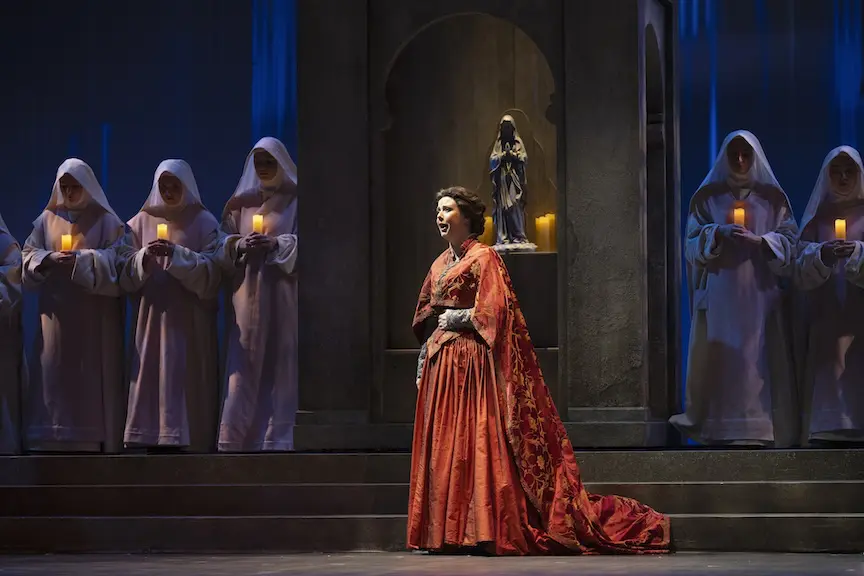
Director Brenna Corner kept Verdi’s original location in 15th-century Spain, but opted for a set, by Olivier Landreville, that succeeded only when animated by soldiers or townspeople. The stop-action tableaux Corner created against the backdrop of modular pieces were fabulous, reminiscent of great Renaissance paintings, but with fewer people on stage, the blocky blandness of the pieces worked against the drama. So did the anemic projections by S. Katy Tucker: pale blue and wispy white, with barely discernable shadows, they were meant to show us key acts like the burning of Azucena’s mother, but they felt fake and distracting.
There was also a misguided attempt to keep the progress of the civil war in our thoughts by regularly showing hard-to-read excerpts from the Conte di Luna’s messages to Ferdinand I on a scrim. Who cares? Take us back to the fabulous singing, please!
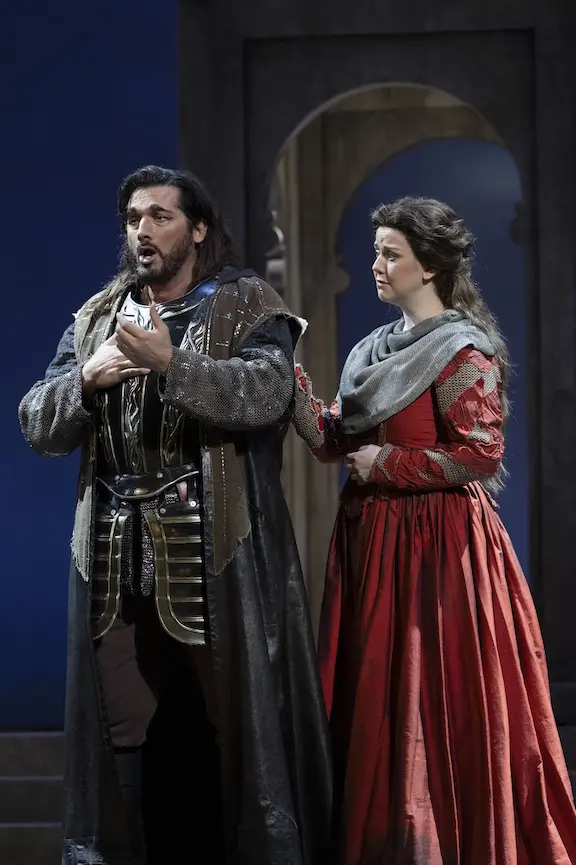
Photo Credit: Michael Cooper Photography
Marcelo Puente (Manrico) and Kirsten LeBlanc (Leonora) in Il trovatore
Opera Canada depends on the generous contributions of its supporters to bring readers outstanding, in-depth coverage of opera in Canada and beyond. Please consider subscribing or donating today.