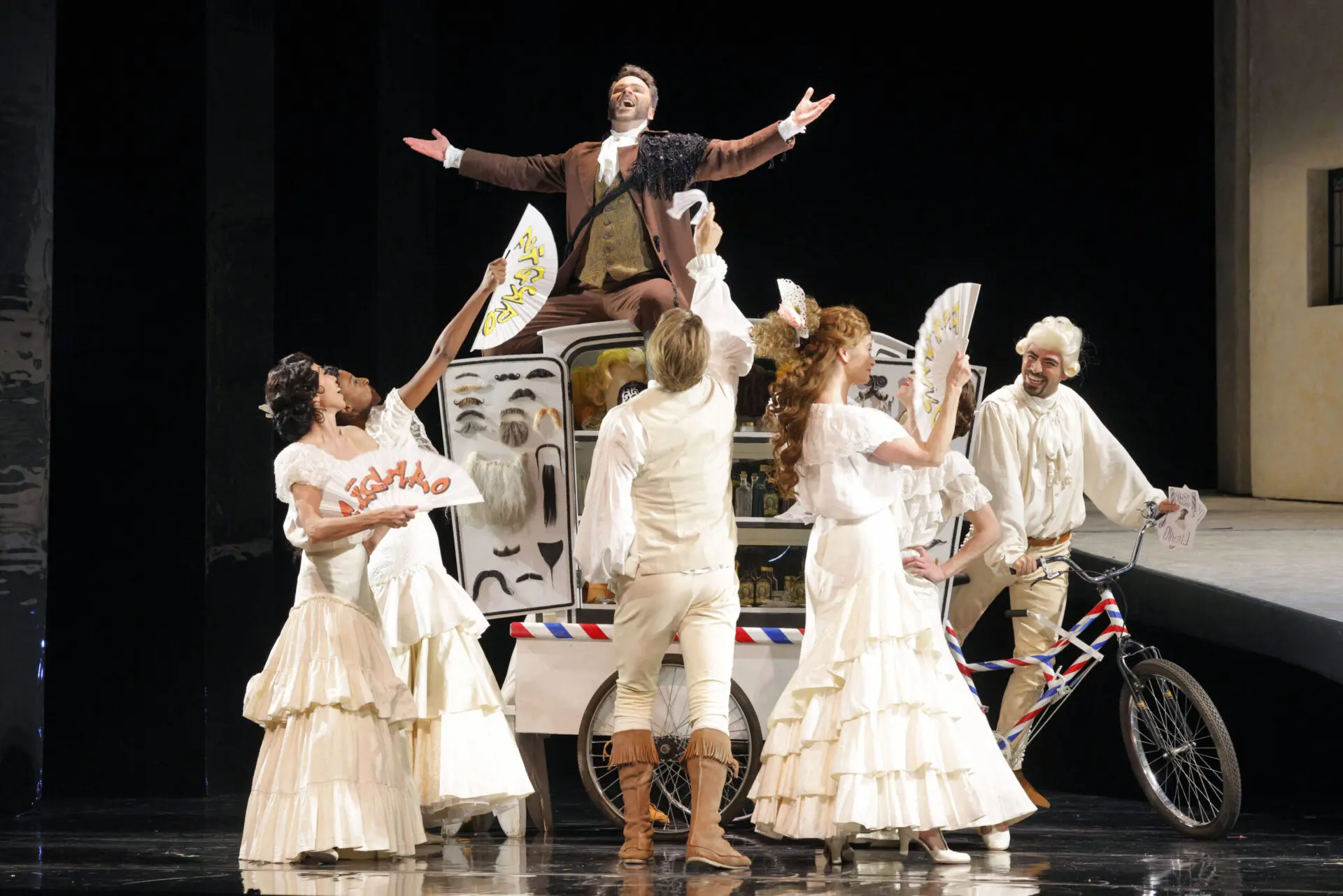
Figaro masterminds the countless plot twists, disguises and games of trickery in his and Gioachino Rossini’s opera, The Barber of Seville. The work bears a subtitle, “The Useless Precaution,” because Figaro’s plan is to dupe the heroine Rosina’s guardian, Doctor Bartolo, out of his scheme to marry the luscious young heiress. Figaro serves two masters, officially the doctor and, most profitably, the Count Almaviva, who loves Rosina at first sight and contrives with Figaro to sweep her away in marriage.
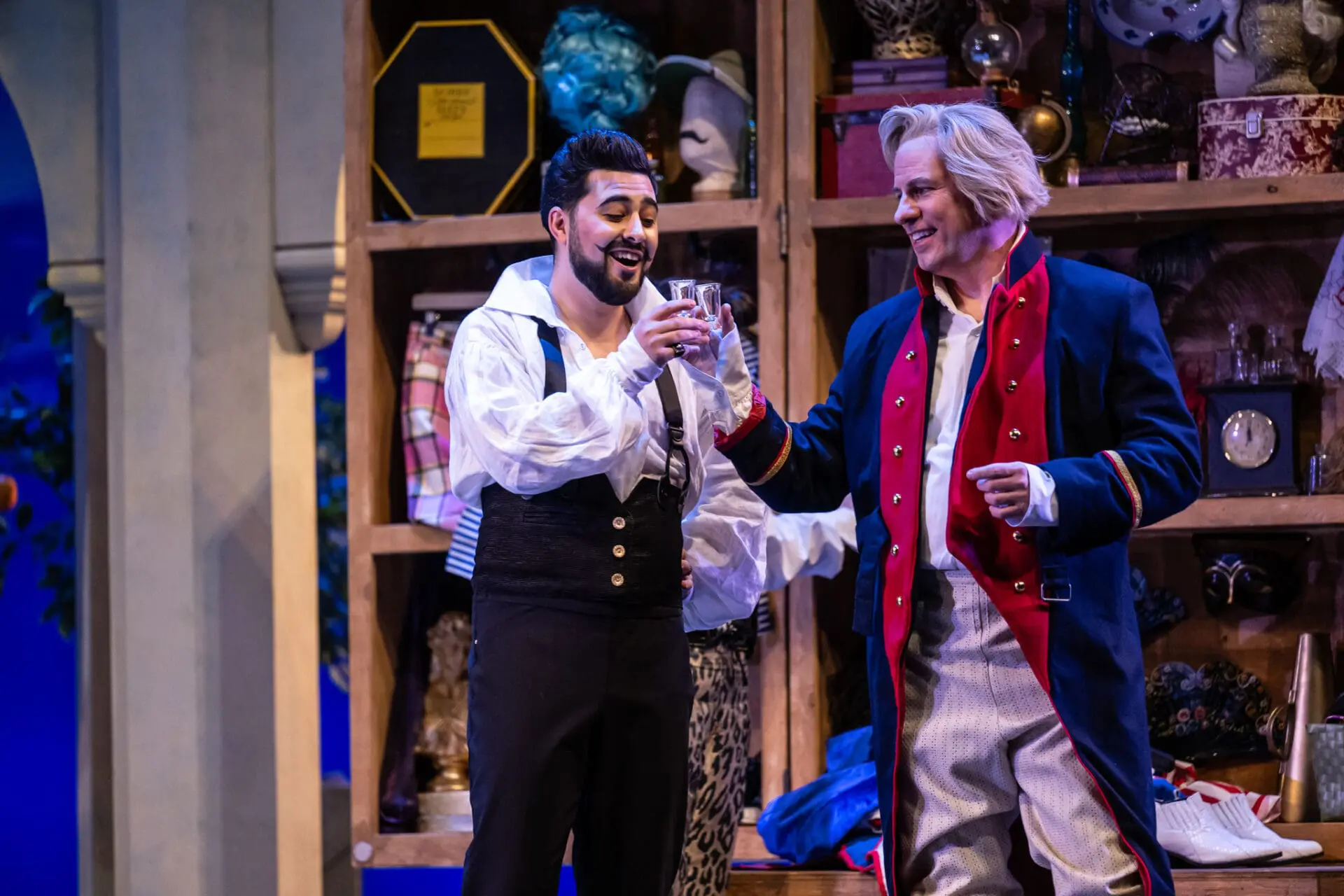
Joshua Hopkins, the fine Canadian baritone, supervised the intricate doings at Figaro’s command, often joining in the elaborate action while sometimes watching with bemused authority. Hopkins also was in charge of every convoluted detail of his musical line – rhythmically precise, with immaculate diction and tonal beauty. I would place him among the top dozen or so Figaros I have heard, along with Thomas Hampson and Dmitri Hvorostovsky.
The Barber of Seville ranks among the ten most often performed operas, which may seem surprising given the score’s demands for vocal virtuosity from five leading performers, precision ensemble among them and, at least in modern productions, complex physical coordination. More surprising still is that this opera remains highly entertaining and really crowd pleasing, even when the singers do not rise to remarkable feats of vocalism. This is a comedic machine of the highest order.
An accomplished conductor is required, however, to keep the machine well-oiled and running. Benjamin Manis, an emerging maestro boasting notable awards and a festival appointment by Donald Runnicles – the beloved past music director of San Francisco Opera – brought exciting energy to the score. In tandem with Bryndon Hassman shaping the pianoforte continuo, Manis guided singers with a sure hand through Rossini’s shifting, rhythmically convoluted ensembles, while honoring the lift and propulsive energy that so delights in this music.
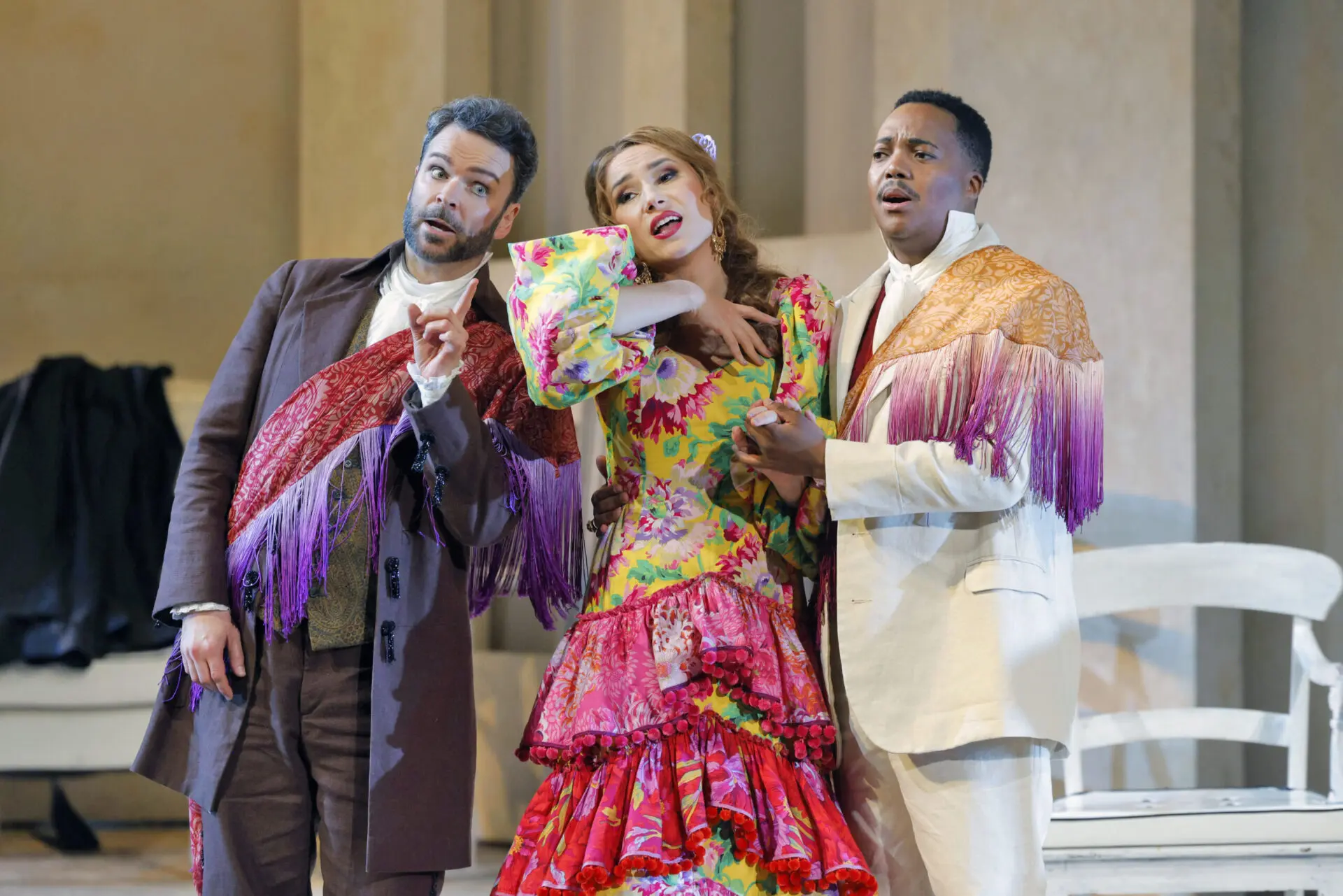
Photo Credit: Cory Weaver / San Francisco Opera
Figaro (Joshua Hopkins), Rosina (Maria Katanga) and the Count (Levy Sekgapane) at San Franciso Opera
Bass-baritones of some age often take up Doctor Bartolo, an old man often at the center of the action. If a few notes disappear, this may be a small price to pay for rich characterization and expressive complexity. Renato Girolami in fact sang most of his notes, if in rather hoarse tones. But he is a master of comedic antics, some in the libretto, some not. And he possesses that elusive trait in singers: vocal ease.
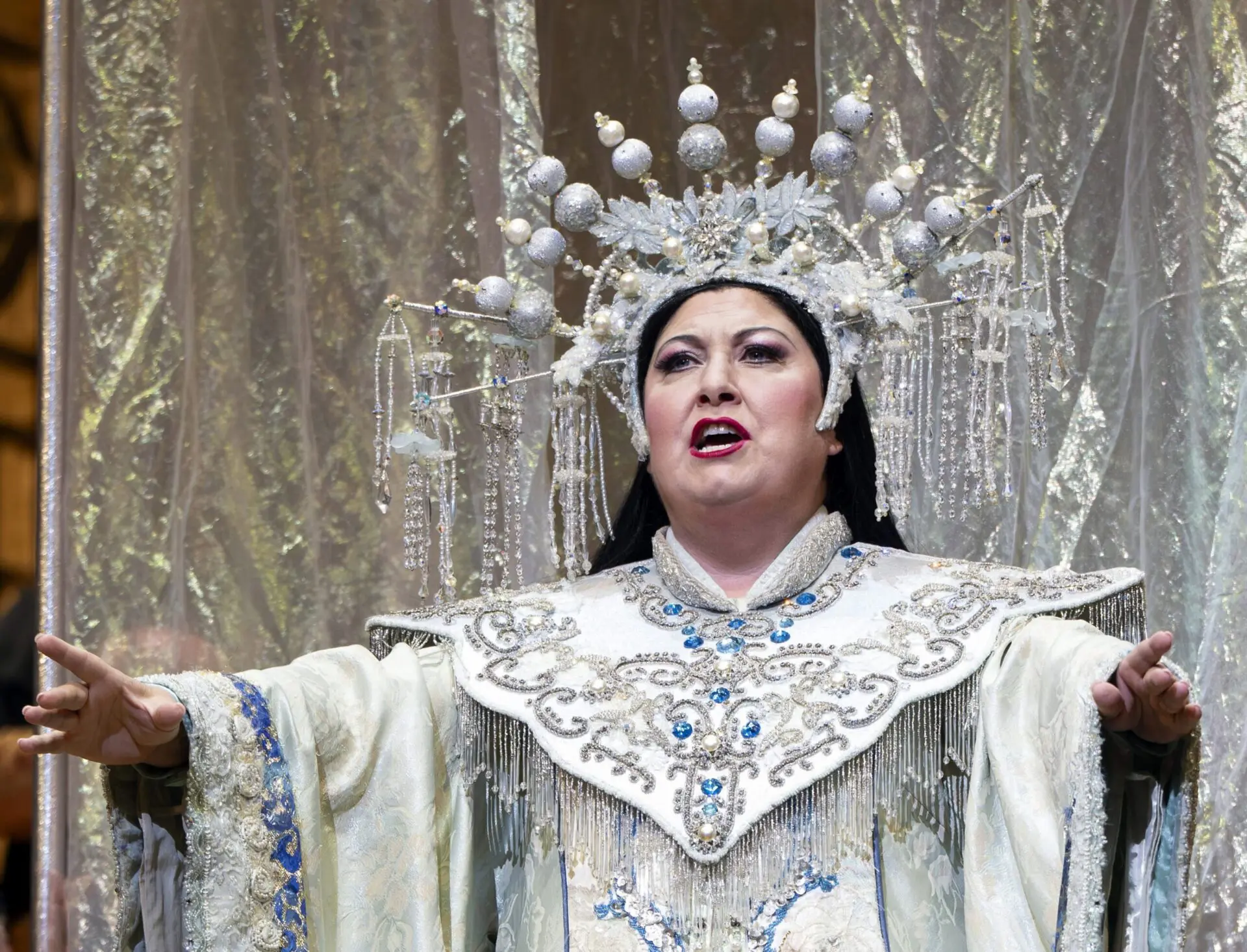
Ease is exactly what I found missing in our Rosina and our Almaviva. I refer here, especially, to breathy attacks (aspiration) and to a tendency to shout as the tessitura rises and the sense of easy flow (legato) vanishes. The notes are accurately sung yet never quite achieve the magic of fine singing. Maria Kataeva played the coquette with flirtatious skill, despite being draped in garish, engulfing dresses out of harmony with the production as a whole. She brought plenty of fun and and sparkle to Rosina. If the ultimate in bel canto technique was missing, she and Rossini guaranteed the love of the audience. Levy Sekgapane’s tenor gave youth and sincerity to Almaviva, along with a welcoming tone and some fine singing. His acting, like his high-lying phrases, left me wishing for a sense of relaxed achievement.
As the chameleon Don Basilio, Riccardo Fassi used his booming bass with discretion and an elegant agility unexpected from a big voice, while his tall stature allowed for several nice comedic twists. The stalwart San Francisco regular Catherine Cook nicely discharged Berta’s big aria.
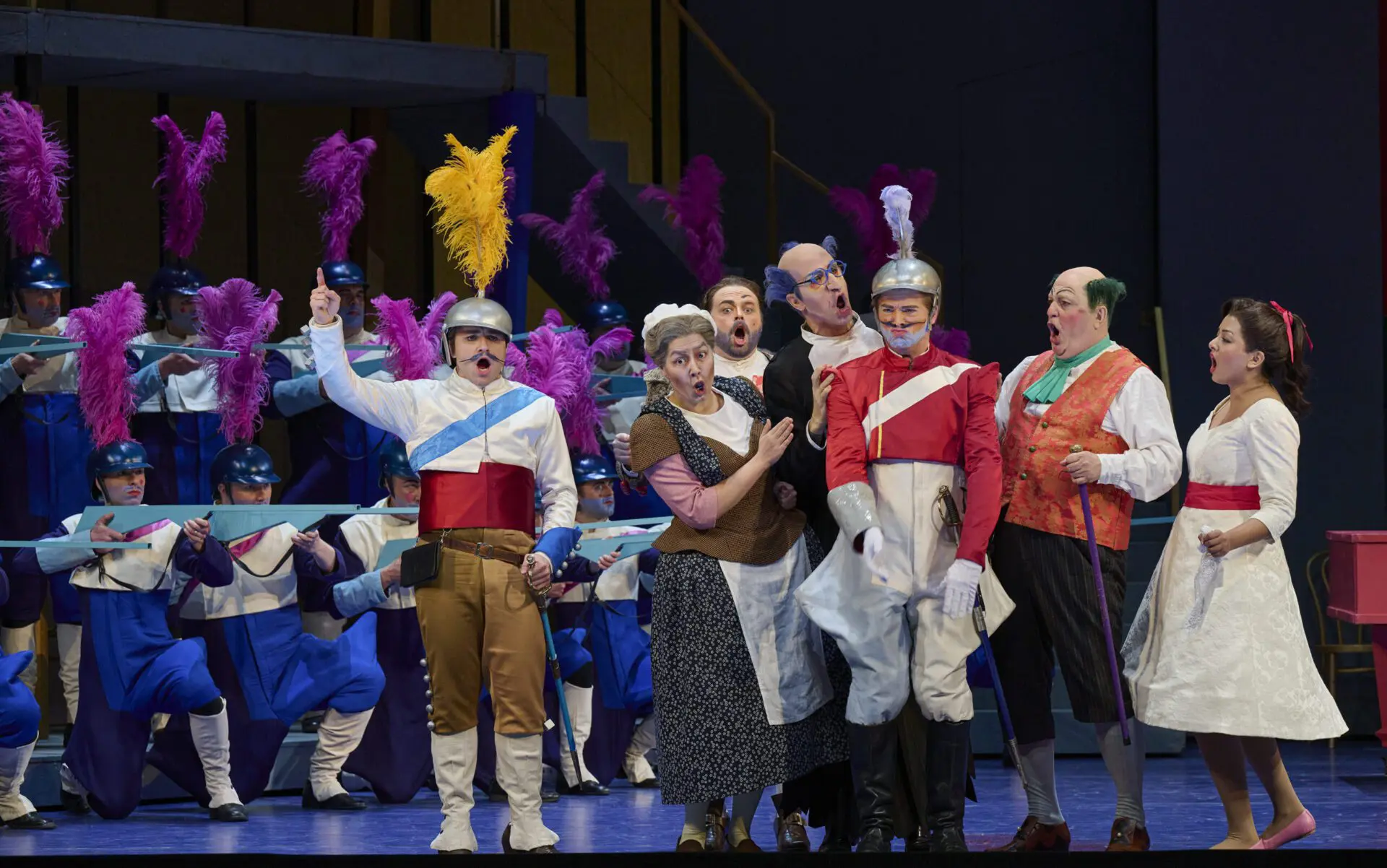
Director Emilio Sagi kept everyone in constant motion – usually in tune with the libretto – but fell into the current fashion, it seems, of inserting dancers not just at festive moments but in surprising spots (revival choreography by Colm Seery). The dramatic unit set, by Llorenç Corbella, angled like a city wall front to back of the entire stage, atop a tilted platform from beneath which amusing figures and objects would emerge. Although this enormous, windowed wall did not seem to move, bright lighting offered a Mediterranean atmosphere for the street scenes of Act One, and a forest of chandeliers and domestic furniture defined Act Two’s interior. Costumes by Pepa Ojanguren held to tasteful beiges, browns and blacks, with colorful shawls added all around toward the end – and, yes, Rosina’s screaming colors.
The explosive finale featured stars, balloons, confetti and the loving young couple’s departure (reasons mysterious) in an antique, flaming orange 1971 Morgan Plus 8 sports car. The audience joined in their rapturous happiness.
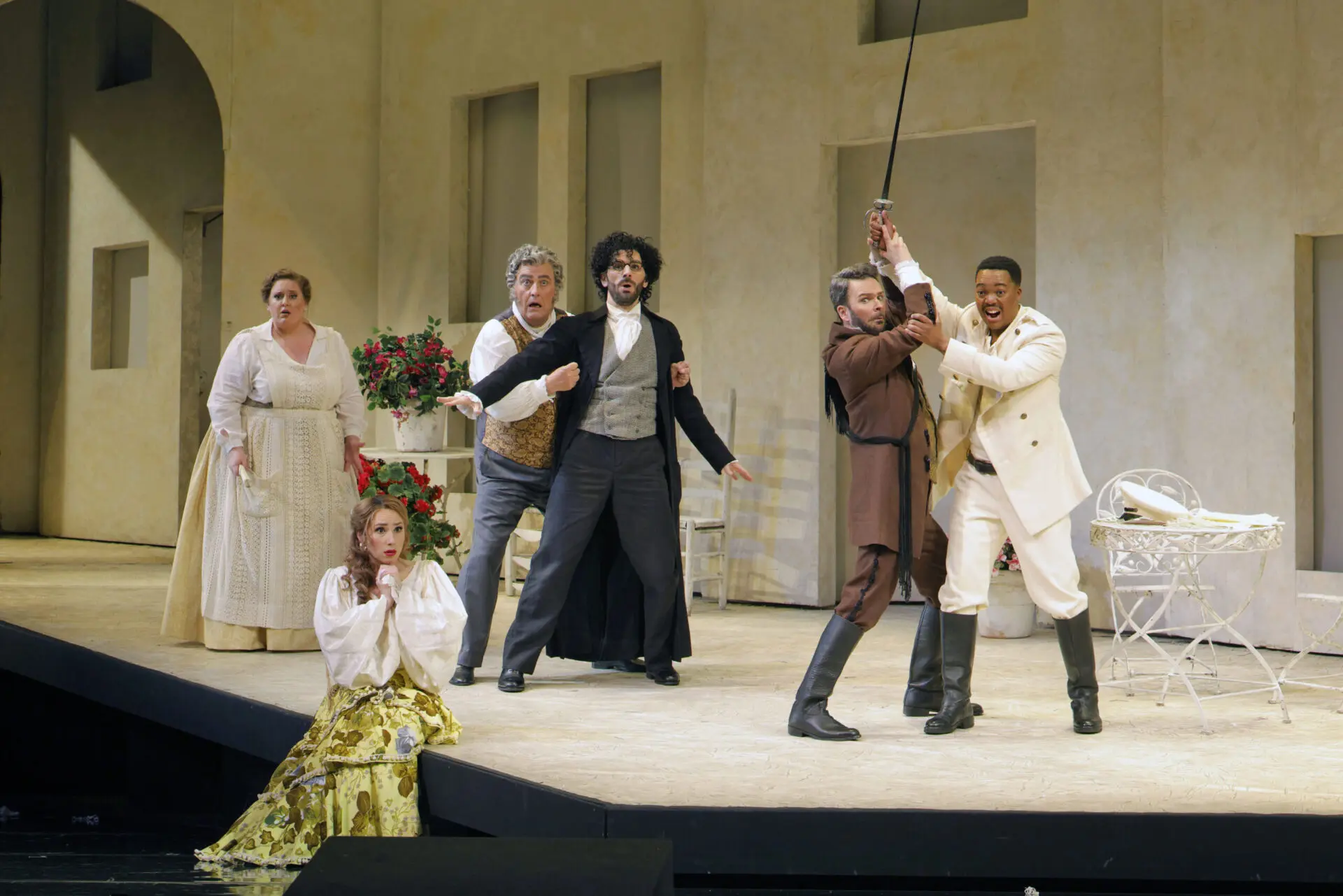
Photo Credit: Cory Weaver / San Francisco Opera
The principal cast of The Barber of Seville, from left to right: Mary Hoskins (for Catherine Cook as Berta), Maria Kataeva, Renato Girolami, Riccardo Fassi, Joshua Hopkins and Levy Sekgapane
Opera Canada depends on the generous contributions of its supporters to bring readers outstanding, in-depth coverage of opera in Canada and beyond. Please consider subscribing or donating today.