The current staging of Mozart’s Le nozze di Figaro at the San Francisco Opera, set nominally in Colonial America, resembles a Canadian takeover. Olivia Smith, who sang notably here before as the mother of Steve Jobs’s child in Mason Bates’s The (R)evolution of Steve Jobs, assumed the towering role of the Countess. Simone McIntosh, familiar from San Francisco’s programs for younger singers, waltzed about as Cherubino, wearing pants as Mozart’s beloved lover boy.
The late Michael Cavanagh – a third Canadian – dreamt up the notion of presenting the three Mozart / Da Ponte operas as if in America, all set in the same grand villa. It is under construction in Figaro, with attractive Palladian architecture overlain by construction drawings (designed by Erhard Rom). This villa will become a luxurious country club for Così fan tutte and fall into decay for a dystopian Don Giovanni.
The current revival of Figaro, re-staged by Shawna Lucey, maintains the fine, clarifying detail of Cavanagh’s inventive action, which even managed to track the tangled happenings in the final act’s shadowy garden. She toned down some of the Colonial references, leaving chiefly live enactments of a famous flag and drum painting, The Spirit of ’76, and the celebrated Washington Crossing the Delaware. Otherwise, this comedy could be unfolding in any Georgian mansion, anywhere. Lucey also added scabrous gestures that are intrusive and beside the point, since eroticism saturates this score, especially with Cherubino’s and Barbarina’s antics (Sofia Gotch).
The costumes (Constance Hoffman) keep historical details in mind – such as the merging dress of masters and servants and the influx of French fabrics into America during the later 18th century. Such fine points, even if imperceptible to the audience, do add to the ongoing spirit and feel of the production for those onstage. Bright lighting (Justin A. Partier) cast these details into relief and set a cheerful frame as for a spring or summer season.
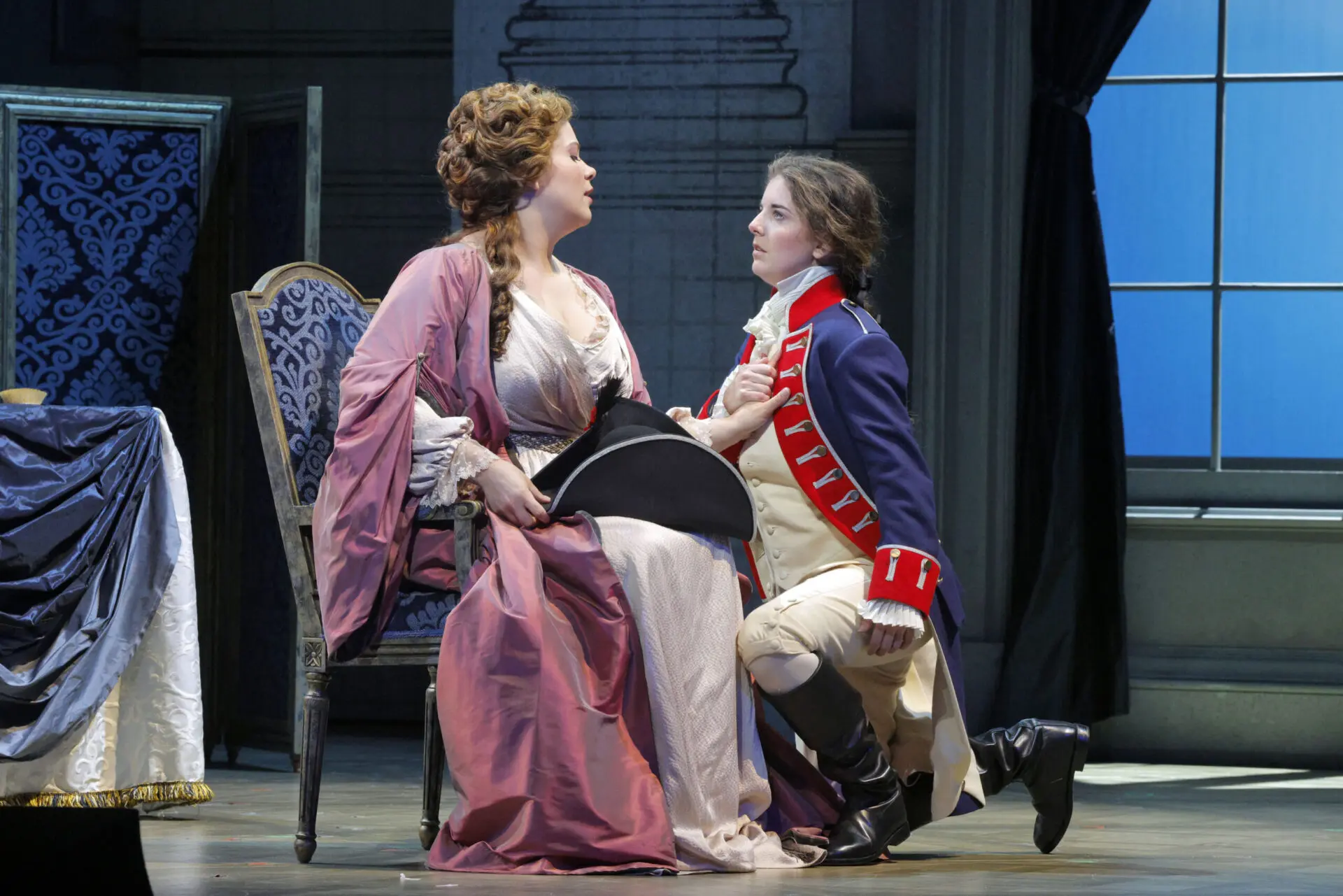
Olivia Smith, in her role debut as the Countess, scaled the Everest of her monumental Act Three “Dove sono” with grace and legato flexibility. She projected a real woman of character in deep distress at the loss of her husband’s love and the need to connive with servants to attempt to regain it. Perhaps less secure, even if it is less complex, was her “Porgi, amor.” It is placed demandingly as the Countess’s first appearance at the curtain rise for the second act, with only a short introduction. Ill-advised late seating on the part of the San Francisco Opera could only have proved distracting.
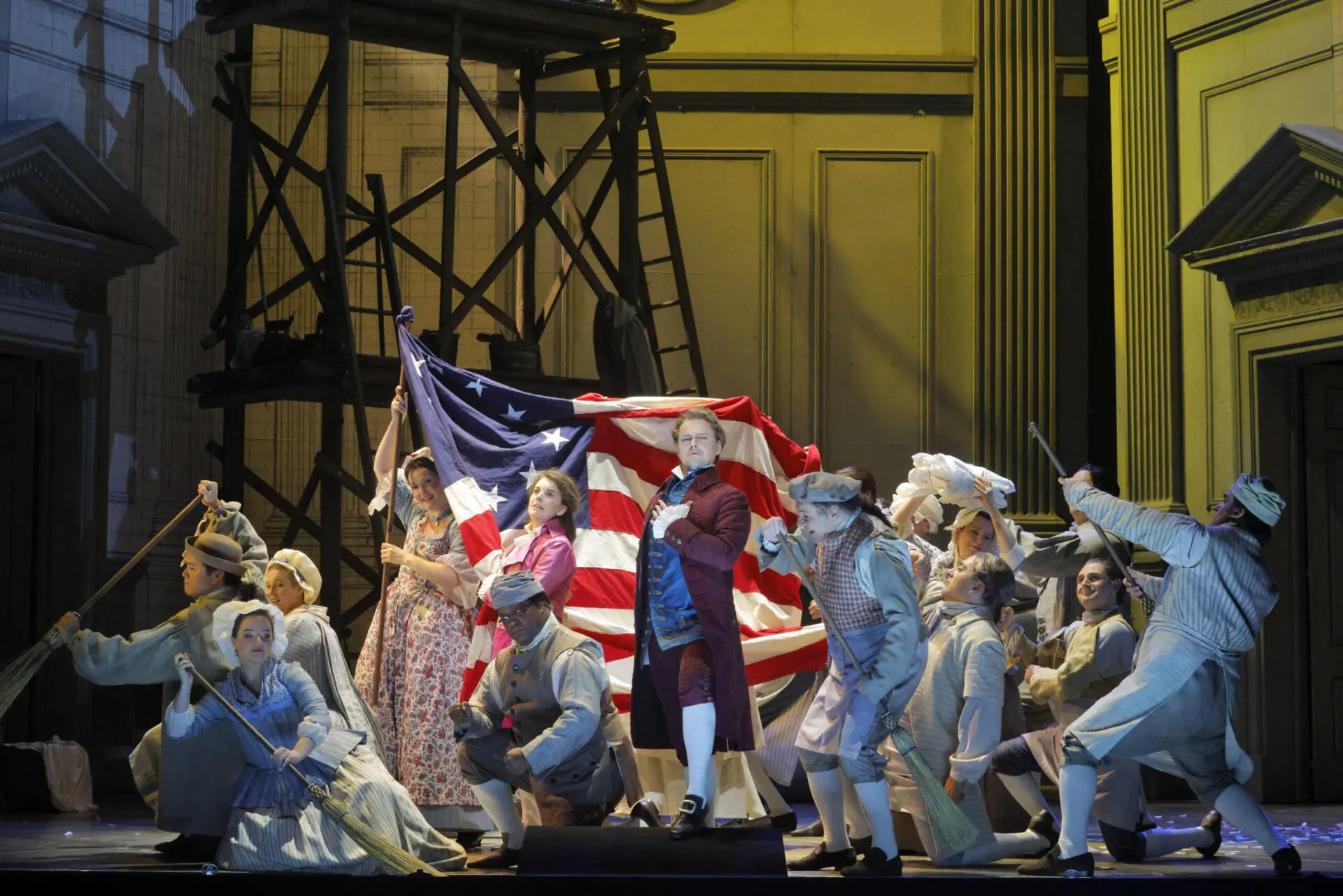
Photo Credit: Cory Weaver / San Francisco Opera
The late Michael Cavanagh’s staging recreates some classic Colonial American imagery
Simone McIntosh romped her way through the ravishing part of Cherubino, wearing a gleaming magenta suit to start, then military uniforms and girly dress-up for later clowning. At least in San Francisco’s very large house, her mezzo seemed on the light side compared with the deep plush of singers often cast in this part. But her musical execution was elegant, and she added delightful ornamentation to repeats, a practice not consistently observed across this production.
Figaro and Susanna made a sympathetic couple – perhaps to be expected, for they actually are married. Peter Kellner’s voice seemed more in the bass-baritone range than a strict bass, at least to my ear, but he admirably dispatched Figaro’s long and complex part, both at the vocal level and in the varied business of the Cavanagh staging. Slávka Zámečníková charmed everyone as Susanna. And, like Kellner, she easily kept up with the escapades of the staging. Her refined, agile soprano is tailor-made for this intricate part. Her bright tonality chimed to perfection with Smith’s sonority in their gorgeous letter duet.
The youthful appearance of Thomas Mole as the Count delineated his character perfectly as the lead skirt chaser in the Almaviva household, surpassing even Cherubino in this staging. Mole, in his role debut as the Count, brought dramatic conviction to a part that sometimes can seem perfunctory.
Much of the comic energy in this opera arises from the hovering presence of Marcellina and Bartolo, who, to everyone’s astonishment including their own, turn out to be the parents of Figaro. Experienced opera buffa singers like Catherine Cook and Maurizio Muraro can lift a performance. Certainly, here they laid on amusement for each and every member of the audience. Alek Shrader might be inexperienced with the catalytic role of Basilio, but his is an always-welcome face in San Francisco and he is always splendidly in character any time he appears.
This Figaro’s conductor, Sebastian Weigle, masterminded the highly effective proceedings, guiding his lovely ensemble cast through Mozart’s layered, fast-moving music. Weigle showed the San Francisco Opera Orchestra at its very best and brought propulsive motion to the whole evening. The fortepiano continuo, inventively played by Bryndon Hassman, infected the countless recitatives with a subtle hilarity, and the audience responded with continual laughter and final cheers.
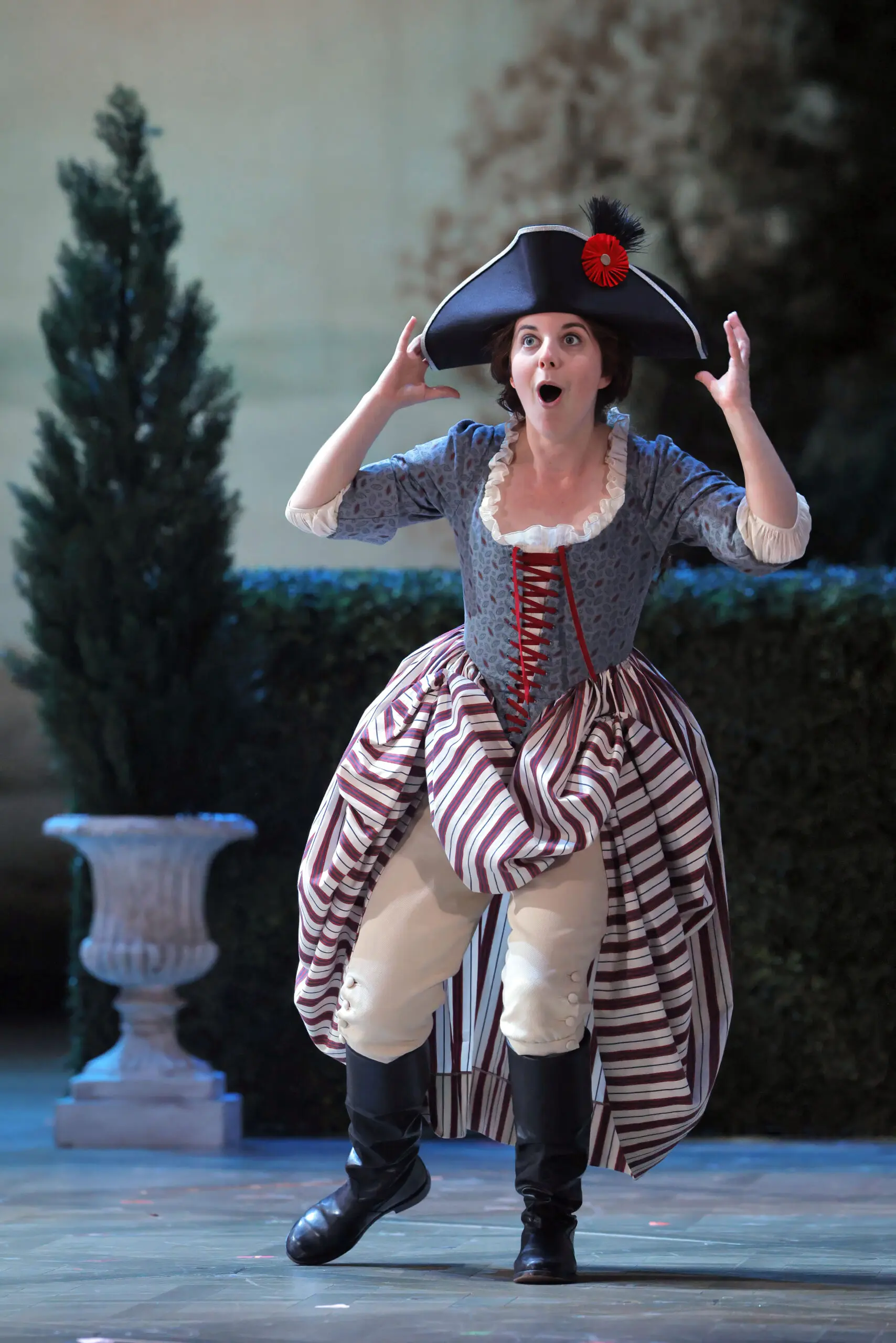
Photo Credit: Cory Weaver / San Francisco Opera
Cherubino (Simone McIntosh) “in disguise” as a woman in Le nozze di Figaro
Opera Canada depends on the generous contributions of its supporters to bring readers outstanding, in-depth coverage of opera in Canada and beyond. Please consider subscribing or donating today.