Dog Days, an earlier work (2012) by Canadian librettist Royce Vavrek and American composer David T. Little, is receiving its Canadian premiere in a co-production by Tapestry Opera and Against the Grain Theatre.
Vavrek has been having something of a “banner fall.” With the premiere of his Lincoln on the Bardo at The Metropolitan Opera, he became the first Canadian creator to have a work premiere at North America’s largest opera house, and English National Opera brought his Pulitzer Prize-winning Angel’s Bone to London. It is certainly an appropriate time for Canadian audiences to see Dog Days, which Vavrek says comes from “a foundational year for [his] collaborative cohort.” And this co-production, directed by Tapestry’s artistic and general director Michael Hidetoshi Mori, is an excellent presentation of this very dark work.
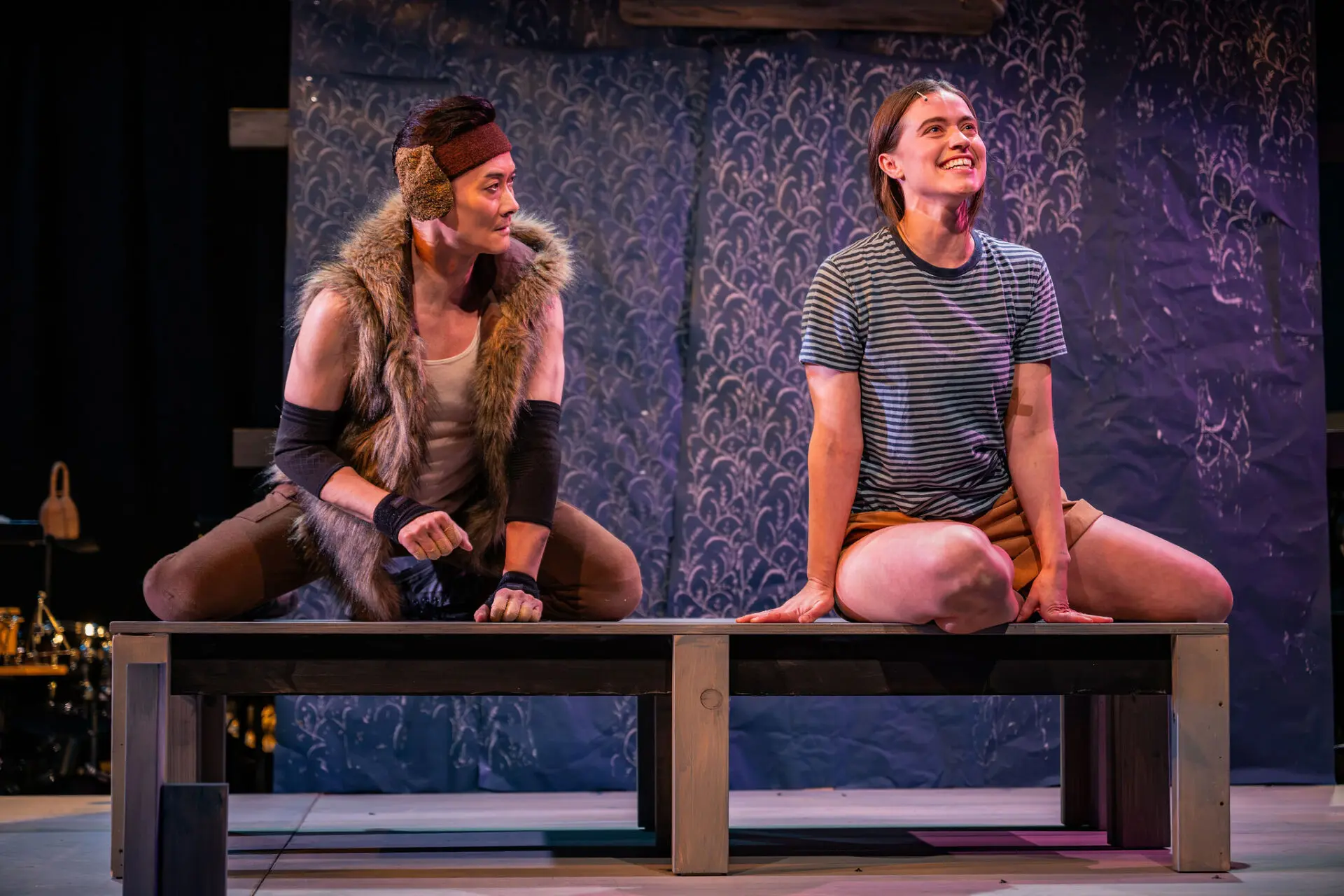
Based on a short story by Judy Budnitz, Dog Days presents an American family as wars have hit the continental US. Supply chains have failed, food is in short supply and neighbours are mysteriously vanishing, but this family – father, mother, two sons in their late teenage years and a 13-year-old daughter – has decided that the best way to survive the current crisis is to “wait it out” inside their home. The family is joined by Prince, a man in a dog costume who doesn’t speak (beyond barking) and won’t stand erect, who becomes a companion for the youngest child, Lisa. Lisa and Prince become the centre, and the heart, of the story while it raises questions about humanity and accountability in a world on the brink of destruction.
Little’s score, written for nine players including an electric guitarist and a pianist who doubles on synthesizer, seems to infuse both rock music and traditional operatic structures. It provides an effective soundscape for the piece, but there are also lyrical moments – particularly the grace sung by the family (which is quoted back mockingly in the second act) and some beautifully lyrical solos for Lisa – that show a great understanding of vocal writing. The libretto is economical but expressive, with words containing layers of impact. This is a true piece of music drama, where the music and text contribute equally to depiction of circumstance and character.
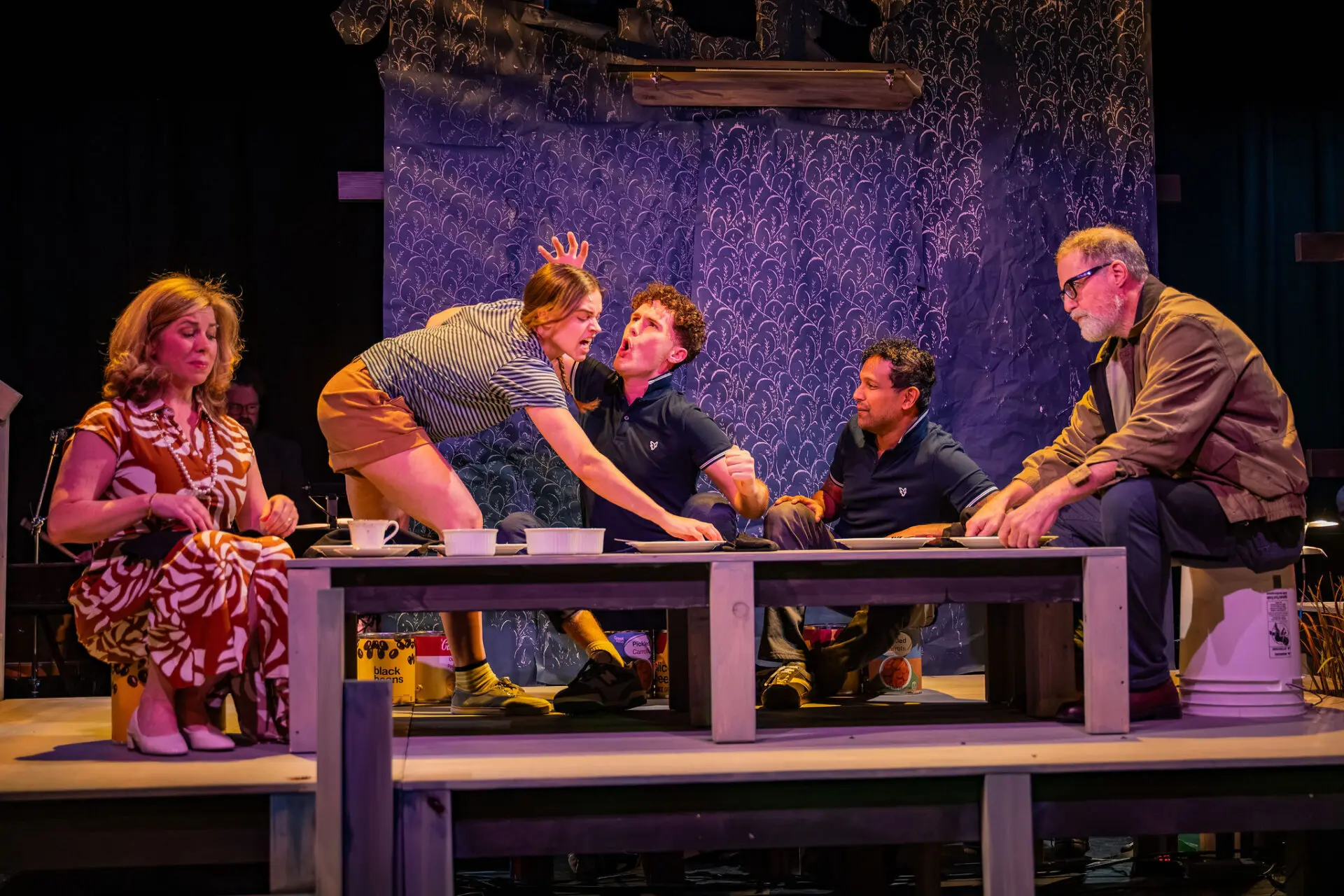
Photo Credit: Dahlia Katz
The family in crisis: from left to right Amelia Watkins, Elena Howard-Scott, Yanik Gosselin, Asitha Tennekoon and Keith Klassen
Mori has crafted a very strong, complete stage picture for the audience. The set, designed by Holly Meyer-Dymny, indicates different areas in the family’s house and yard in a way that both speaks to their decline and includes elements of humour. Some rooms have only skeletal beams in place of walls and windows, and some are only suggested – I particularly enjoyed the “toilet” constructed of boxes labelled as luxury goods like Prada and St. Laurent. More importantly, however, Mori’s process appears to have left time for the cast to create their own characters and worlds, so that they seem to fully inhabit this dystopian future.
Elena Howard-Scott, whose credits include both opera and musical theatre, was wonderful. She played a 13-year-old child without recourse to stereotype, and her discovery of her maturing body was honest and heartfelt. She also sang the score very well, with great sense of phrase and a “younger” sound that was consistent throughout her range. Dancer/actor William Yong was assigned the difficult and pivotal role of Prince. He had a superb command of the canine physicality required for the role, and his reaction to the touch of another cast member was very moving. Mori interpolated an uplifting dance moment into the opera’s epilogue, and Yong was at his best here – spellbinding in intensity and with every gesture assigned intention and emotion.
The remaining cast members were also superb. As parents dealing very differently with an uncontrollable situation, Keith Klassen and Amelia Watkins grounded the piece in recognizable emotions. Watkins sang particularly well, with great legato and evenness of tone. As the older sons, Asitha Tennekoon and Yanik Gosselin gave good physical performances, whether imagining their possible conquests over women when re-population would be a priority or slipping into the lethargy of marijuana. In only one scene as an unnamed Soldier, Alex Hetherington was in turns captivating and threatening.
There were a couple of technical issues. Performers appeared to be wearing microphones, but sound design was subtle with the exception of the amplification of Klassen in the first act. It got better after intermission, but it initially felt like all of his sound was coming through speakers and none from the singer himself, which shouldn’t happen in a space the size of the Nancy and Ed Jackman Performance Centre. It’s possible that much of the role sat too low for Klassen; it was sung by a baritone in the premiere production. The surtitles were also very difficult to read: small, poorly focused and obstructed for some audience members. Thankfully, however, all of the singers had exemplary diction, so the surtitles weren’t really necessary.
Dog Days is more than early work by a now-important writer – it’s a compelling opera on its own merits. It’s dark, both in subject matter and in the honesty with which the ideas are addressed, but it’s an evening of theatre that will likely remain with viewers for a very long time, and it shouldn’t be missed.
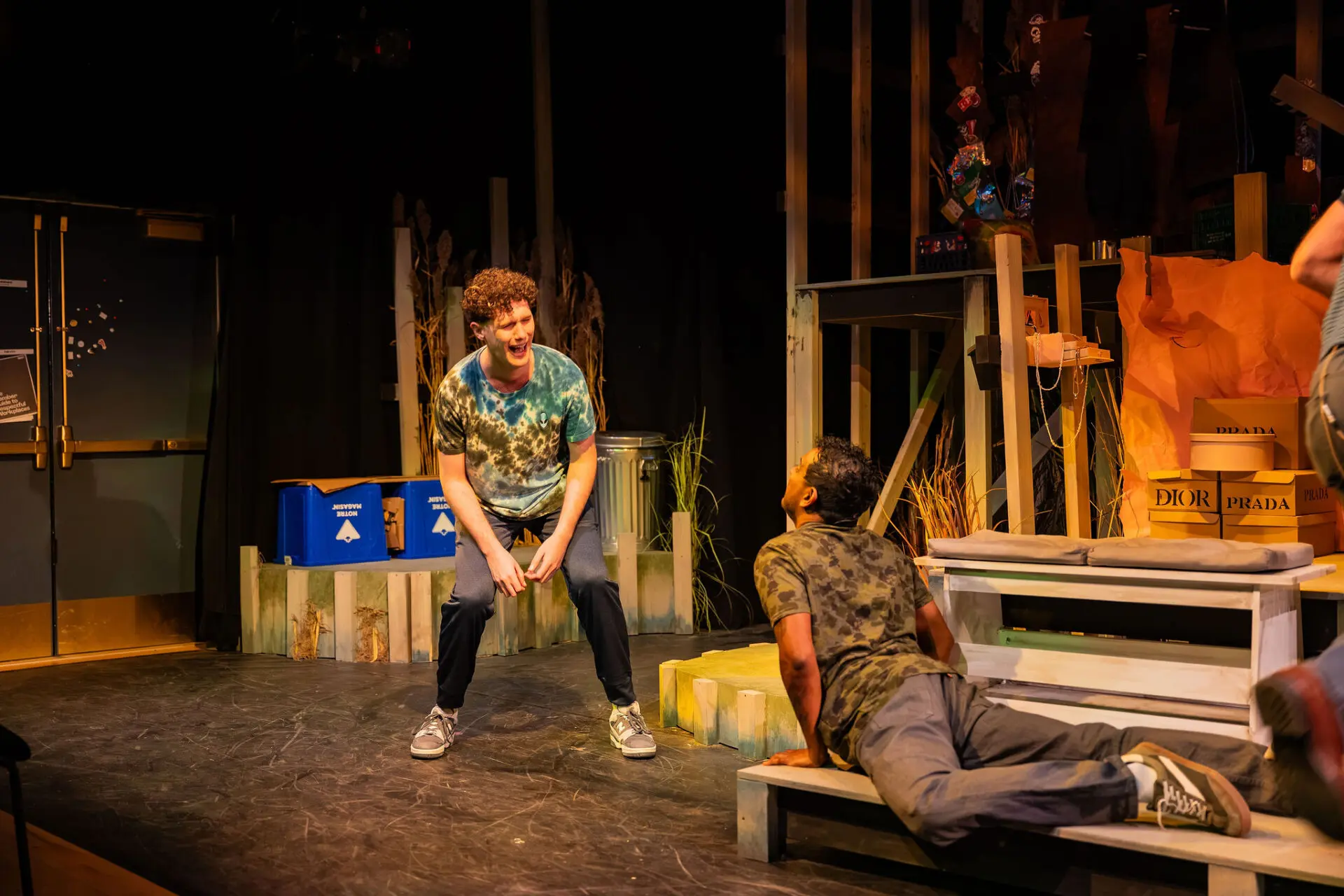
Photo Credit: Dahlia Katz
Yanik Gosselin and Asitha Tennekoon gave strong physical performances as the older children
Opera Canada depends on the generous contributions of its supporters to bring readers outstanding, in-depth coverage of opera in Canada and beyond. Please consider subscribing or donating today.