The sky broke on opening night of Vancouver Opera's Tosca and delivered a reprieve from serious drought. A sold-out audience appeared anxious to forget the vagaries of political fortune, hubris and cynicism being played out that election night. But if they pined for escape, the cast and crew of this stunning Tosca handed them a reminder to believe in the power and longevity of beauty, endurance, faith, sacrifice and, above all, collaboration.
The audience took one long collective breath and immediately engaged with Maestro Jacques Lacombe's impressive handling of the magnificent voice of the orchestra from its iconic opening chords. What followed was clarity of textures and timbres, dramatic chord structures, ostinatos, pedal notes, bells, diegetic passages (Tosca is an opera diva after all) and even the silences within Puccini's score. Lacombe gives the orchestra, soloists and choruses the space to catch breath in this opera, sometimes known as “the Mount Everest of song.”
From the warm register of bass-baritone Neil Craighead’s opening bid as the doomed politico-then-suicide, Cesare Angelotti, to soprano Joyce El-Khoury’s glorious “O Scarpia, avanti a Dio!” as she leaps to her death, the audience travels the Alpha to Omega of vocal ranges. Puccini’s score sublime, the singers entranced the audience with the infusion of the natural world embedded in Luigi Illica and Giuseppe Giacosa's libretto, which shapes and drives the action. The marriage between word and music in this production is gorgeous – with kudos to the secondary players, strong presence and performances were given by all.
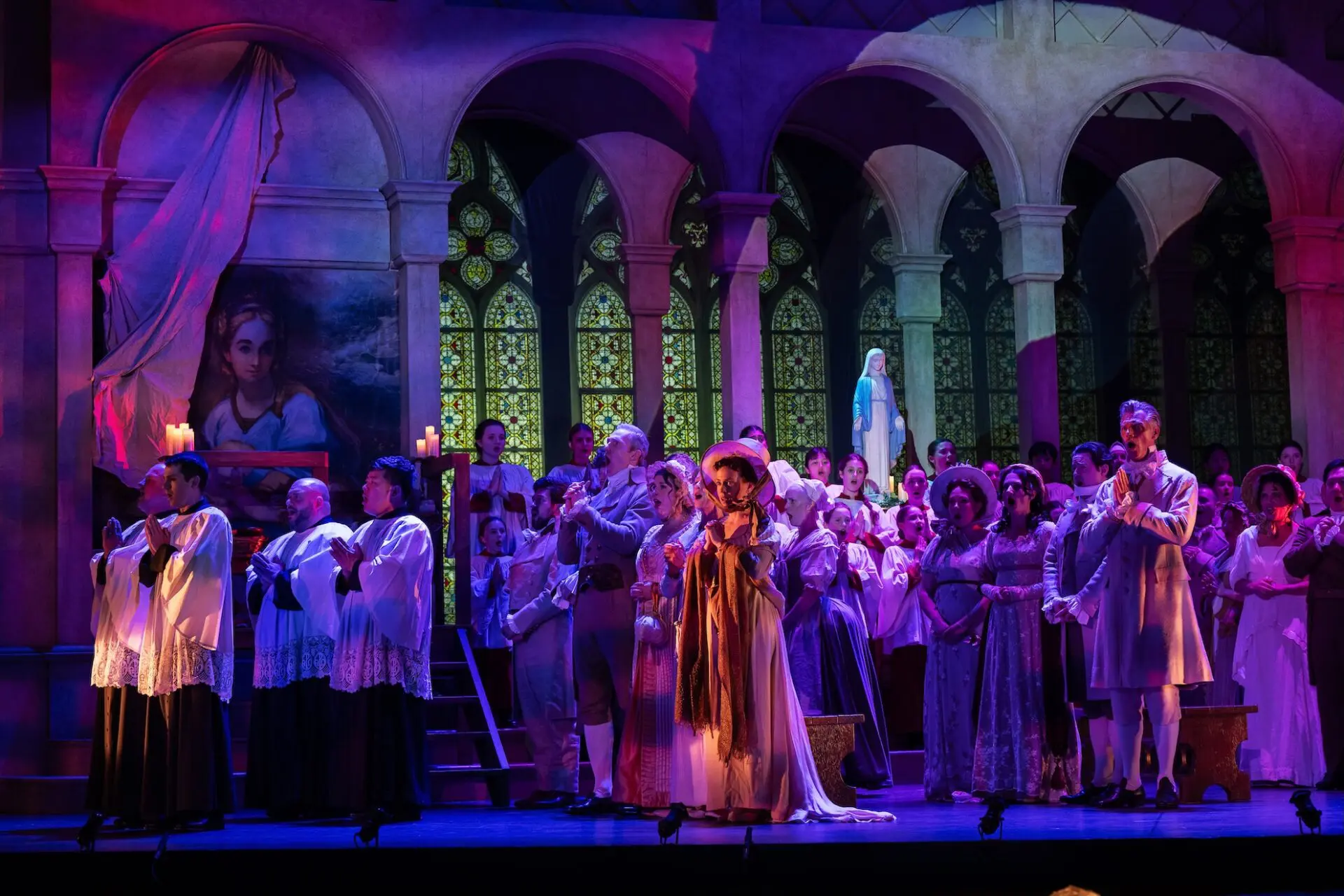
It was thoughtfully directed by Brenna Corner. The stage business works well, especially the larger ensemble pieces – the “Te Deum” with Tina Chang's adult and children's chorus is gorgeous, bathed in Michael Walton's rich lighting design. Silhouettes projected over the ensemble and a diaphanous stained-glass screen are compelling; at intermission, period-costumed silhouettes stroll across the stage creating a continuity of mood. Scott Reid's period piece set design is exquisite yet never distracts from the main action.
Sweeping the audience at Intermission, eager to pick up the “vibe,” reviews were ecstatic. “This is how opera should be done!” exclaimed a gentleman with a European accent. “Beautiful, just beautiful,” a local shouted across the bar crowd. Indeed, the “Te Deum” was the scene in which the entire production ensemble soared, and with it, the emotional temperature in the theatre.
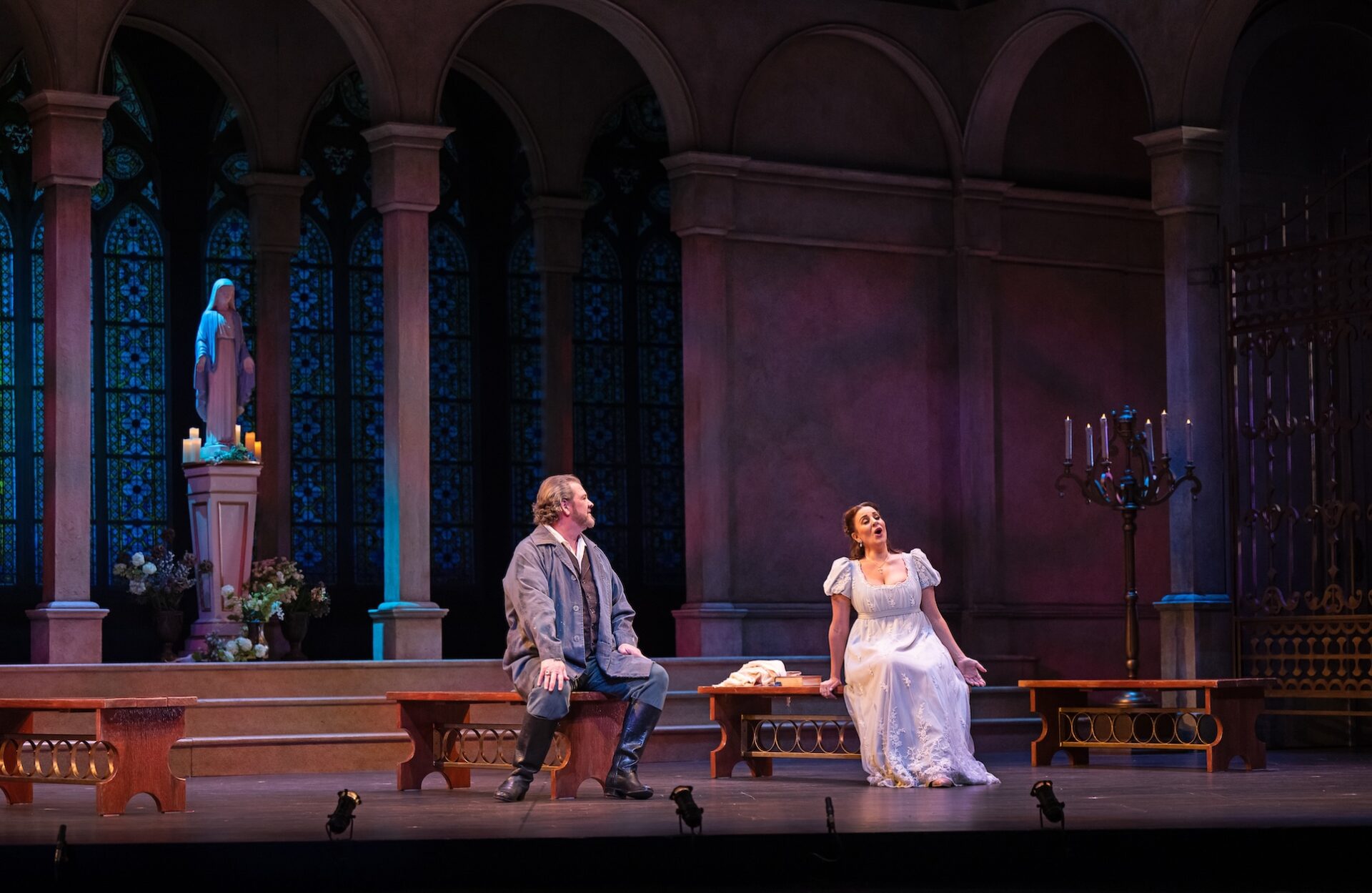
Photo Credit: Emily Cooper
Joyce El-Khoury and David Pomeroy as Tosca and Cavaradossi in Vancouver
Soprano El-Khoury as Tosca carries the weight of women of all time who face political upheavals that invade the personal. Tosca, originally a vehicle for Sarah Bernhardt by playwright Victorien Sardou, is fundamentally a woman’s opera. El-Khoury's Tosca is powerful. Hers is a controlled instrument, exacting, warm and admirable – she is a magnificent diva to audiences of anywhere, any time in Tosca's 126-year history. Yet her Tosca remains relevant to our age through the intelligence of El-Khory's interpretation. The audience watches and hears her Tosca transform from jealous lover yet pious woman, in a soft Madonna blue dress, to confidant diva in magnificent scarlet and gems ready to fight, and finally into one profoundly changed by the loss of spiritual innocence in the second act as she commits murder. By the final act, ready to flee with her lover and ultimately leaping to her death, she reminds us that even the most successful women cannot skirt oppression. An inspiration, El-Khory's Tosca demonstrates faith.
David Pomeroy as Mario Cavardossi is exquisite in the first act, alongside the Sacristan fabulously portrayed by Peter Monaghan, Craighead's Angelotti, and then, spectacularly, with Tosca. Pomeroy comes into his own by the final act, notably, in his “E lucevan le stelle.” This standard of the tenor canon requires steadfast, athletic mastery of breath, a sure heart, beautiful tone and emotional intellect. Pomeroy gives the audience all of these, duly rewarded as his “E non ho amato mai tanto la vita!” provoked loud cheers and audible tears from the audience.
Anyone familiar with Tosca knows what happens in the second act, yet the fantastic Gregory Dahl brought new and complex characterizations to an age-old villain as the predator Scarpia. Dahl’s body language and splendid voice portray the manipulative, oddly compelling yet ultimately heinous character in a manner that was completely void of cliché. His second act scene, with El-Khoury's splendid “Vissi d'arte” building to the climactic stabbing of Scarpia as she sings “Questo è il bacio di Tosca!” is worth the price of admission. A note on the contributions from fight and intimacy director Geoff Malcolm: El-Khoury and Dahl’s interplay easily could have been overdone, yet Scarpia’s attempted sexual assault was pitched correctly in its violence and intent.
Initially ambivalent of the aesthetic choice to make this Tosca a period piece with period costume and set, I see wisdom in not fixing it to the present. I appreciate an artistic decision that allows audiences to draw their own connections to broader themes and haunting continuity of political oppression and cruelty witnessed; this was nowhere more obvious than in the grotesque relevancy of the firing squad of the final act.
As always, I asked my “everyman,” Jeff, what he thought of his first Tosca. “I loved it all,” he responded. As we walked out into the rainy night and a vastly changed political landscape, we had hope, given to us by the endurance of Tosca – the character and the artform – and the heart of all the artists who gave her to us. Bravo tutti!
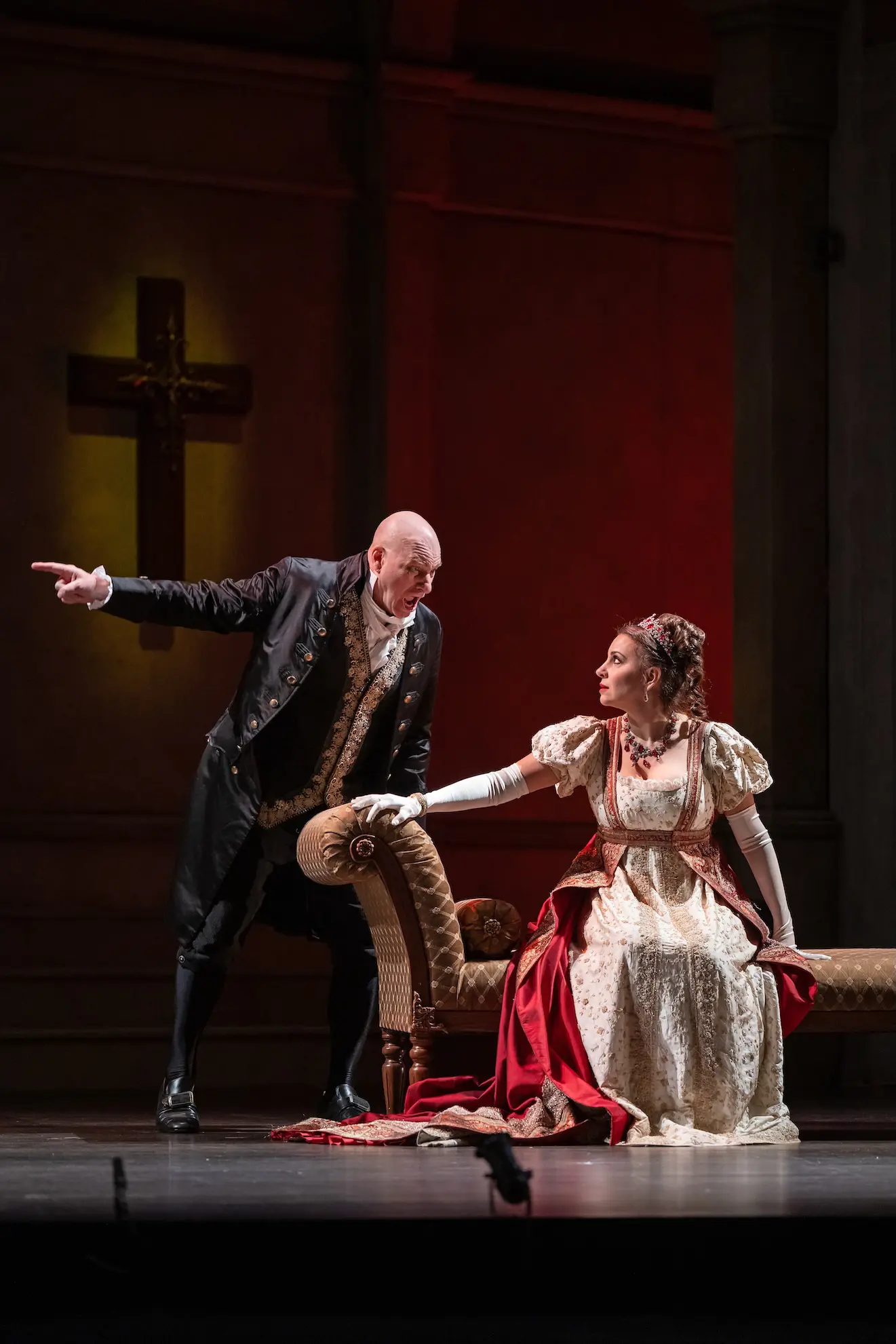
Photo Credit: Emily Cooper
Scarpia (Gregory Dahl) threatens Tosca (Joyce El-Khoury) at Vancouver Opera
Opera Canada depends on the generous contributions of its supporters to bring readers outstanding, in-depth coverage of opera in Canada and beyond. Please consider subscribing or donating today.