Canadians have enjoyed a long and fruitful history as residents in San Francisco’s Merola program for young singers, which offers free summer training in every aspect of opera performance as well as five years of career support. Some these singers move on to the Adler Fellowship for more advanced young artists, including such Canadians as Philippe Sly and Olivia Smith, who appears on the mainstage this season.
The Merola Summer Festival includes one fully staged opera as well as concerts and recitals to show off the singers. This year’s treat was the rarely performed Le comte Ory, an important later comedy by Gioachino Rossini. Composed in 1828 for the grand house of the Opéra national de Paris, this is an ambitious score loaded with big concerted numbers and noted for its witty, brass-heavy orchestration. It also demands a lucid sounding and physically agile chorus – here the work of other Merola summer fellows, including Canadian Alexa Frankian this year. The Opéra showed it 433 times in the 19th century.
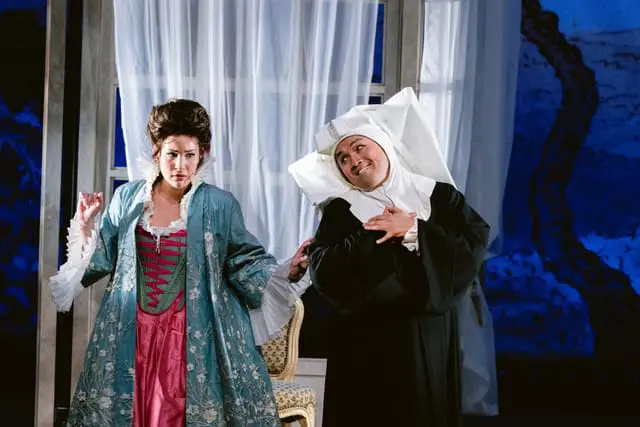
The story, also unusual, centres on a libertine Count, bent on seducing the glamorous Comtesse Adèle and every other woman in sight. He and his disguises as a hermit and as a nun are clumsy and absurd. She is magnificent. Each is surrounded by a bevy of retainers, and all by large chorus. It winds up with a glorious extended trio ringing changes in mistaken identity for the Comte, his aristocratic page Isolier and Adèle. The Comte is bounced, and the page marries Adèle.
The mobile action flowed among Liliana Piñeiro’s tall, see-through folding screens, sometimes veiled in gauze. Miriam Lewis’s handsome updating of the costumes to about Rossini’s time precisely tracked the ins-and-outs of the antics in a story built on visual subterfuge.
The intricate plot of Le comte Ory demands precision stage direction that both moves everyone through often puzzling, even chaotic, doings while clarifying who is who – in what disguise – and what they are up to. Director Garnett Bruce managed to sort it all out, whether in crowded or intimate scenes. The multiple-identity confusions lead to a climactic trio that floated enticingly and included some accidental implied male-on-male romance.
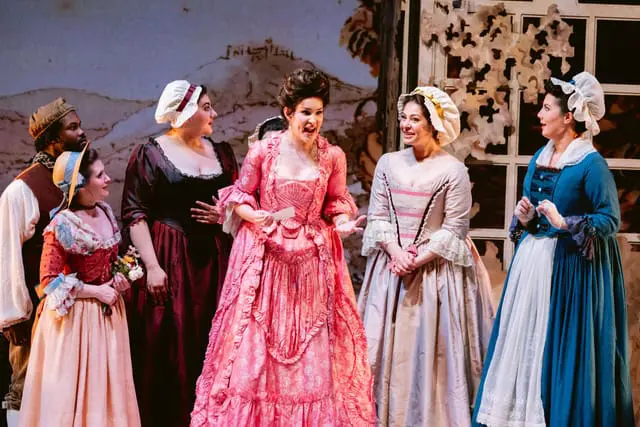
Photo Credit: Kristen Loken
The women of Le comte Ory with Eva Rae Martinez centre and Canadian Ariana Maubach on the right
Eva Rae Martinez flashed vocally as Adèle and glowed with movie star glamour in Lewis’s ravishing gowns. Her tonally lovely, evenly scaled voice commanded Rossini’s treacherous arias and rose above even the large extended episodes that made the composer famous. The audience granted Martinez the day’s only continuing ovations, both in Act One and at the end.
Adèle’s confidant Ragonde anchors many numbers, including Act One’s prominent ensemble “Je viens à vous!” and its enormous, all but never-ending finale. We all love what I call Rossini’s “running music” and crave its varied repetitions! Canadian Ariana Maubach’s opulent mezzo-soprano attractively embraced Ragonde, while her fine acting and vocal agility lent an indispensable presence. She and Martinez glistened in a sumptuous second act duet that recalls the sensuous letter writing scene in The Marriage of Figaro. Maubach may be stepping into a notable career.
Meg Brilleslyper, an elegant mezzo in the trouser role of the page Isolier, played her odd part with presence and clarity. Her bright tone and flexible technique contrasted nicely with the sound of the other female leads. Her final romantic triumph could seem to imply a shadow variant of Mozart’s Figaro, in which Cherubino might pair up with the Countess.
The all but omnipresent Comte dominates this opera with numerous, virtuoso arias and marked presence in ensembles. His disguises and ludicrous exercises demand the comic timing of a Charlie Chaplin. Minghao Liu hit every note with fluent energy (high Cs included). His stiff and extreme gestures seemed, indeed, almost out of silent film. Although Liu’s voice shows great promise, its tonal character can be tight and edgy. He should shine with further coaching and experience.
Benjamin Dickerson used his attractive baritone and witty facial mobility to create a commanding presence as Raimbaud, the Comte’s ever-present major domo. Rossini is famous for rollicking coloratura bass roles that light up the stage with specialized vocal fireworks. He scripted the Comte’s tutor, called the Gouverneur, as such part. Although Wanchun Liang deserved credit as he worked to fit his relatively light bass-baritone to the score’s demands low down the scale, in my view he suffered from miscasting.
The French conductor Pierre Vallet, leading this outstanding performance with propulsive energy, was handsomely served by orchestral players, most of whom may never before have seen this virtuosic score.
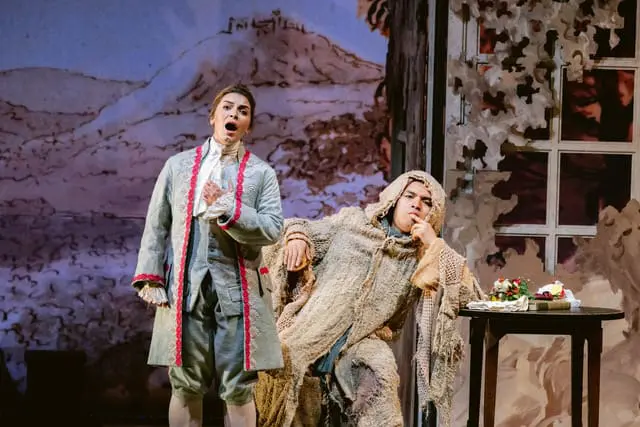
Photo Credit: Kristen Loken
Isolier (Meg Brilleslyper), the Comte’s page, seen here with the Comte (Minghao Liu), this time in disguise as a hermit
Opera Canada depends on the generous contributions of its supporters to bring readers outstanding, in-depth coverage of opera in Canada and beyond. Please consider subscribing or donating today.