Engelbert Humperdinck’s Hansel and Gretel is a well-known opera, but it has been many years since it was mounted by Calgary Opera. Its appearance as the second of three mainstage productions this season was welcome, and the production was given an extra twist by the prominent presence of the Old Trout Puppet Workshop.
This was, in essence, a re-mounting of a production first seen at Vancouver Opera about ten years ago for which the sets, costumes and puppets were originally designed. Over the years, the production has been seen in various American cities; it is currently in the possession of Kentucky Opera. As with the original Vancouver production, the stage director was Brenna Corner, currently artistic director of Pacific Opera Victoria. An experienced stage director, Corner has directed the production across North America. But for Calgary Opera, it has come home, since the puppet company hails from Southern Alberta.
Corner’s vision of the opera is based significantly around the presence of the puppets and what puppetry can do. Instead of the Ruth and Thomas Martin translation, Corner has also provided her own translation, a free one that is verbally more playful, more literary its artifice of language. The new translation has the effect of distancing the viewer from the children’s world depicted by the stage action. This “distancing” is in keeping with Corner’s idea of combining a foreground presentation of the opera in a child’s world and a viewing of this world through adult eyes. In its way, it is like the Auden translation of Mozart’s The Magic Flute.
The darker, Jungian side of the story, as described in her note, is not very much in evidence and is confined to the forest and nocturnal scenes. Even the stepmother, who is sometimes taken to be less than kind to the two children, is presented with sympathy as a woman at the end of her tether. This makes the nature of Peter’s engagement with her in the first act more convincing. I prefer Corner’s view of this role as it is more congruent with the tone and style of the opera overall; it also makes the scene of rejoicing at the end more convincing.
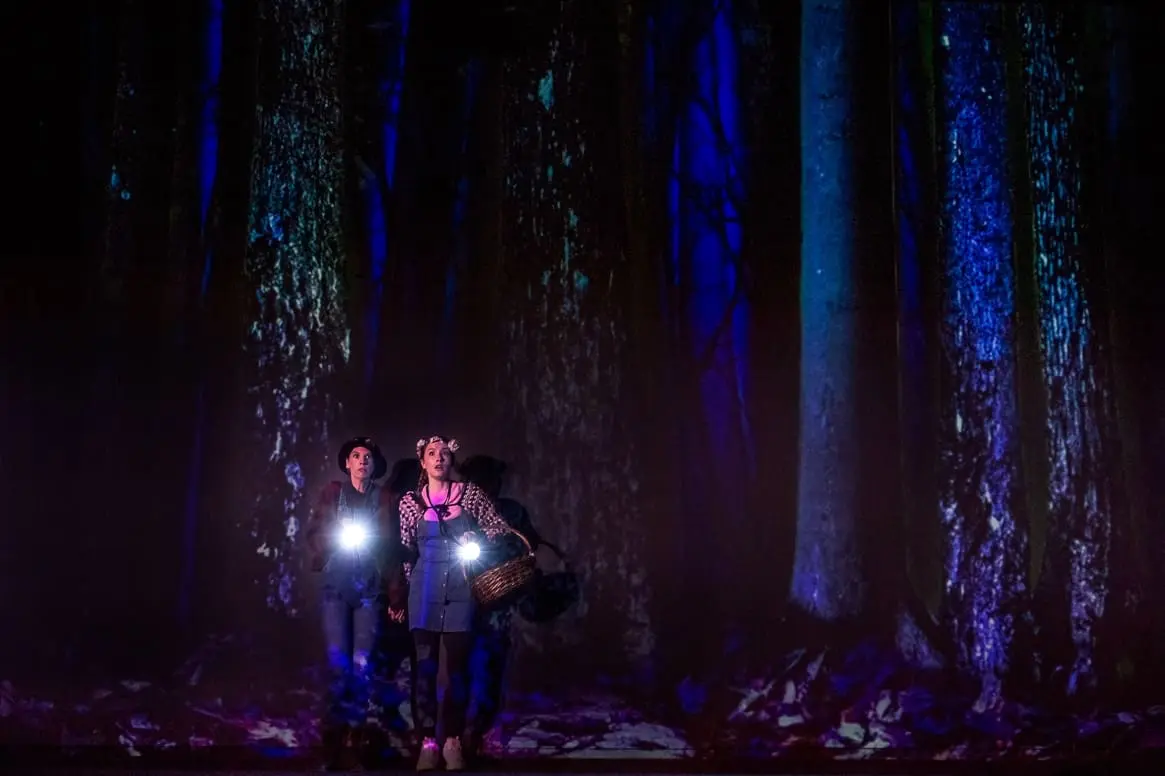
One could not fail to be entranced by the puppets, most especially the will-o’-the wisps and the various forest creatures. Darker tones and comedy intermingle in a wonderful fantasy. Of course, this leads to the famous prayer duet and the following dream ballet sequence, always the highlight of the opera, as indeed it was here.
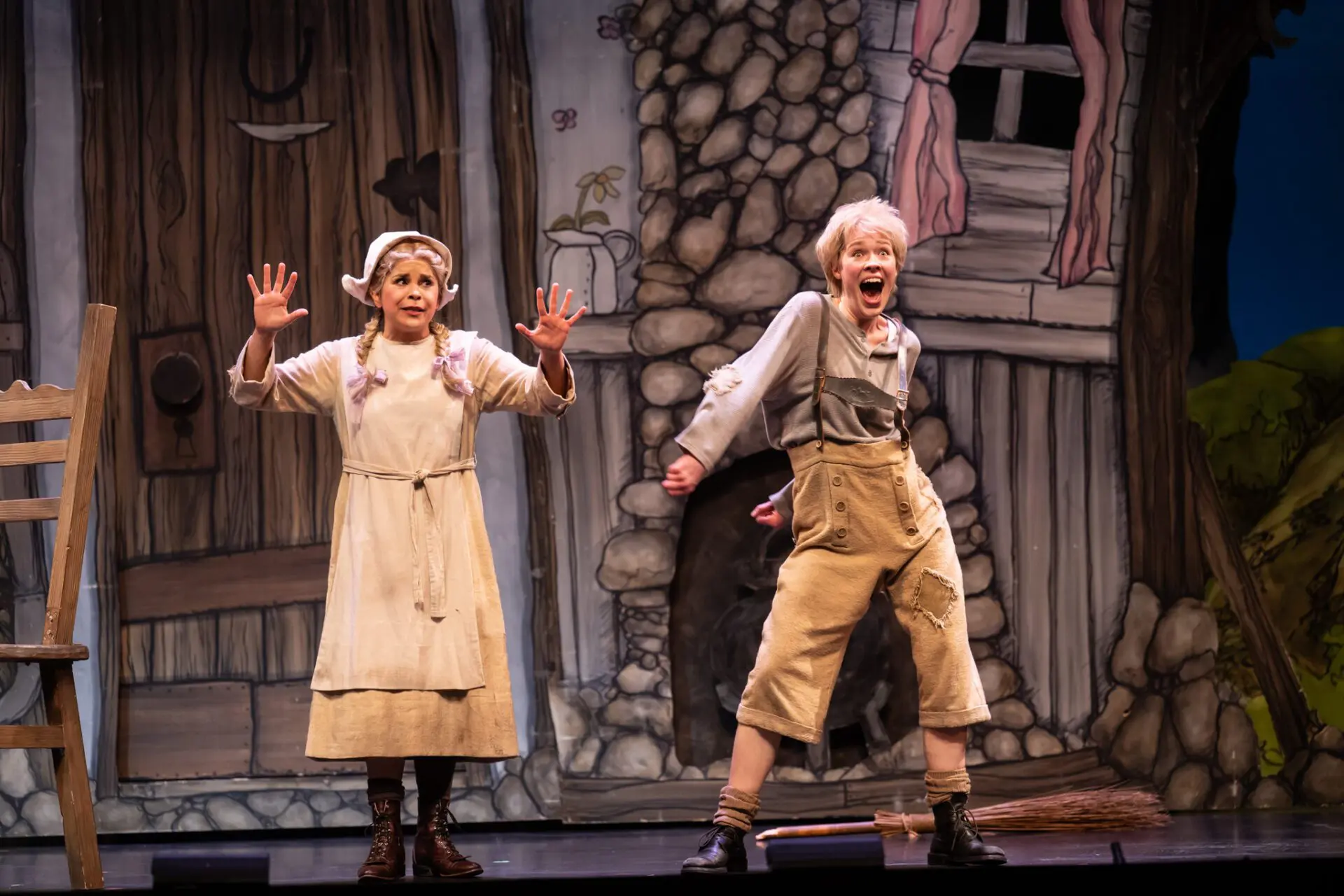
Photo Credit: Benjamin Laird
Simone Osborne and Xenia Puskarz Thomas as the titular children in Hansel and Gretel
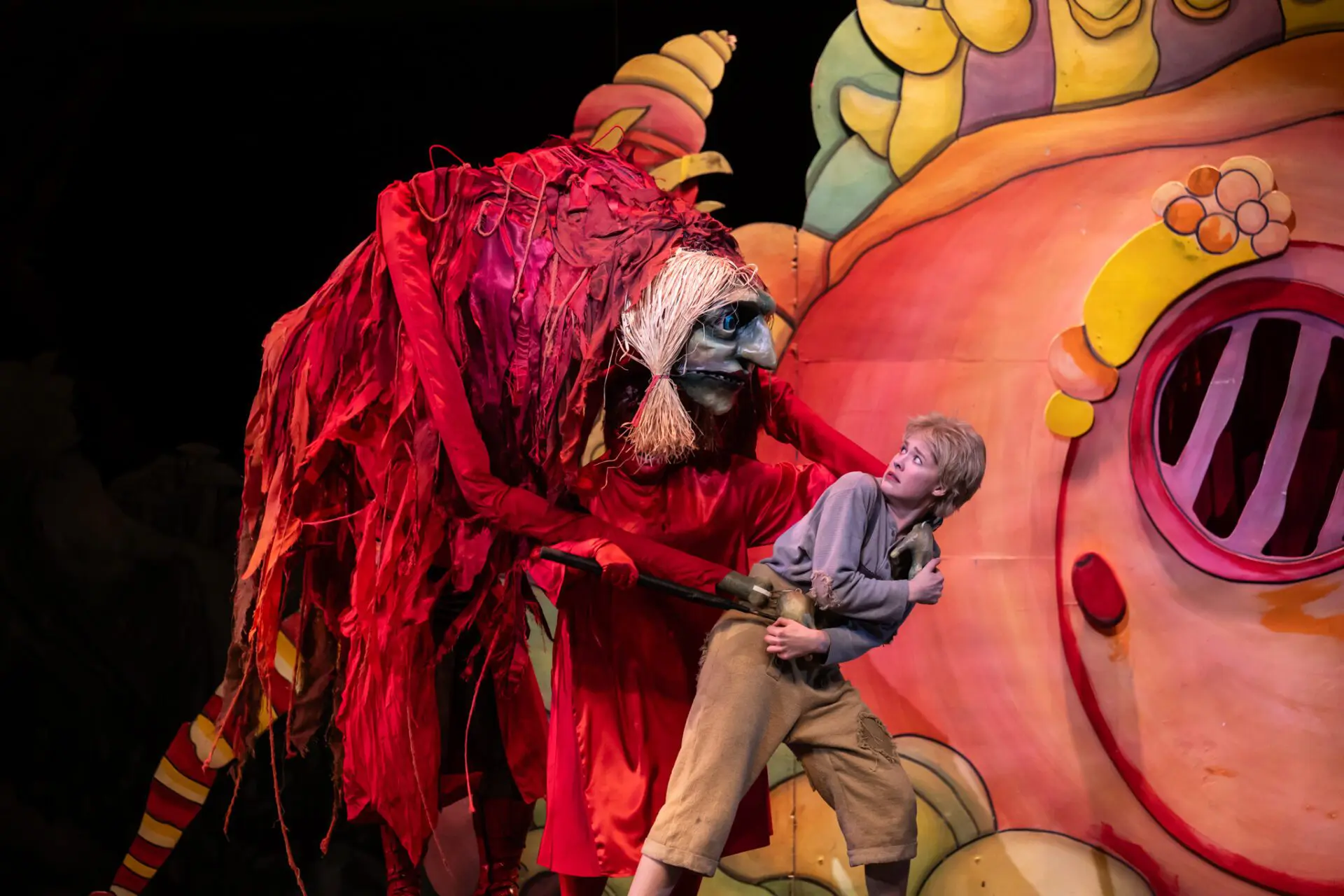
There is always the matter of the witch who, as with the other puppet characters, is pictured as a Sendak-style puppet. Of course, with a terrestrial-bound puppet, there cannot be a pictorial representation of the witch’s ride on a broomstick. This aside, all the witch’s business was remarkably well handled.
As is often remarked, the musical score, despite its saturation in faux German folksongs, is really an example of Wagner-lite, most especially in the overture and in the prayer duet with the subsequent dream. Conductor Jonathan Brandani had the full measure of the music here, the dream ballet music rising to a cathartic climax that could bring a tear to any adult eye. Throughout the opera, the Calgary Philharmonic Orchestra played expressively and with authority, but never covering the voices. Overall, the music and singing, recitative or aria, were well integrated into the dramatic action and hardly noticeable: the art that conceals art.
As operas go, the vocal music is not so very difficult to sing. The two leads were sung, and sung with aplomb, by Xenia Puskarz Thomas as Hansel and Simone Osborne as Gretel. Thomas’s voice is both strong and warm, and she always sang expressively and in tune. Osborne has the high-lying type of voice for this very girlish role, one that included some impressive high Ds. She managed the singing the acting very well and convincingly, including her set piece in the second act where she wakes up from her sleep. The stepmother and witch were sung by Claire Barnett-Jones with Peter Barrett as the father, both of whom were well cast for their vocal qualities and presence on stage.
The Sandman and Dew Fairy get some of the most attractive vocal music in the opera. Both roles were taken by members of Calgary Opera’s McPhee Artist Development Program, Maria Milenic and Katelyn Bird. Clearly enjoying themselves, they tucked into their great tunes with commitment, making their time on stage more memorable than the length of time they are actually onstage. The Cantaré Children’s Choir, conducted by Catherine Glaser-Climie, contributed some well-sung choral parts, especially in the final act. They also participated in the action, which is not always easy for young people.
The question always remains as to whether this is an opera for children, or an opera about children for adults – adults who must find their inner child to be able to revisit emotional spaces long in the past, but which are part of the larger tapestry of the human psyche. This production, sitting on the borderland between these two ideas, was not only well done, it was enjoyable to watch and, for some, perhaps just a little thought-provoking.
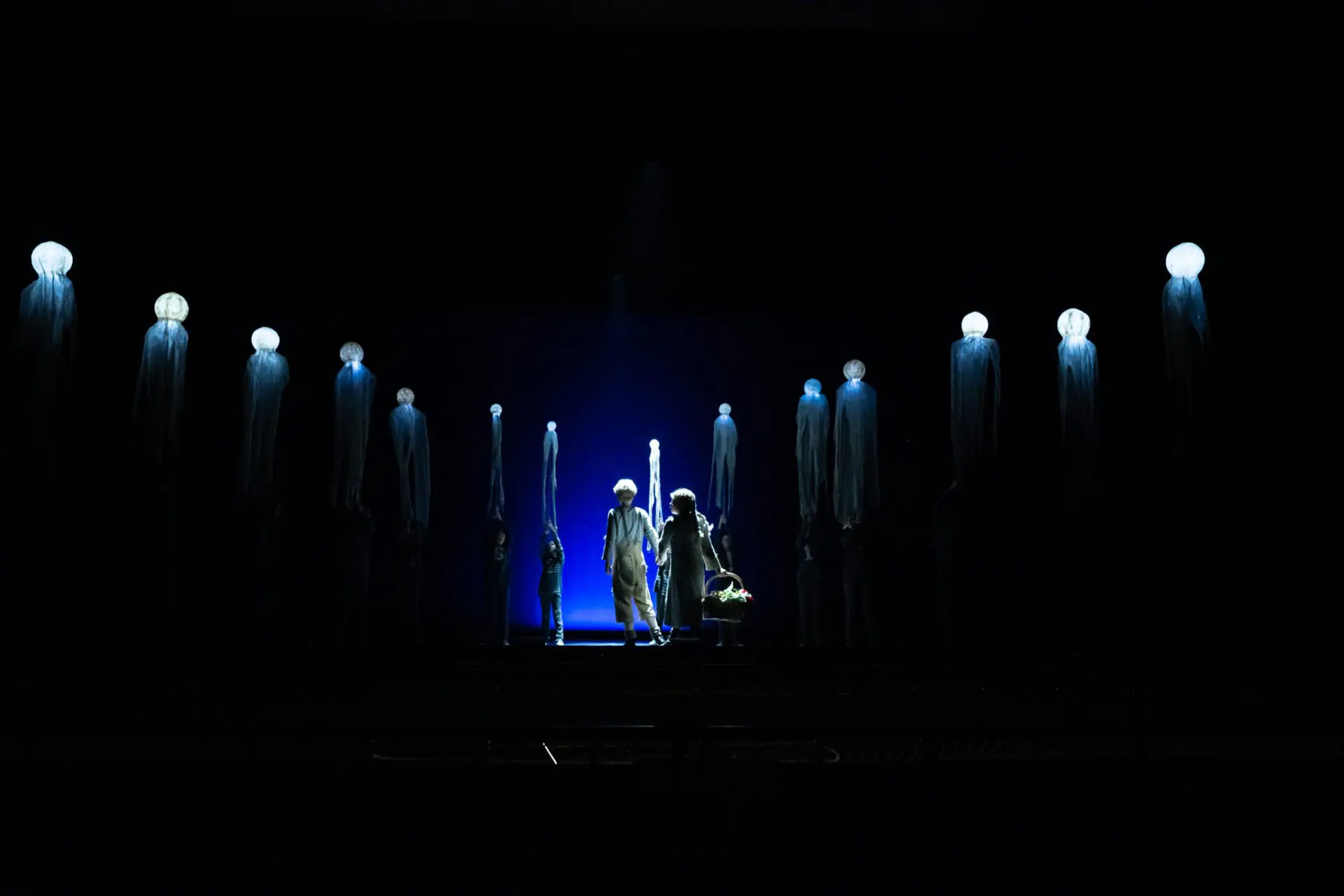
Photo Credit: Benjamin Laird
The 14 will-o’-the-wisp angels watch over Hansel and Gretel in the nighttime forest
Opera Canada depends on the generous contributions of its supporters to bring readers outstanding, in-depth coverage of opera in Canada and beyond. Please consider subscribing or donating today.