On February 7th, a sold-out audience at the Ancaster Memorial Arts Centre braved the arctic chill to see a unique production of Mozart’s Don Giovanni.
This co-production, by the Centre for Opera Studies & Appreciation and the Hamilton Philharmonic Orchestra, was a 90-minute version of Mozart’s two-and-a-half-hour marathon. Mozart himself adapted his operas to fit specific sized venues or occasions, so I have no doubt that the wunderkind himself would have approved of the Don being sucked down to hell in an hour and a half. Arias were cut, choruses were deleted and recitatives were shortened, resulting in a bite-sized, approachable masterpiece which could be appreciated by opera aficionados and newbies alike.
Maestro James S. Kahane led the 11-piece HPO ensemble. Despite a rocky five-bar start in the overture and a later pregnant pause while pages were heard flipping, the musicians showed that they were in shape and ready for the demanding score. It was refreshing to hear individual instruments take the place of entire musical families, opening up the audience’s ears to the exquisite layering of Mozart’s music. The pressure was on with continuous solo work, but under Kahane’s sensitive direction, the pairing of voices and ensemble work was exquisite.
Alexander Hajek is a dynamic actor whose attention to detail made his title character completely believable; a flick of a finger, a sideways glance, a sniff of the air or an adjustment of his costume all added to his lascivious Don. His final journey to hell, complete with body twitches and agonizing cries, was chilling. Hajek’s beautiful “Deh vieni alla finestra” was tenderly phrased and formed a contrast with his full-voiced baritonal bravado throughout the rest of the opera.
The Don’s sidekick, Leporello, was delightfully portrayed by Giles Tomkins. Tomkins’ Catalogue Aria was a clever mix of joy and sarcasm, with well-executed rapid patter, complex phrasings and varying tempos. His knack for physical comedy was entertaining, and his bass-baritone was a rich addition to ensemble and solo work. Jeremy Scinocca was an empathetic Don Ottavio whose inner strength was evident in “Il mio tesoro.” Scinocca’s lyrical voice was in complete command of the long, demanding coloratura passages and delicate phrasings. The audience’s prolonged applause indicated they knew they had just heard four minutes of Mozartean mastery.
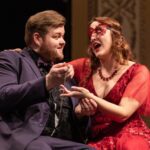
Sydney Baedke was an elegant and vibrantly voiced Donna Anna. Her “Or sai, chi l’onore,” with its ringing high notes, was a high point in the opera. Yet that same voice was also capable of tenderness when portraying the grieving daughter. Leanne Kaufman had the vocal pyrotechnics needed to portray the blustery Donna Elvira. Kaufman had great comic timing but also conveyed heartbreak, making her Elvira far more than a one-dimensional character. Kathryn Rose Johnston was a demure Zerlina. Her “Vedrai, carino” was delicately sung and embodied the sweetness of some of Mozart’s arias which appear simple yet require something that Johnston has in spades: incredible vocal control.
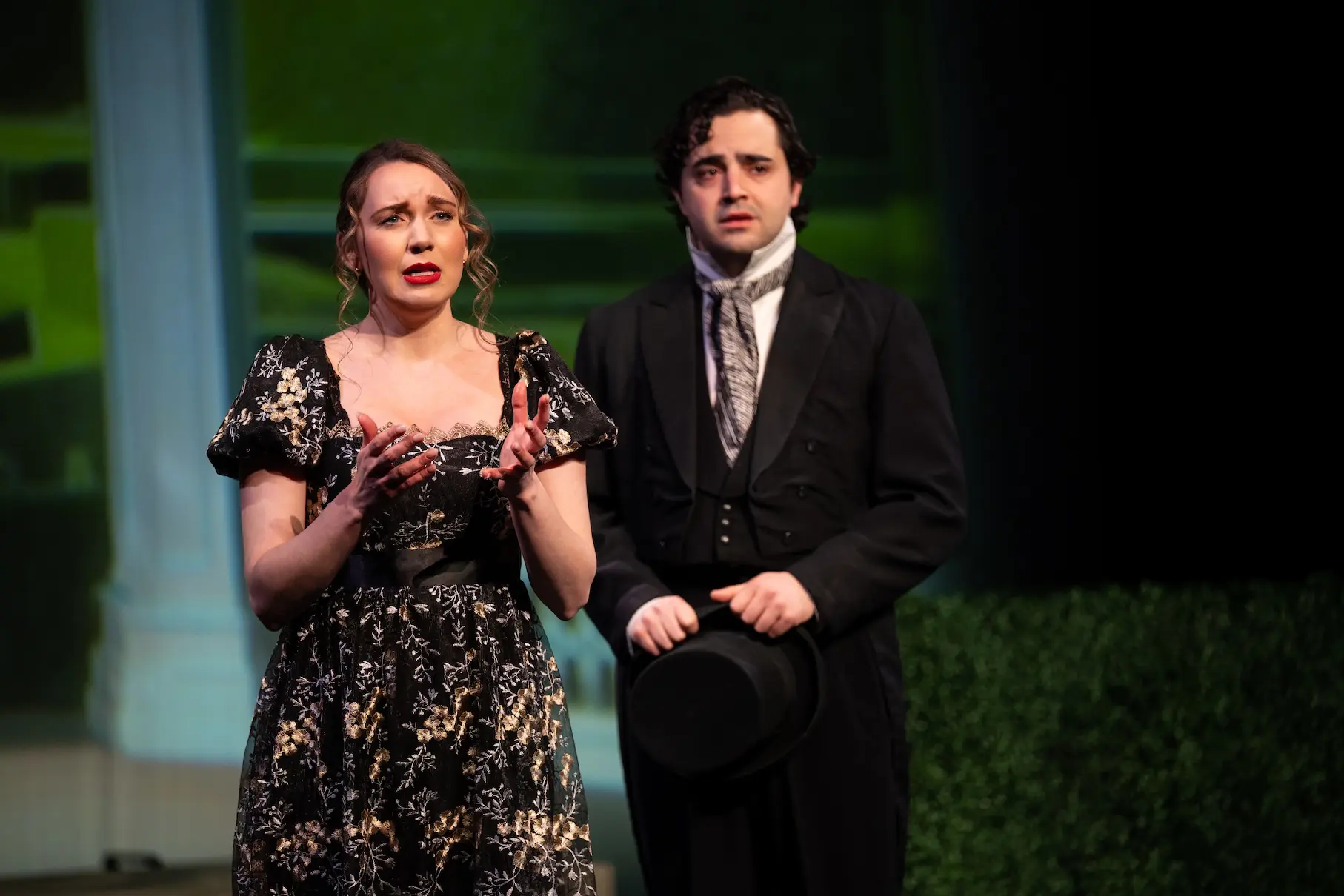
Photo Credit: Sam Moffatt
Sydney Baedke and Jeremy Scinocca as Donna Anna and Don Ottavio
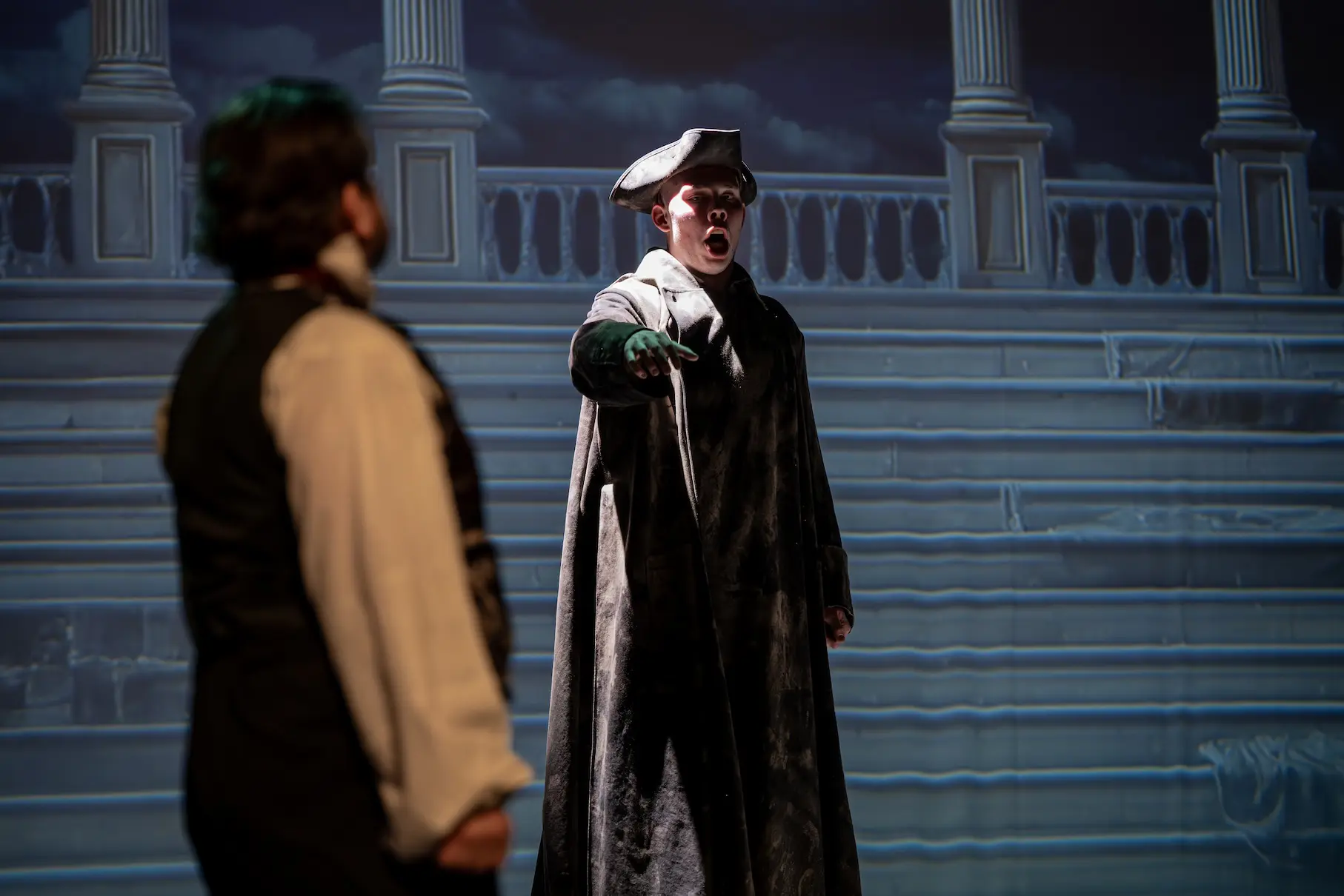
The big surprise of the evening was Owen Phillipson who played Zerlina’s unlucky lover, Masetto. It is hard to fathom that Phillipson is just finishing up his undergraduate degree at the University of Toronto. Charming and vulnerable as Masetto, he was forceful and chilling as the Commendatore. Everything from his posture to his resonant tone and focused projection made Phillipson a star in his own right… and a voice to watch in the future.
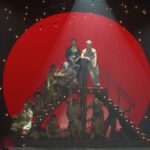
Part of what made Phillipson’s role as the Commendatore so compelling were the outstanding video and projection designs by Corwin Ferguson. The animation of the Commendatore in the graveyard was truly creepy, and the death scene was made even more lugubrious by Gabriel Cropley‘s sophisticated lighting design. Ferguson’s projections were integral to the entire opera, not simply photos slapped on the back wall to make up for a minimalistic set. Pathetic fallacy was evident with thunderstorms, clouds and stars, and his animated variations of buildings’ angles in scenes was fascinating.
Set in the Regency-period England, the costumes complemented the rich settings, and every outfit was in complete unity with this era. Kudos to wardrobe coordinator Carlyn Rahussar Routledge and hair artist Shirley Barrington.
Stage director Melissa Bencic was the astonishing woman who brought all the staging and music together in the Ancaster venue in just over four days. Her attention to detail and her enthusiasm for the project bubbled over into joyous interpretations by the artist themselves. The participation of Bencic’s Bravo Academy students as supernumeraries and dancers (thanks to Stephan Dickson’s brilliant choreography) was delightful, and the clever use of scrolls at the beginning of the opera and during the catalogue aria was inspired. Boncic’s 1813 setting was anything but jarring and complemented Mozart’s themes of status and class distinctions.
After its debut in Prague in 1787, librettist Da Ponte told Mozart that Emperor Joseph II thought that Don Giovanni was too difficult for the Viennese crowd to comprehend. Mozart’s reply? “Give them time to chew on it.” Rather than present the whole smorgasbord of an opera, COSA and the HPO gave the audience a sampling of how delectable Mozart can be. After this delicious entree, the audience is primed for another operatic feast.
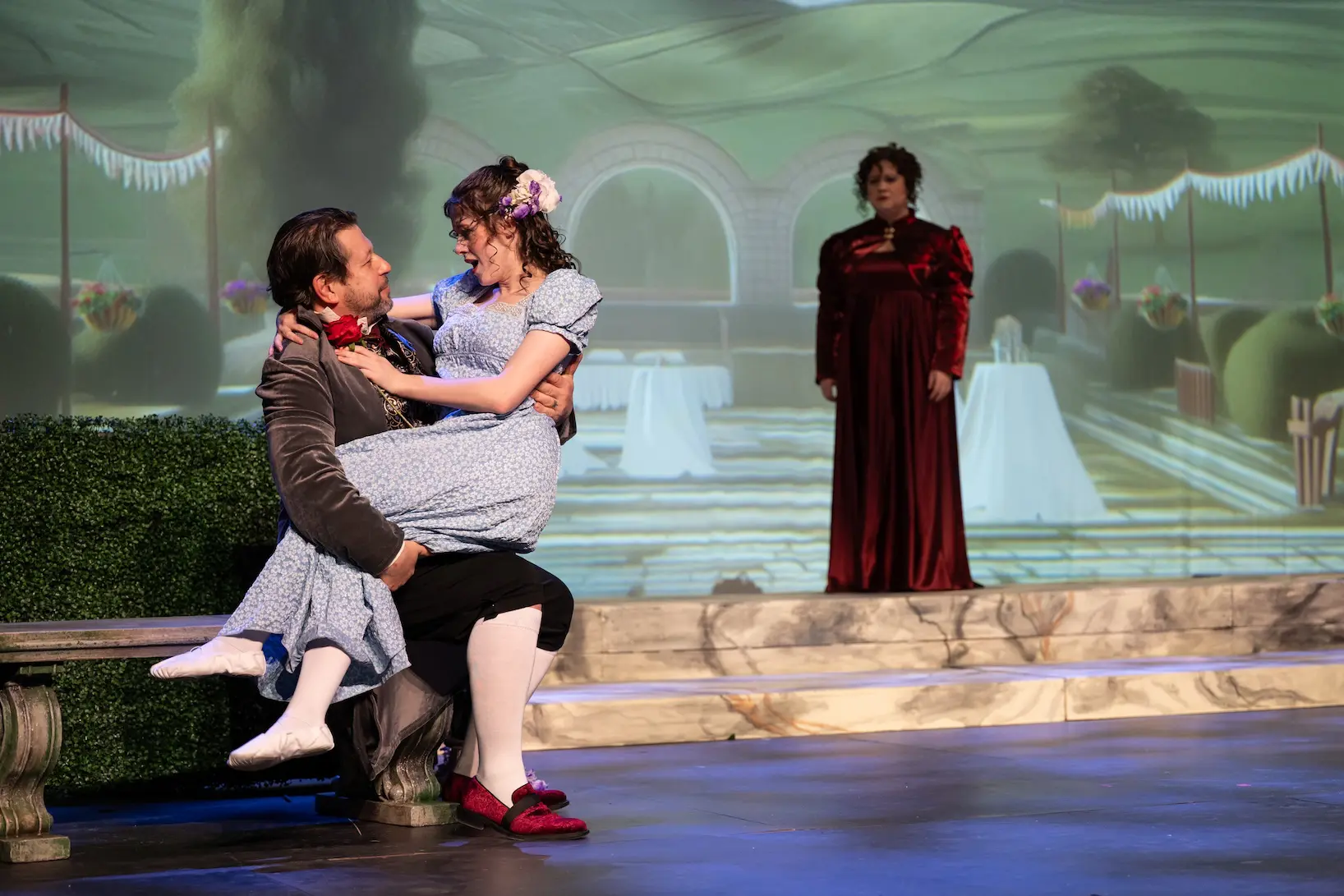
Photo Credit: Sam Moffatt
Don Giovanni (Alexander Hajek) seduces Zerlina (Kathryn Rose Johnston) while Donna Anna (Leanne Kaufman) watches
Opera Canada depends on the generous contributions of its supporters to bring readers outstanding, in-depth coverage of opera in Canada and beyond. Please consider subscribing or donating today.