Jean Cocteau’s film La Belle et la Bête (1946) remains near the top of classic cinema rankings. Its surrealistic imagery – touched often by fog and by smoke around the beast – uniquely projects mystery and alien desire, notably with actor Jean Marais’s heart-rending portrayal of the beast even through dense, if brilliant, makeup. Detached muscled arms hold candlesticks, caressing hands wait at the beast’s magical table, while a rose, his glove, a mirror, his golden key and a prancing white stallion serve at his potent command.
Why intervene in such a masterpiece? Might anyone replace Georges Auric’s opulent score with other music? If so, would Philip Glass at once come to mind?
But yes, Glass restored the film’s original black and white in 1994, with English subtitles, and scored it afresh with singers stepping in to replace dialogue. All synchronized and timed with immense technical precision. The film becomes an opera.
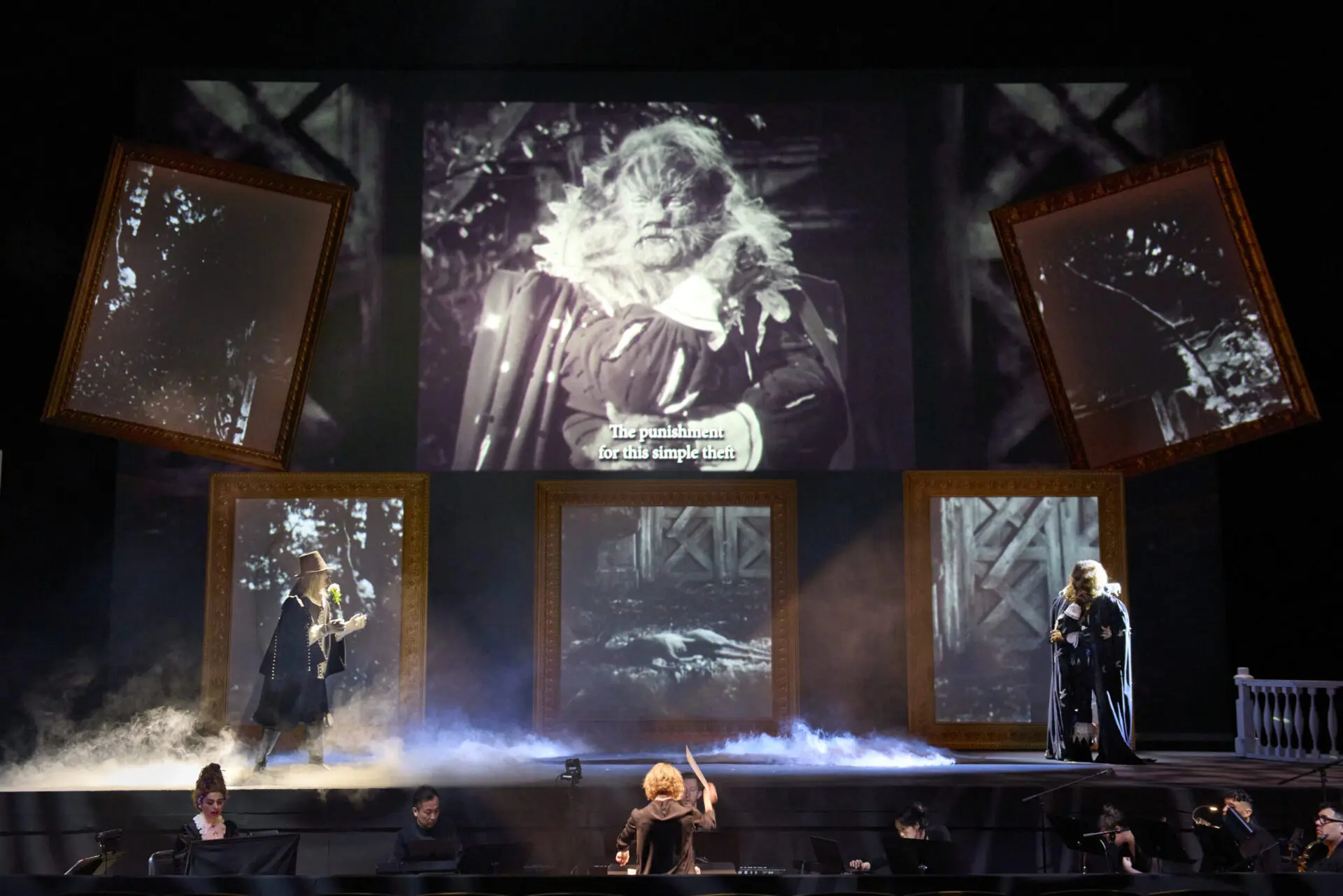
Canadian Nicole Paiement and her Opera Parallèle have revived Glass’s demanding fusion of cinema, orchestra and song, and also increased its complexity by surrounding a large screen showing the film (considerably modified) with picture frames projecting related imagery, including strange faces along with those of performers. And the richly costumed singers often appear on stage as well. This is a true multi-media hybrid of film, conventional live opera and adjunctive imagery. And so, adding to the intricate technique of the initial version by Glass, Paiement and her collaborators seamlessly have layered the faces of her live singers into episodes in the original film, most especially the final apotheosis in which La Bête becomes a prince and soars with La Belle to his opulent kingdom. In this production at Berkeley’s Cal Performances, we must engage with a new form of opera.
Paiement often has presented simplified versions of recent operas, usually with reduced orchestration and usually to powerful effect. Her La Belle et la Bête, in fact, is more layered visually than the Glass original, while keeping his chamber instrumentation: her three programmed keyboards may differ subtly from the Glass synthesizers, though his core of flutes and saxophones remains. These players must be named, for they rest at the emotional core of the work: Jessie Nucho, David Cortez and Michael Hernandez. All instruments and singers amplified.
The powerful score leads us, even propels us, with an impulsive momentum – an energy superbly captured by Paiement. The churning ostinato familiar from much of Glass’s music underlies this drive, yet melodic obbligato lines float free in a manner reminiscent of traditional film scores. The saxophones, for instance, are associated with intensely felt moments, especially those of La Bête. Feelings of inevitability envelop us. This is music of genius, brought to compelling life in Opera Parallèle’s staging.
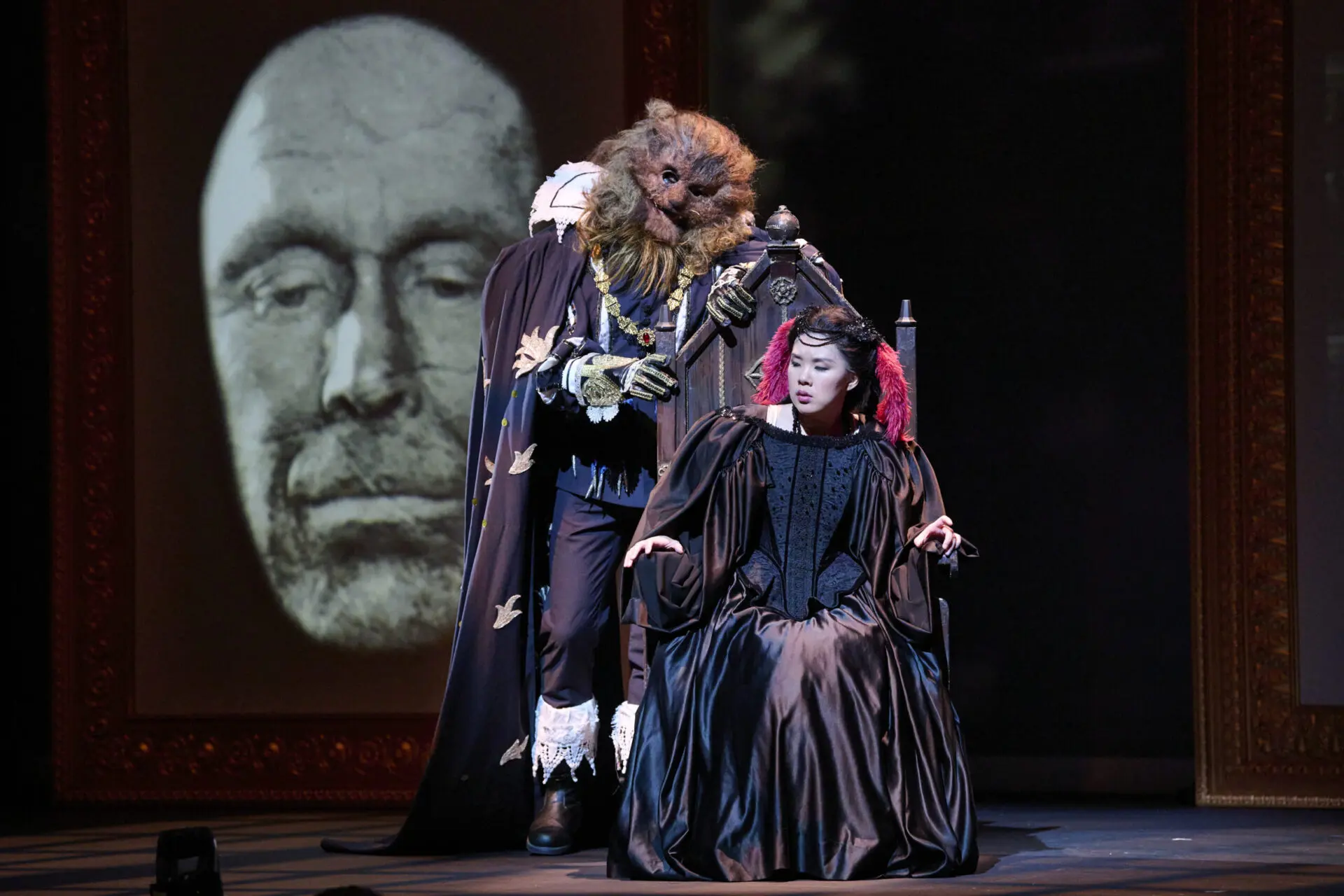
Photo Credit: Stefan Cohen
Hadleigh Adams and Chea Kang in La Belle et la Bête
And what of Auric’s music – that of a renegade classical composer turned prolific, highly visible author of film scores? Gone, along with the original dialogue (notably La Bête's raspy voice). Glass does seem to me to register, within his own vocabulary, traces of Auric’s melodic textures and an atmospheric dimension that one might call “filmic.”
The arrangement of the large central projection screen and singers far forward on the stage, close to the audience, surrounded by ornate picture frames with changing images, is that of Brian Staufenbiel, the company’s creative director, working to achieve special effects with projection designer and director of photography David Murakami. Lush costumes by Natalie Barshow and important hair by Y. Sharon Peng both parallel the film and complete the live opera dimension.
Hadleigh Adams’s visage strikingly resembles Jean Marais’ and renders him the ideal prince charming in the finale. His rich, gentle baritone underlines La Bête’s assertion that although he is ugly, his soul is good. Chea Kang as La Belle offers a bright, flexible voice and a presence that contrasts with La Belle of the film, and thus chimes with the ongoing tension in this work among its various realms – especially the taut relationship between the film and living, colorfully costumed singers.
Sophie Delphis and Aurelien Mangwa skillfully deployed mezzo-soprano and baritone voices to assume, variously, the roles of La Belle’s pretentious sisters (whom she serves – yes, this also is a Cinderella tale), their father and their feckless brother Ludovic. Delphis sported an extraordinary conical hairdo laced with beads. Although fully costumed, they sang often from the pit, at times with the two leads.
It is difficult to account for the tremendous impact of Glass’s cinematic opera, which remains unfamiliar despite prestigious performances over its life of some 30 years. Descriptions of the work, especially with Paiement’s and Staufenbiel’s additions, easily veer into the laughable or just plain weird – issues that hover to a degree around Cocteau’s original film. How can this possibly work?
Perhaps the answer must be that the business of opera (an art form invented from scratch in Renaissance Florence) remains the magical transformation of the strange, the potentially laughable (Marx Brothers noted), and even the weird into conviction. Music always lies at the core of operatic transfiguration, and Philip Glass’s splendid score in Nicole Paiement’s and Opera Parallèle’s brilliant hands potently reminds us of this truth.
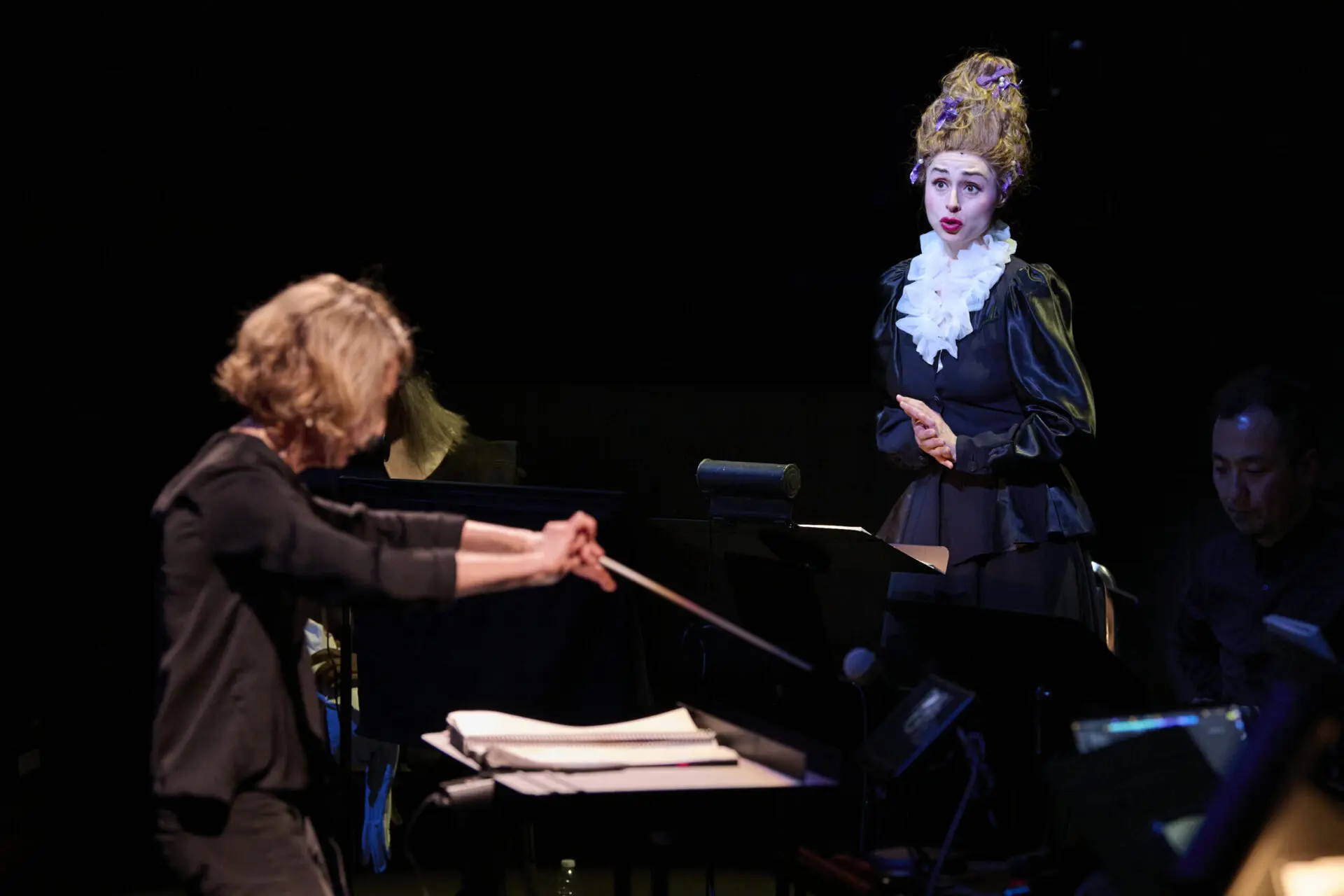
Photo Credit: Stefan Cohen
Canadian Nicole Paiement conducting La Belle et la Bête in San Francisco
Opera Canada depends on the generous contributions of its supporters to bring readers outstanding, in-depth coverage of opera in Canada and beyond. Please consider subscribing or donating today.