Opera Atelier has earned an enviable reputation in its 41-year history as a company that focuses primarily on performing Baroque and, to a lesser extent, Classical operas like those of Mozart. In 2012, it ventured for the first time into the 19th-century Romanticism with a successful mounting of Weber’s Der Freischütz. Therefore, it came as a complete surprise when it was announced that the spring 2026 presentation would be Debussy’s only opera, the impressionistic Pelléas et Mélisande (1902), a 20th-century work.
Debussy is a far cry, aesthetically and musically, from the Baroque world. Pelléas is also a lengthy work at nearly three hours, requiring a large orchestra of up to 80 musicians. OA announced that assistant conductor Christopher Bagan would reorchestrate the score – an intriguing thought! I was therefore really looking forward to experiencing it in person at Koerner Hall. While it’s not an opera house, OA has already successfully mounted several productions in this space, so I was looking forward to experiencing its magic again.
Pelléas et Mélisande opened on April 15th in the acoustically friendly Koerner Hall to a supportive and enthusiastic, though less than full, audience. At the end of the evening, the artists were given a most laudatory – and very well deserved – reception. I certainly joined in the cheering, I am happy to say. If I had my doubts before the show, I needn’t have worried, as the reimagined Pelléas et Mélisande exceeded my expectations.
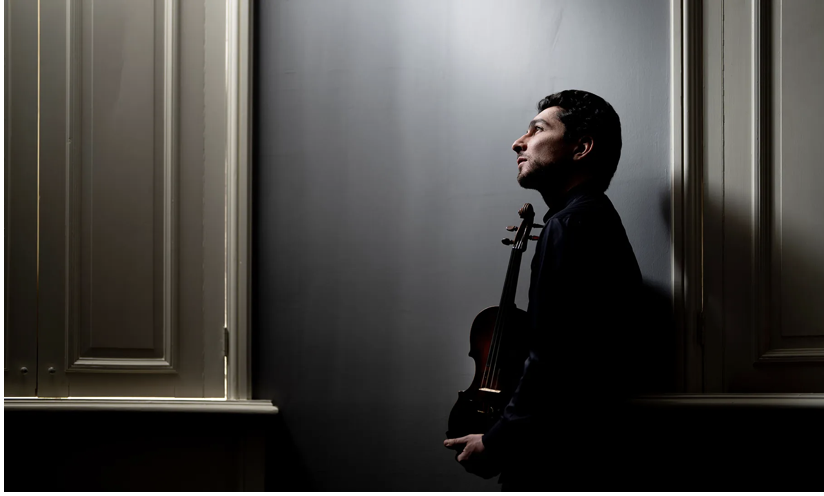
Before the show, I was curious as to how Debussy and Impressionism would work with a Baroque aesthetic. In an essay by Maestro Bagan that I received from the OA publicity department, he provides the detail of his reasoning for the reorchestration. “I am looking at this piece from the lush splendor of the French Baroque looking forward. I want to view Pelléas through the eyes of the Couperins, Charpentiers and Rameaus of the past.” I have to say that he achieved his objective convincingly. Under the sensitive conducting of David Fallis, I found the reduction of the score totally ingratiating to the ear, and the use of gut strings produces an ideal sound.
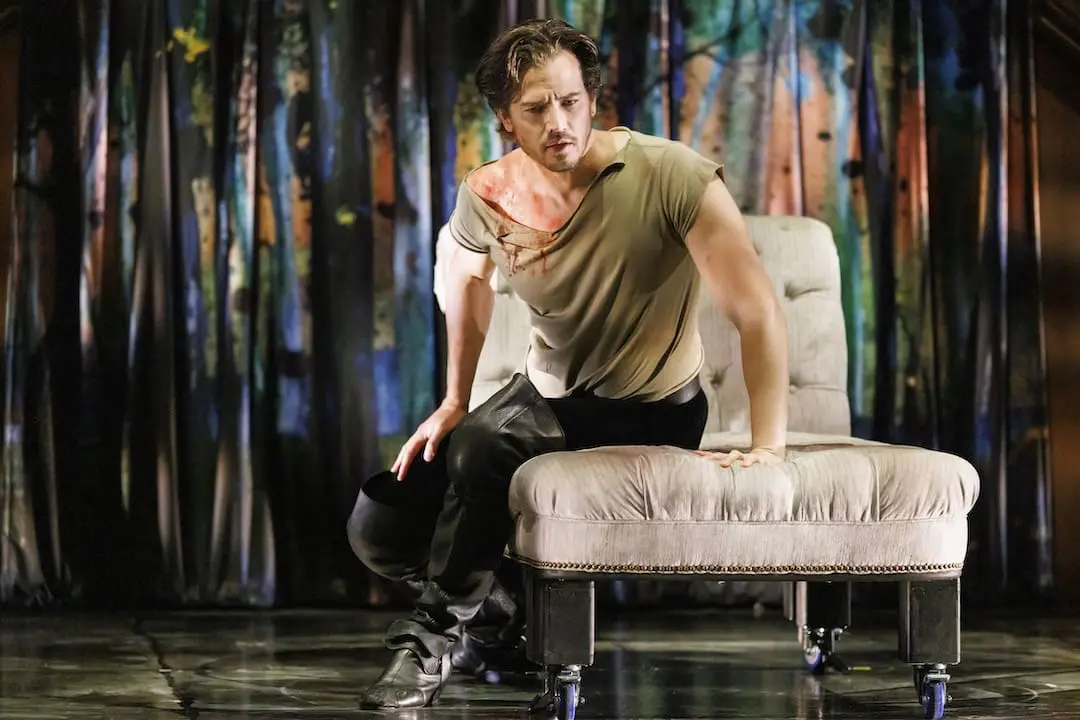
Photo Credit: Bruce Zinger
Bass-baritone Douglas Williams as Golaud at Opera Atelier
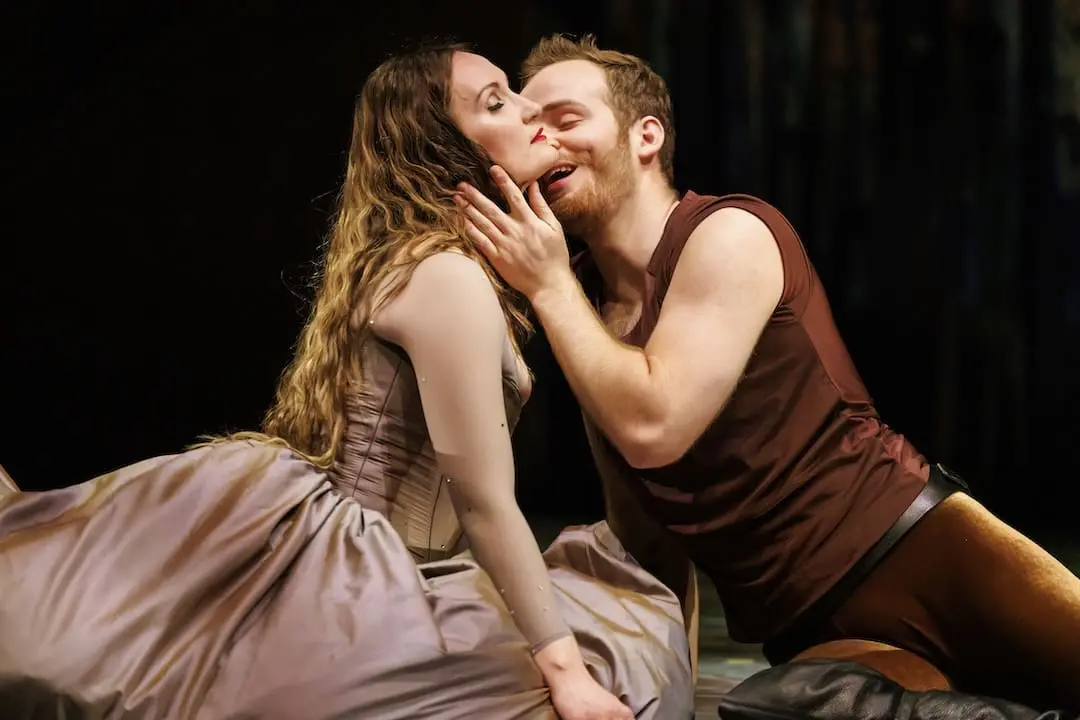
Having 14 instead of 80 musicians in the orchestra led to a more delicate sonic world that was lovely to the ear, and it also meant the singers didn’t have to worry about being covered by a large orchestra. In fact, they were heard loud and clear, and all sounded wonderful. I was particularly impressed by how beautiful – and big(!) – soprano Meghan Lindsay (Mélisande) sounded. She almost sounded like she was amplified, which was most unlikely! She was well partnered by the bright and youthful tenor of Antonin Rondepierre as Pelléas; the two of them have good chemistry.
Also worthy of praise was the powerful Golaud of bass-baritone Douglas Williams. He dominated the action in his many scenes. A pleasant surprise was the OA debut of bass-baritone Philippe Sly, back in TO for the relatively small role of Arkel. Sly was a member of the COC Ensemble some 15 years ago and is now having a great career in Europe. His Arkel has all the vocal and dramatic gravitas that one would want. As Geneviève, soprano and OA artist-in-residence Measha Brueggergosman-Lee shone in the brief moments allotted to her character. Soprano Cynthia Akemi Smithers was a suitably girlish Yniold.
Since dance is a calling card of Opera Atelier, there was plenty of it here, while none exists in the original Debussy score. The dance sequences were accompanied by music by Baroque composers, likely Rameau and Charpentier, although I confess I don’t know the exact origins and the details are not found in the program. Musically, it gives Pelléas a completely different “feel” – gorgeous to the ear, if one isn’t a stickler on authenticity. In fact, this show is not for the traditionalist. Some might argue that the huge amount of dancing combined with cuts to the original score have the effect of taking away some of the emotional gravitas of the tragic story.
Set designer Gerard Gauci has done wonders utilizing the Koerner Hall space, aided by the subtle lighting of Kimberly Purtell. The details and use of colours are pleasing to the eye. Finally, I want to comment on the choreographed movements. Typical of OA productions, there’s a lot of running on-and-off stage, singers being pushed or thrown to the stage floor repeatedly. Some of it is fine and serves to advance the drama. But in this production, it’s too much of a good thing, visually distracting to the audience and taking away from the Impressionistic nature of the work.
That said, the attempt by OA to tackle Pelléas in such an unconventional fashion has largely succeeded – it makes us look at this opera from a different angle. Speaking for myself, it was an enjoyable evening at the opera.
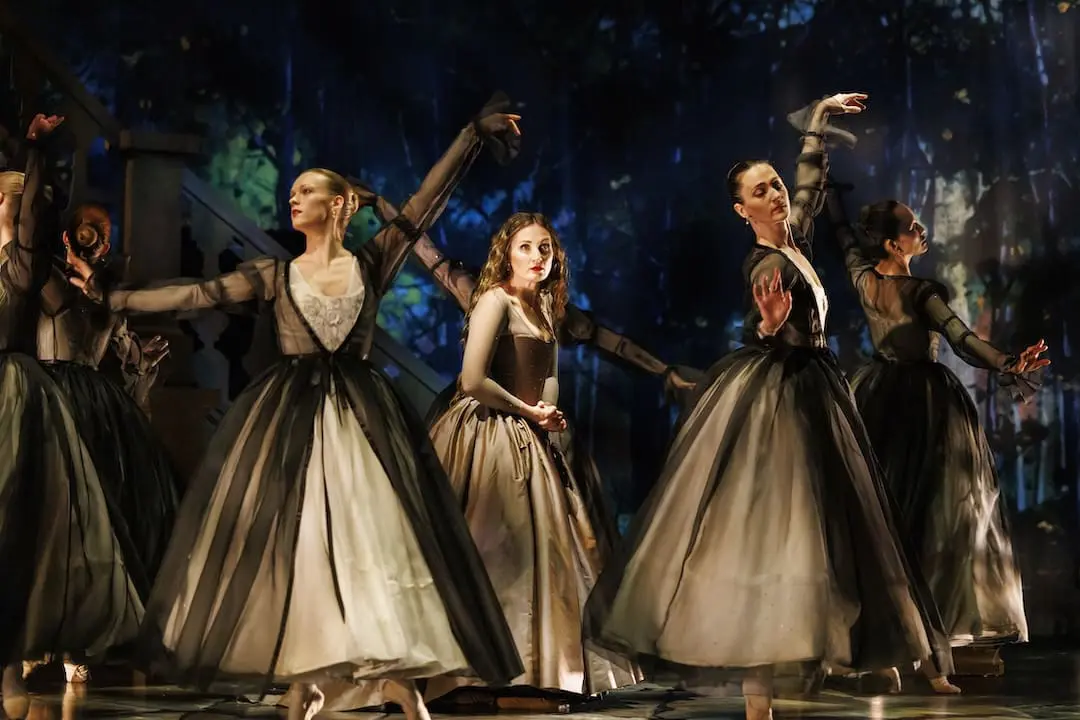
Photo Credit: Bruce Zinger
Meghan Lindsay with the artists of the Atelier Ballet in Pelléas et Mélisande
Opera Canada depends on the generous contributions of its supporters to bring readers outstanding, in-depth coverage of opera in Canada and beyond. Please consider subscribing or donating today.