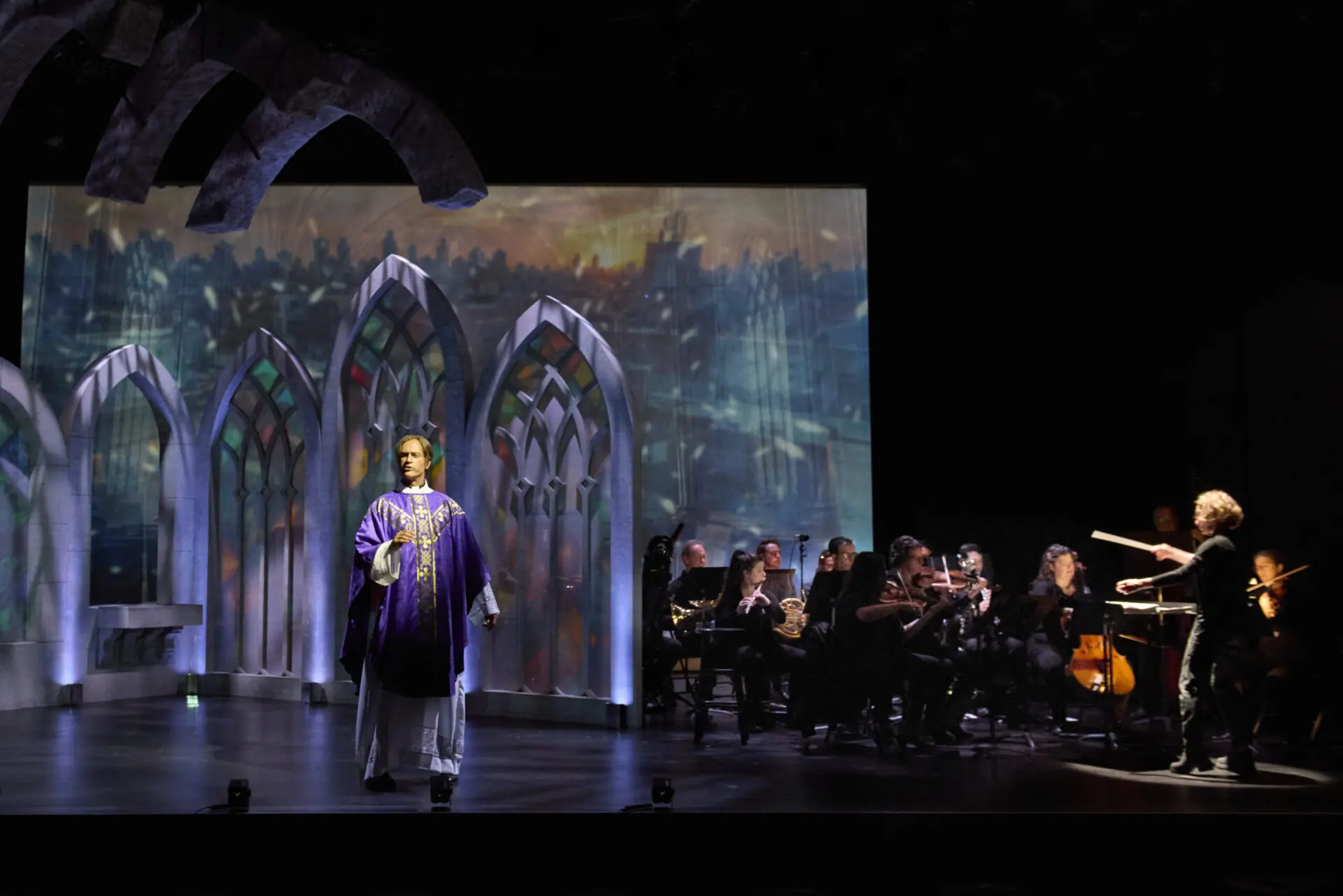
Rhoslyn Jones, a Canadian soprano with a rich recent past at the San Francisco Opera, dominated the stage in Opera Parallèle’s new chamber version of composer Douglas J. Cuomo’s opera Doubt (2013). Canadian Nicole Paiement conducted and also directs this company that brings new and newly reshaped operas to San Francisco.
Jones brilliantly becomes Sister Aloysius, the 1964 principal of the school attached to Saint Nicholas Church in the Bronx. This was just after the liberal Vatican Council of 1963 and prior to the church’s wide-spread sex-abuse scandals of the 1980s – those certainly in every mind when the play by John Patrick Shanley opened on Broadway in 2004. Sister Aloysius embodies an old-style martinet of a nun, who substitutes discipline for understanding, rigidity for virtue and suspicion for trust. In Meryl Streep’s film portrayal, she became the wicked witch of the west.
Jones, by contrast, also laboring under the constraints of the nun’s black habit and bonnet, deployed fine-grained facial acting and expressive hands to depict the dominant harsh side of Aloysius, along with wisps of underlying wit and repressed pliancy. Most of this sustained characterization she gained through wide-ranging use of her potent dramatic soprano. Even though much of the vocal writing approaches the declamatory, Jones hit the very high and low notes expressively to depict the sister’s fraught personality.
Father Flynn, the young Rector of St. Nicholas, becomes the principal’s antagonist. In Matthew Worth’s splendid portrayal, Flynn is athletic and vocally charismatic. Aloysius grows certain that Flynn, who is mentoring the only black boy in the school, is seducing, perhaps abusing, this child of 12. She becomes ever more relentless. The evidence remains second-hand: chiefly a report from the novice nun and teacher, Sister James.
James personifies the “doubt” of the title, questioning, defending and protesting in her timid way as a continuing interlocutor of Aloysius. Naomi Steele caught this innocence elegantly, again limited by her nun’s habit, but offering expressive, delicate mezzo-soprano singing at every turn.
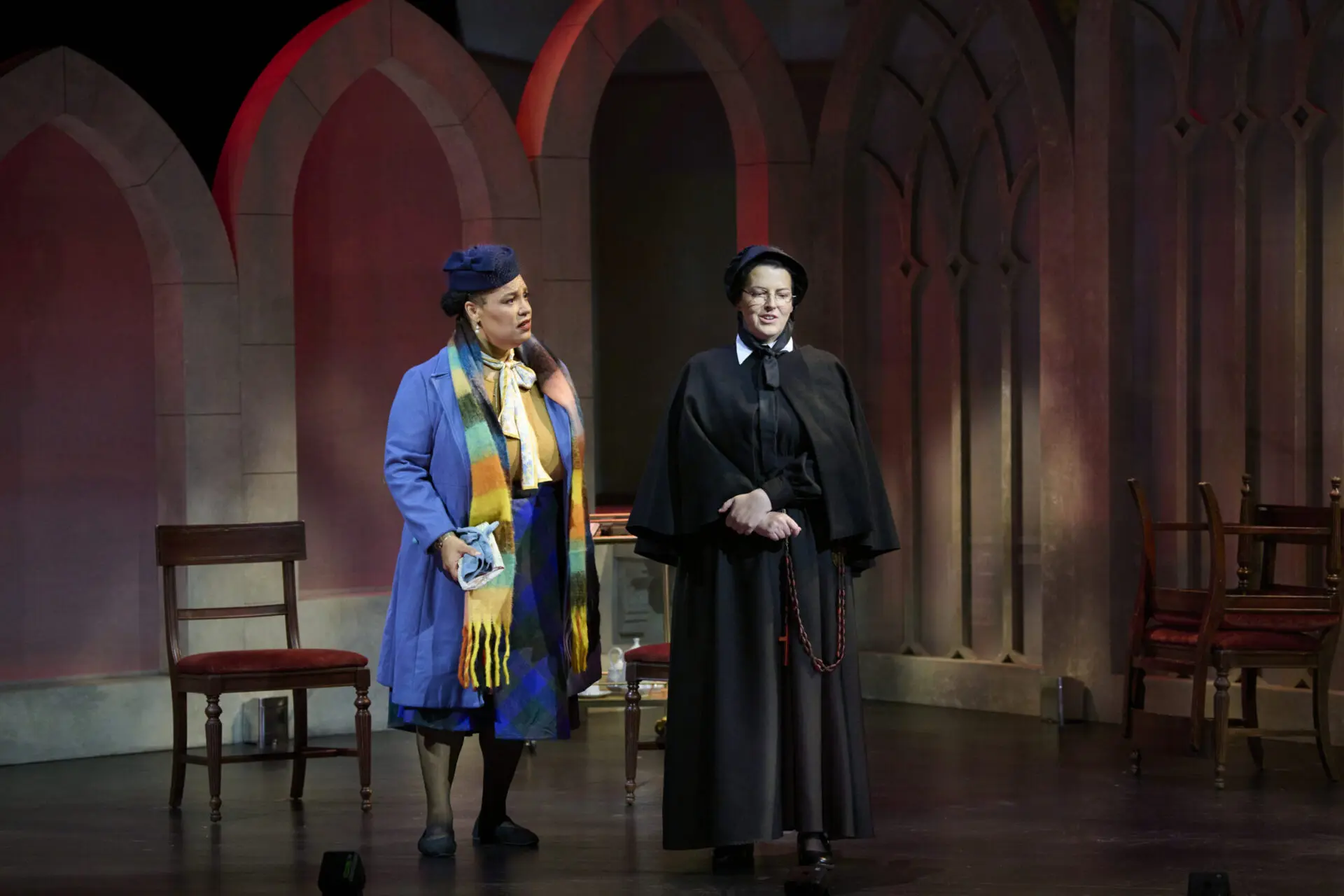
Photo Credit: Stefan Cohen
Rhoslyn Jones as Sister Aloysius and Deborah Nansteel as Mrs. Miller face off in Doubt
The opera’s pivotal scene occurs when Aloysius calls in the boy’s mother, Mrs. Miller, for a conference. Deborah Nansteel, a lush mezzo-soprano, seemed to live the part of the downtrodden, worldly-wise woman of infinite practical wisdom. Almost too blatantly the opposite of Aloysius, she survives through compromise. With a job to support her family, a husband who beats and might kill her son, and the burning goal of seeing her fragile boy into high school and beyond, this mother embodies a mode of secular devotion that transcends religiosity. Nansteel’s subtle vocal understatement breathed life into this superb woman and brought us the most touching moments of this rather cold work.
Why cold, when the action would seem to imply the opposite? The answer, I believe, lies with the genre of the underlying play (and the libretto by its author). It is a kind of drama called a “problem play” that explicitly addresses some profound moral, ethical, social or psychological issue and debates it. The play, Doubt: A Parable (the original title), is a problem play – a form that Broadway long has embraced, an embrace shared in this case by the Pulitzer Prize board. The problem with problem plays is that debate tends to take over, while the drama may slide into the background. In the hands of Ibsen, the grand master of the genre, or Shakespeare before and Shaw after, the play is the thing and the balance remains, often with shattering results.
This form of drama seems to me notably unsuited to opera. Yes, we find great debates in certain operas: two of them rest at the core of Act Two of Die Walküre (one about marriage and one about personal destiny) and the whole of Die Meistersinger is driven by debate about the nature of art. Doubt, the play and the opera, throws in a double twist by placing uncertainty itself at the center and by threading in a strand of detection – what really did happen?
But for debate to work in opera, music has to take over from words to shape our sense of the truth. On the whole, Cuomo’s score achieves this through rich, varied and colourful orchestra writing – colourful because, in the chamber version reviewed here, the orchestra of 13 players tilts heavily to woodwinds, brass and percussion, and varied because of an eclectic musical texture that veers among the ostinato of musical minimalism, jazz, the classical tradition and film score. The orchestral players are visible onstage. Yet, the largely declamatory vocal line lies inert for all the engaged efforts of highly skilled performers. I did not detect a sustained melody of any length worth mentioning. Proto-melodies remain as structural motifs driving the musical line.
All of this said, and despite being overbalanced by its early, too long, set-up scenes, this chamber version of Doubt emerges as effective in the theater. Minimal yet attractively functional settings (Jacquelyn Scott) contribute atmosphere, as do the realistic costumes (Y. Sharon Peng). Surely real credit must go to Brian Staufenbiel’s lucid conception and staging as he directed quite remarkable singers. But the creative force and potent musical sensibility of Nicole Paiement stands at the core of this success.
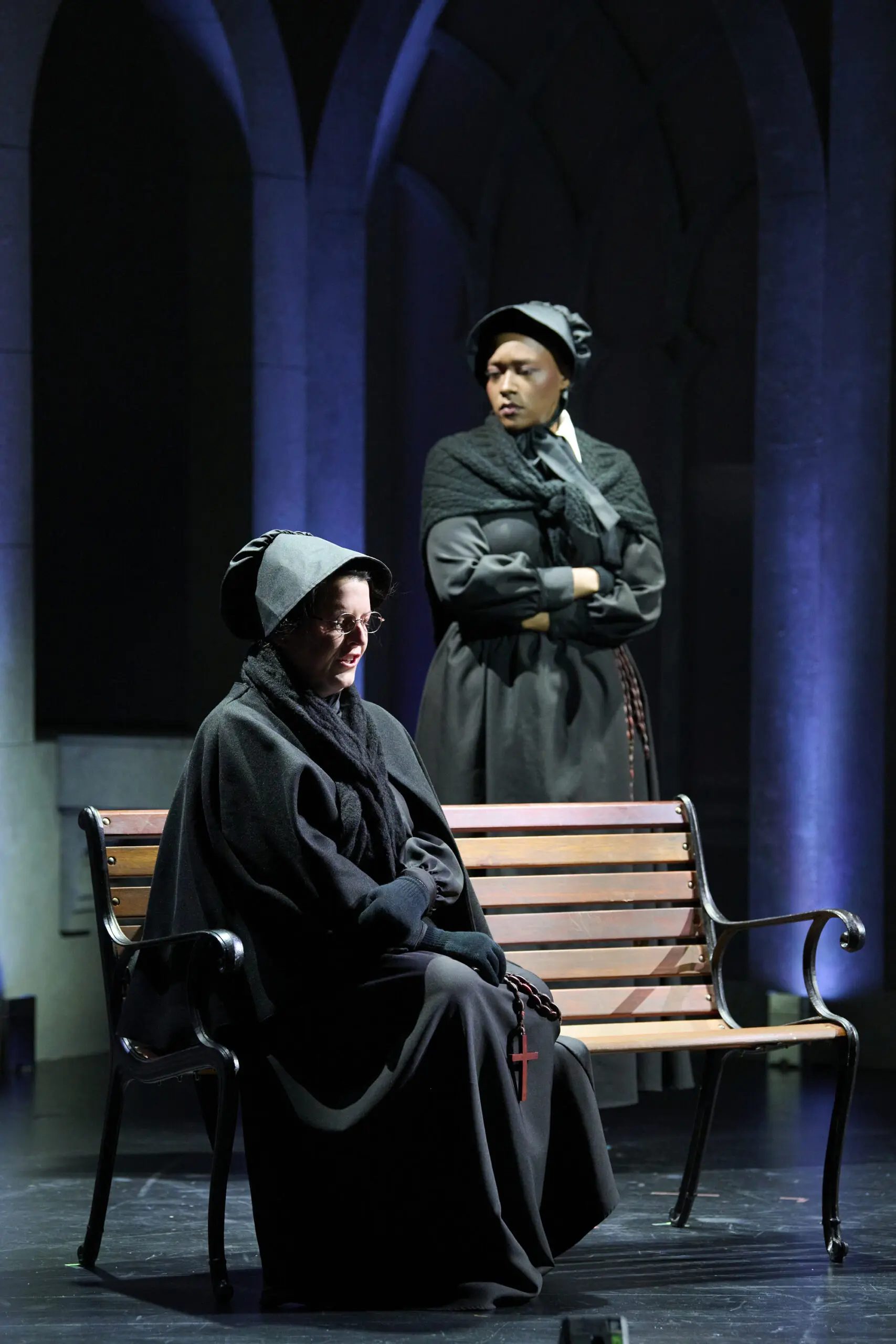
Photo Credit: Stefan Cohen
Sister Aloysius (Roslyn Jones) hears a report from Sister James (Naomi Steele)
Opera Canada depends on the generous contributions of its supporters to bring readers outstanding, in-depth coverage of opera in Canada and beyond. Please consider subscribing or donating today.