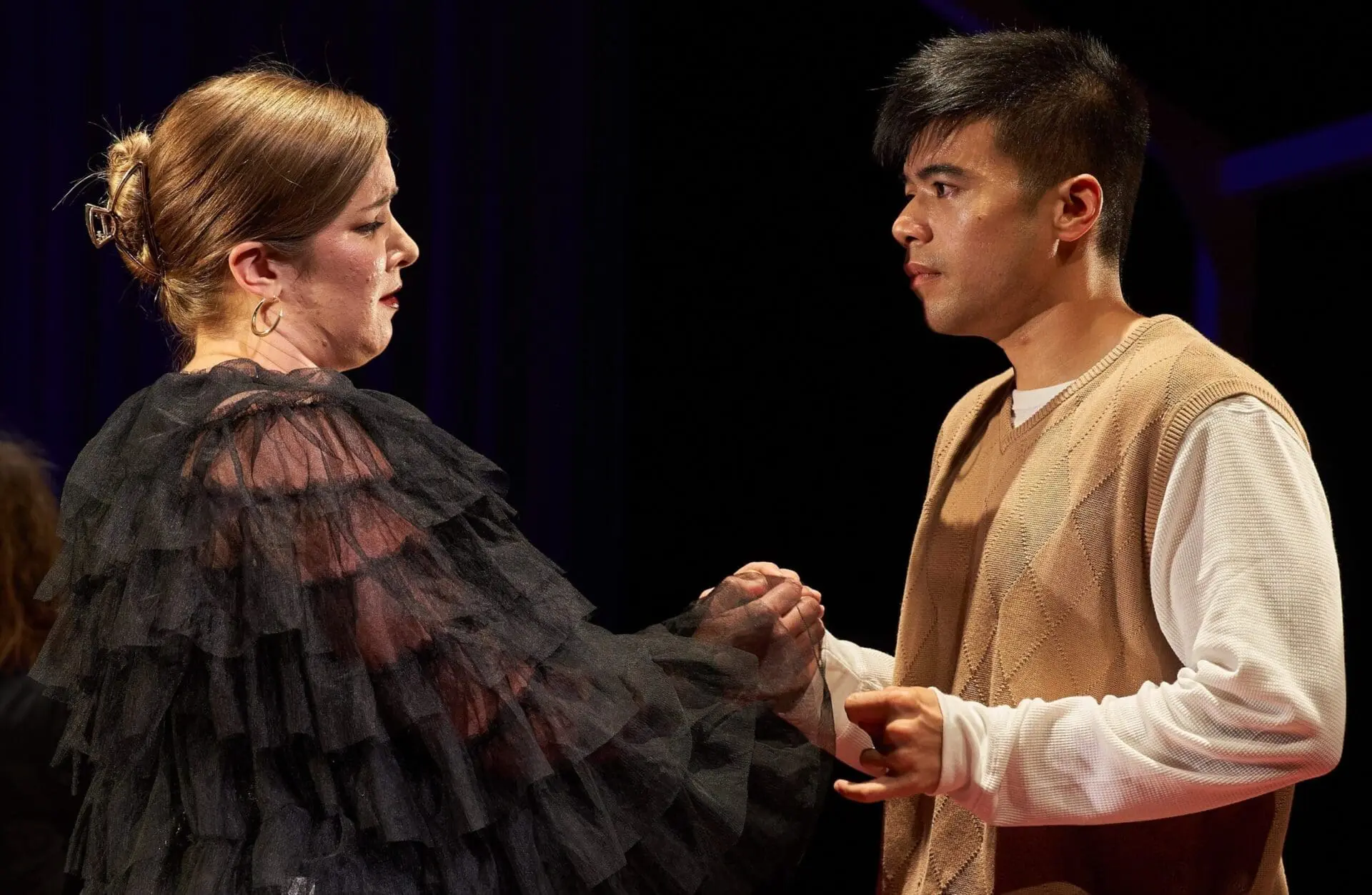
When Calgarians think of opera, they naturally think of Calgary Opera, the city’s long-established company. But the city is now three times the size it was when Calgary Opera was founded, and with the growth in size, the cadre of local singers of significant capability has also grown – more than Calgary Opera can employ. Besides, Calgary Opera has its own McPhee Artist Development Program, adding to the supply of capable singers hungry for work. In short, there is space in the city for more opera.
Over the years, several operatic ventures have been tried, but none has really taken hold in the sense of a long-term existence with multiple seasons. But when it comes to opera, one cannot keep a good singer down: they will find a way. So, now we have Ammolite Opera, a new company now in its second season. Co-founded by Tayte Mitchell (stage director) and Maria Fuller (music director), the new company has the purpose of bringing performances of new chamber operas to the Calgary public.
In a certain sense, while these modern works are called chamber operas in that they are completely sung, they are perhaps better thought of as a type of theatre piece with substantial music, an idea stemming, perhaps, from Brecht and Weill’s The Threepenny Opera. In these pieces, the balance between music, drama and staging is re-thought, and the focus is more on the stage elements and the ideas contained in the libretto.
This was certain the case with Rocking Horse Winner, a theatre piece by Scottish composer Gareth Williams and Canadian librettist Anna Chatterton. The work is based on a short story by D.H. Lawrence about a young, autistic boy named Paul who finds himself able (but not always) to predict the winner of horse races. The metaphor here is his child-like fixation on a wooden rocking horse, somehow the means for him to access his unique, clairvoyant abilities.
This is set against the family back-drop of a mother whom Paul very dearly loves but who cannot really love him. Addicted to luxury, she is fixated on money, always money. Desperate for her love, Paul alleviates the family’s financial stress by winning on the horses, something that involves his uncle and the gardener. His desperation to win his mother’s love, her extravagance and the need to win ever more money ultimately result in Paul’s increasing desperation and death, just at the moment he predicts the winning horse in a big race that earns the family a fortune.
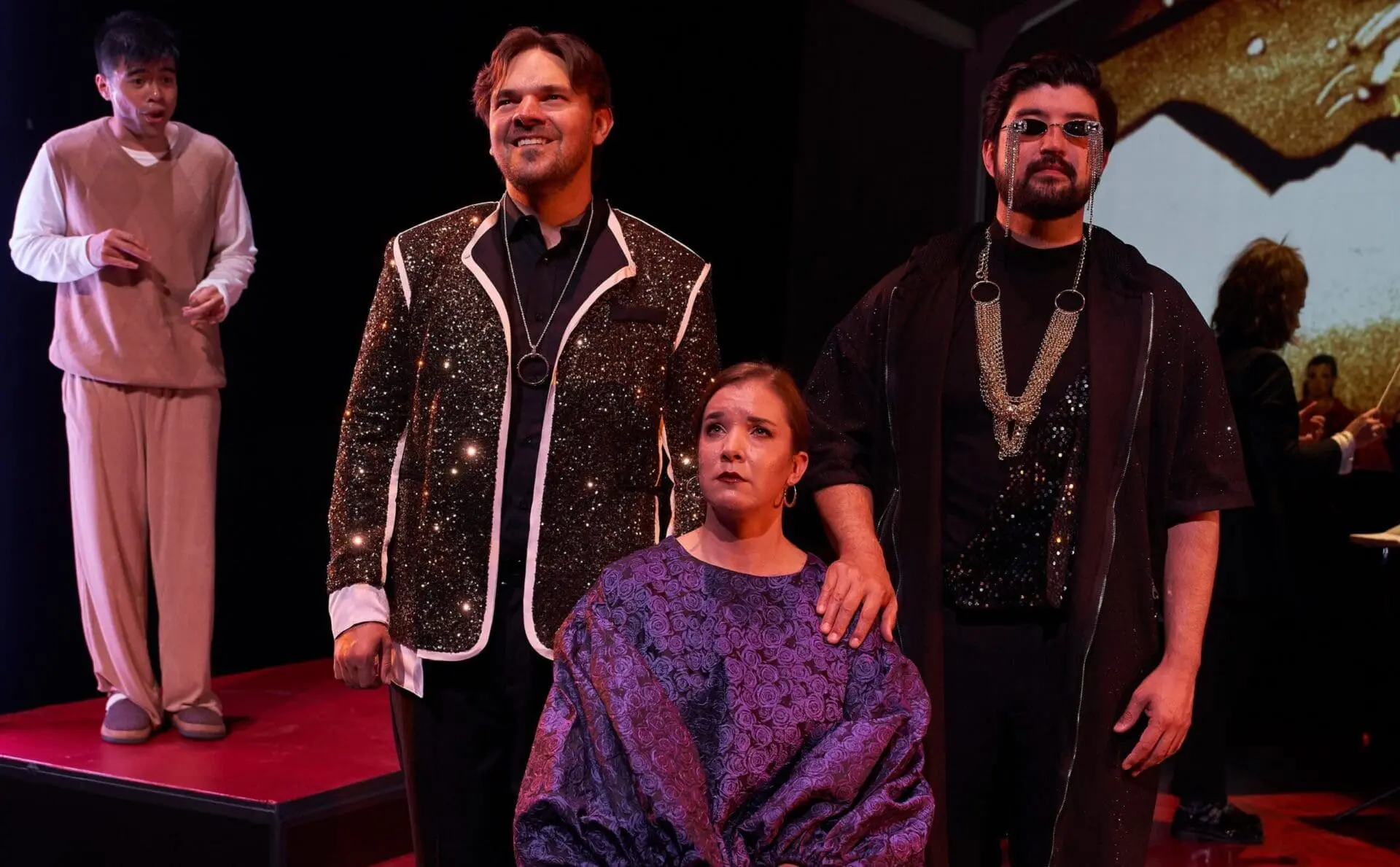
Photo Credit: Chad Mitchell
From left to right: Mishael Eusebio, Matthew Dalen, Anne-Marie MacIntosh and Clarence Frazer in Rocking Horse Winner
Anna Chatterton’s libretto skillfully takes the essence of Lawrence’s story and both contracts it and expands it. In her treatment, the autism of Paul is underlined more sharply, and the lines for the mother more eloquently render her conflicted emotions. The parts for the uncle and the gardener [now a caretaker in the opera] are also more fully developed. There is also a small ensemble that functions as a Greek chorus, effectively engaging in the action as well as observing it. The chorus significantly strengthens the dramatic ideas and psychological complexity of the work.
The music, which is largely a type of modern recitative-arioso, quasi tonal in manner, reinforces dramatic elements and mirrors the growing psychological stress of the plot. There are few places where the music is the principal carrier of the emotion, except some sequences for the mother and Paul. The piece is similar to other music theatre pieces of this type – strong on ideas, with imaginative staging and music that is not particularly memorable but is certainly effective in projecting the drama.
The production and the singing showed the signs of much care, thought and imagination. The simple house frame set was re-purposed in various ways, and the chorus was remarkably well integrated into the action. The set included not only projections but a most unusual element: the work of Kelly Choo, who had a box of sand in which she drew changing pictures that were integrated into the projections. These pictures were rapidly produced and changed as the story changed, and the climax of the story drew strongly upon Choo’s visual images. It was an inspired additional element in the performance.
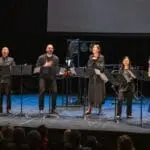
The mother and Paul, the two leads, were sung by soprano Anne-Marie MacIntosh and tenor Mishael Eusebio, both with fine voices and excellent projection of character. The secondary pair of singers, Clarence Frazer and Matthew Dalen as the caretaker and the uncle, were also highly capable singers and well able to embody the slightly sleazy aspect of their roles. The quartet chorus was comprised of well-known local singers, each of whom could have performed one of the lead roles. The tiny chamber orchestra of five, seated at center stage, played with skill and were expertly directed by Maria Fuller.
As music theatre, this was far more than an amateur offering – a fine operatic companion to the Calgary Opera’s more traditional fare. The theatre itself, part of the new YMCA complex in the deep south of the city, could prove a challenge for north-centered Calgarians, but the trip is well worth the effort.
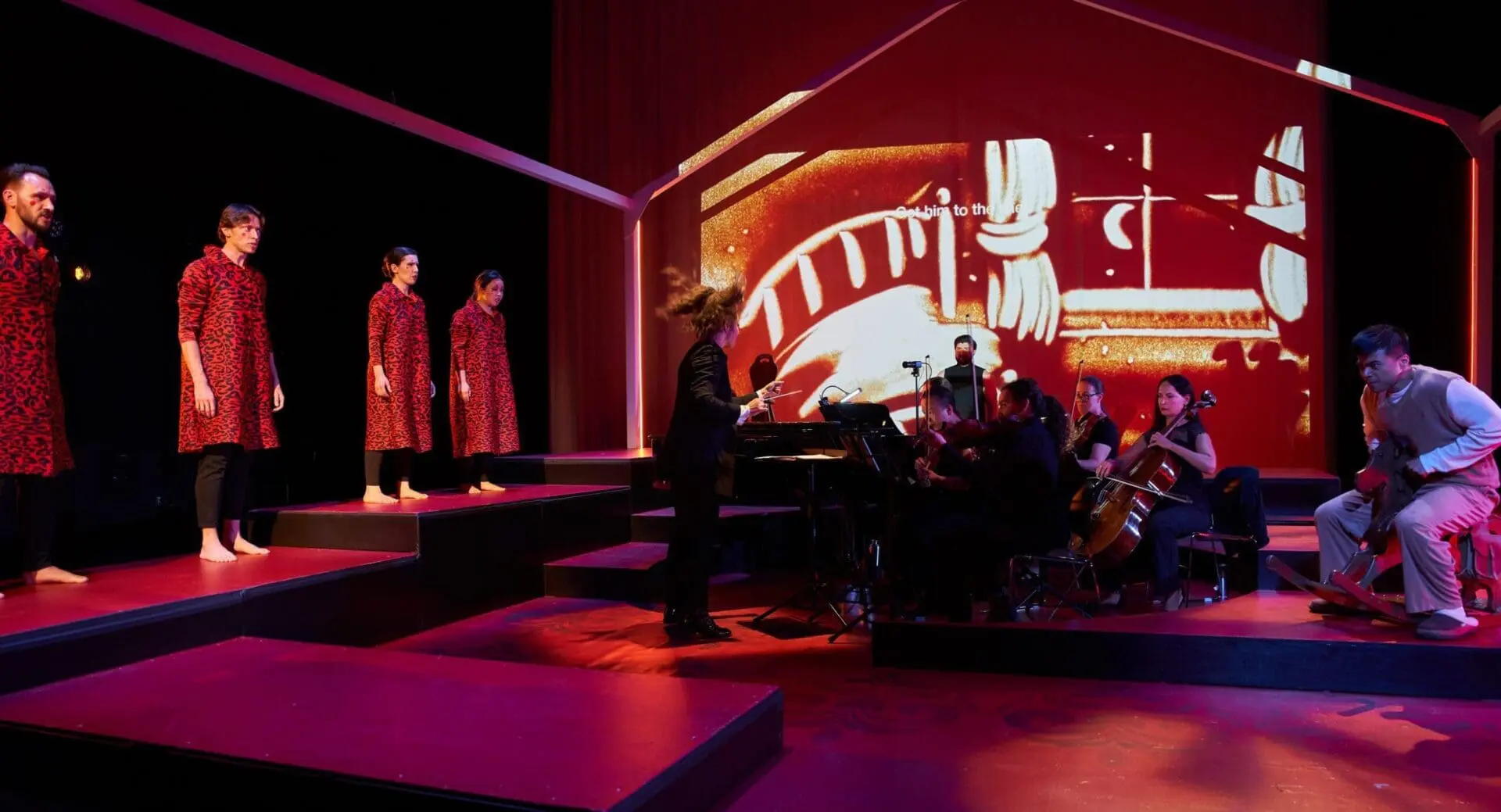
Photo Credit: Chad Mitchell
The chorus and instrumental ensemble, incorporated well into Ammolite Opera’s production, with Paul on his rocking horse at right
Opera Canada depends on the generous contributions of its supporters to bring readers outstanding, in-depth coverage of opera in Canada and beyond. Please consider subscribing or donating today.