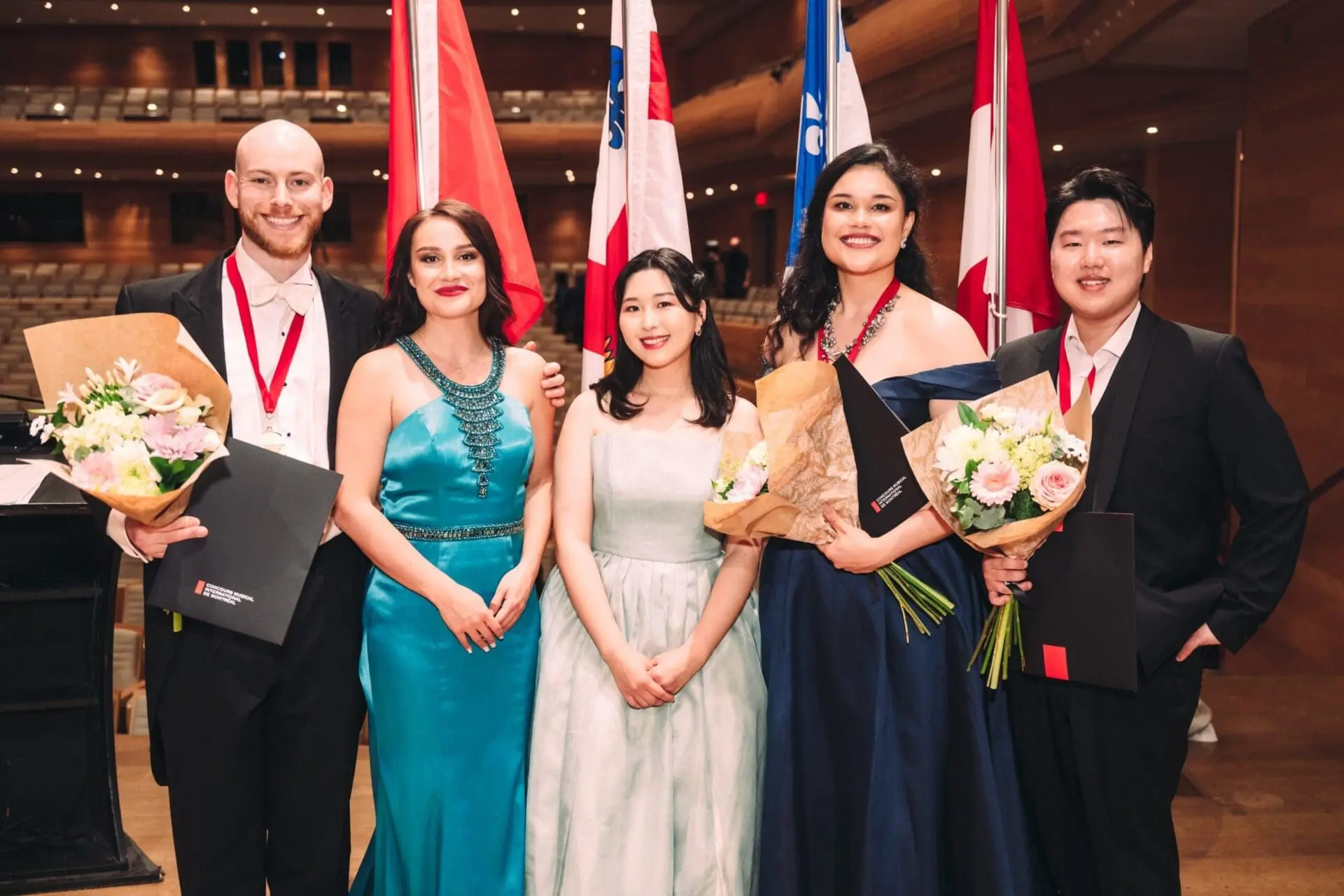
So much a part of an emerging musician’s career, competitions provide opportunities for exposure internationally, chances to be heard by people responsible for casting and programming, and – of course – prize money valuable to shaping a young career. Just as there were eight jury members with no doubt different opinions after the final performance of the Concours musical international de Montréal, there was an entire audience listening, and everyone sitting in my area of the auditorium might have selected different prize winners.
The CMIM was established in 2001 and alternates between three disciplines – voice, violin and piano – over a rotating three-year schedule. It attracts emerging artists from around the world and significant international jurors, and in 2025 it offered prize money in excess of $160,000. The first prize winner alone receives a $30,000 cash prize from Ville de Montréal, a $40,000 career development grant from the Azrieli Foundation and $5,000 plus a promised engagement from Opéra de Montréal.
This year’s final 24 competitors (selected by a Preliminary Jury from almost 350 applicants) included four Canadians: Ariane Cossette, Ihor Mostovoi, Sophie Naubert and Karoline Podolak. Although Cossette proceeded to the semi-finals, none of the Canadians advanced to the final round on June 6, 2025 at Maison Symphonique. The five finalists each had the opportunity to perform three selections – generous in a competition situation, providing ample opportunity for the young artists to work through any initial nerves – with Orchestre symphonique de Montréal.
Coloratura soprano Yewon Han from South Korea opened with “blockbuster” arias from La fille du régiment, Il barbiere di Siviglia and La sonnambula. Han has a beautiful instrument with great facility, and her staccato coloratura passages were strong. She also has a vivacious stage presence. Interestingly, I most enjoyed the cavatina section in “Ah! Non credea mirarti” from La sonnambula. It felt as if, freed from the rapid-fire fioratura so prominent in her other repertoire, Han built gorgeously sustained phrases and found more of the meaning behind the text.
From Russia but currently based in Germany, soprano Julia Muzychenko-Greenhalgh offered two well-known selections (from Manon and La traviata), but her repertoire also included an aria from Rimsky-Korsakov’s The Tsar’s Bride performed in her native Russian. Possibly because I knew this aria less well, it was my favourite part of her performance. Overall, while Muzychenko-Greenhalgh’s voice was impressive, she seemed to struggle with her stage presence, which did not feel as grounded as that of the other singers and made her interpretations seem less natural.
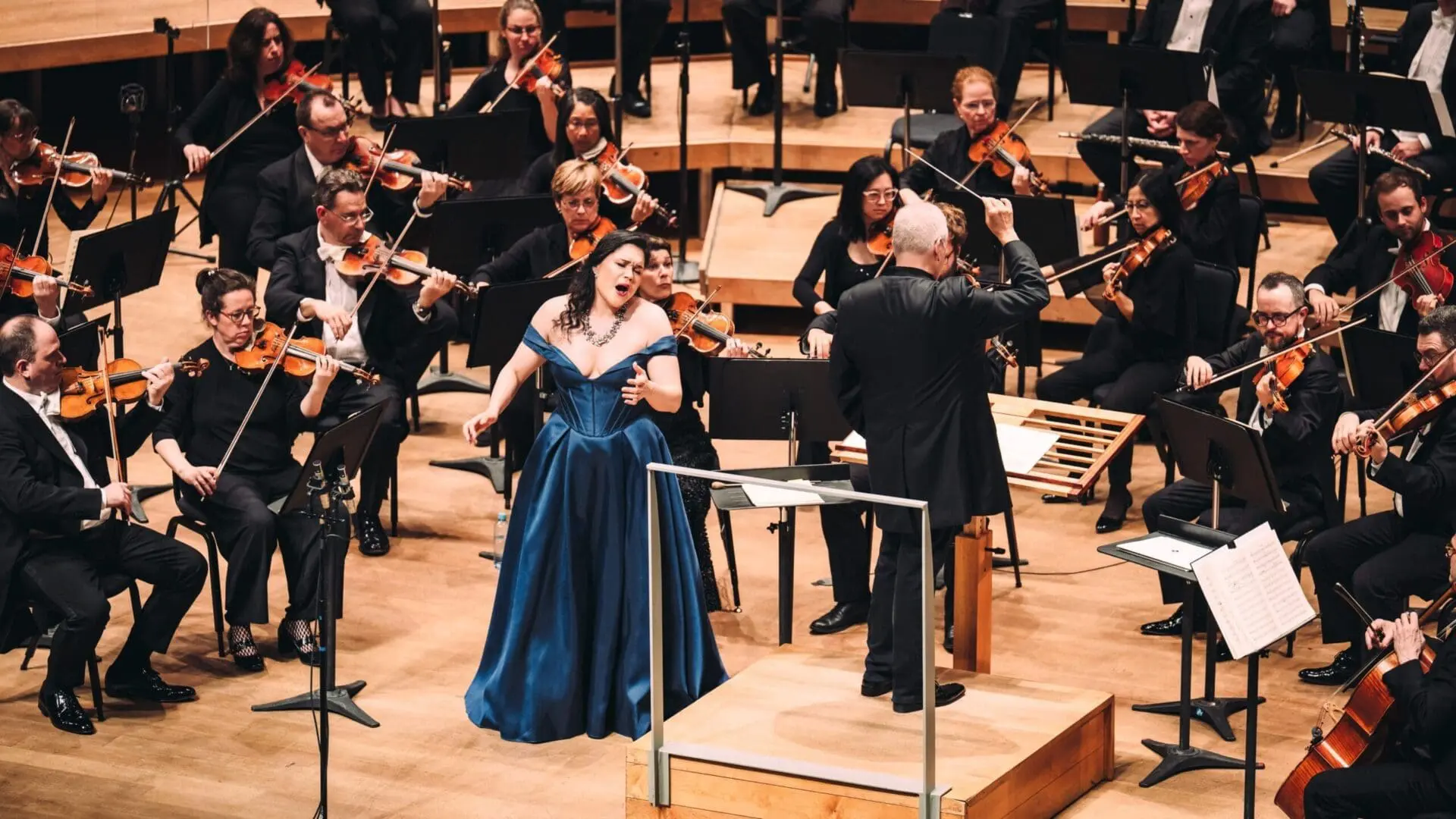
Photo Credit: Tam Photography
Mezzo-soprano Fleuranne Brockway in performance with Patrick Summers and Orchestra symphonique de Montréal
Theodore Platt, a baritone from the United Kingdom, was the final performer in the first half of the program. After opening with an aria from Hamlet, Platt offered exceptional renditions of “Ich atmet’ einen linden Duft” (Rückert-Lieder, Mahler) and “Ja vas lyublyu” (The Queen of Spades, Tchaikovsky). Emotionally and interpretively, this was probably my favourite performance of the evening. Platt’s phrasing was extraordinary, and his voice felt like one perfectly measured strand through his entire range. He had a few slight intonation problems, but overall he showed immense promise for his burgeoning career.
After intermission, we returned with Australian mezzo-soprano Fleuranne Brockway. Brockway opened with arias from two roles that she had already performed, Carmen (the Seguidilla) and Charlotte (“Werther! Qui m’aurait dit”). She felt particularly comfortable in this well-seasoned repertoire with both strong phrasing and clear dramatic intention. Her voice also really shone, though, in “Se Romeo t’uccise un figlio” from Bellini’s I Capuleti e i Montecchi. Working in both extremes of her register, with sustained passages in her lower chest register, it was an impressive performance that assuredly won her many new fans.
The last singer of the program was Junho Hwang, a South Korean tenor, who again offered one unusual choice between two standard arias. He opened with an assured Rodolfo in La bohème (with a strong high C) and closed with the Kleinzach aria from Les contes d’Hoffman. The audience enjoyed his comedic work in the Offenbach, but I found it unfortunate that his stage actions entailed delivering much of the aria to the floor. Particularly beautiful, however, was Hwang’s “Vzglyani, pod otdalyonnïm svodom” from Rachmaninov’s Aleko, written for voice with solo harp accompaniment.
The Orchestre symphonique de Montréal, under the direction of Patrick Summers, played beautifully. Given the rehearsal time frame for this type of performance – the finalists (and therefore repertoire) were only confirmed late Wednesday night before the Friday evening concert – there was very strong cohesion between the singers, the conductor and his orchestra. Summers managed the rapid stylistic changes between the different repertoire capably. Special mention should be made of harp player Jennifer Swartz. Even before her lovely solo playing in the Rachmaninov selection, she stood out with the intuitive nature of her musical lines which helped the performances throughout the evening.
The results don’t really matter – all five of these remarkable young singers should have strong international careers, and practically everyone in the audience around me had a slightly different choice for their laureates. The jury, chaired by Canadian soprano Adrianne Pieczonka, awarded first prize to Brockway, second to Hwang and third to Platt. Platt also received the prize for Best Performance of a Contemporary Aria and smaller prizes went to two Canadians: soprano Ariane Cossette received the award for Best Canadian Artist and baritone Ihor Mostovoi for Best Performance of a Canadian Work.
Opera Canada depends on the generous contributions of its supporters to bring readers outstanding, in-depth coverage of opera in Canada and beyond. Please consider subscribing or donating today.