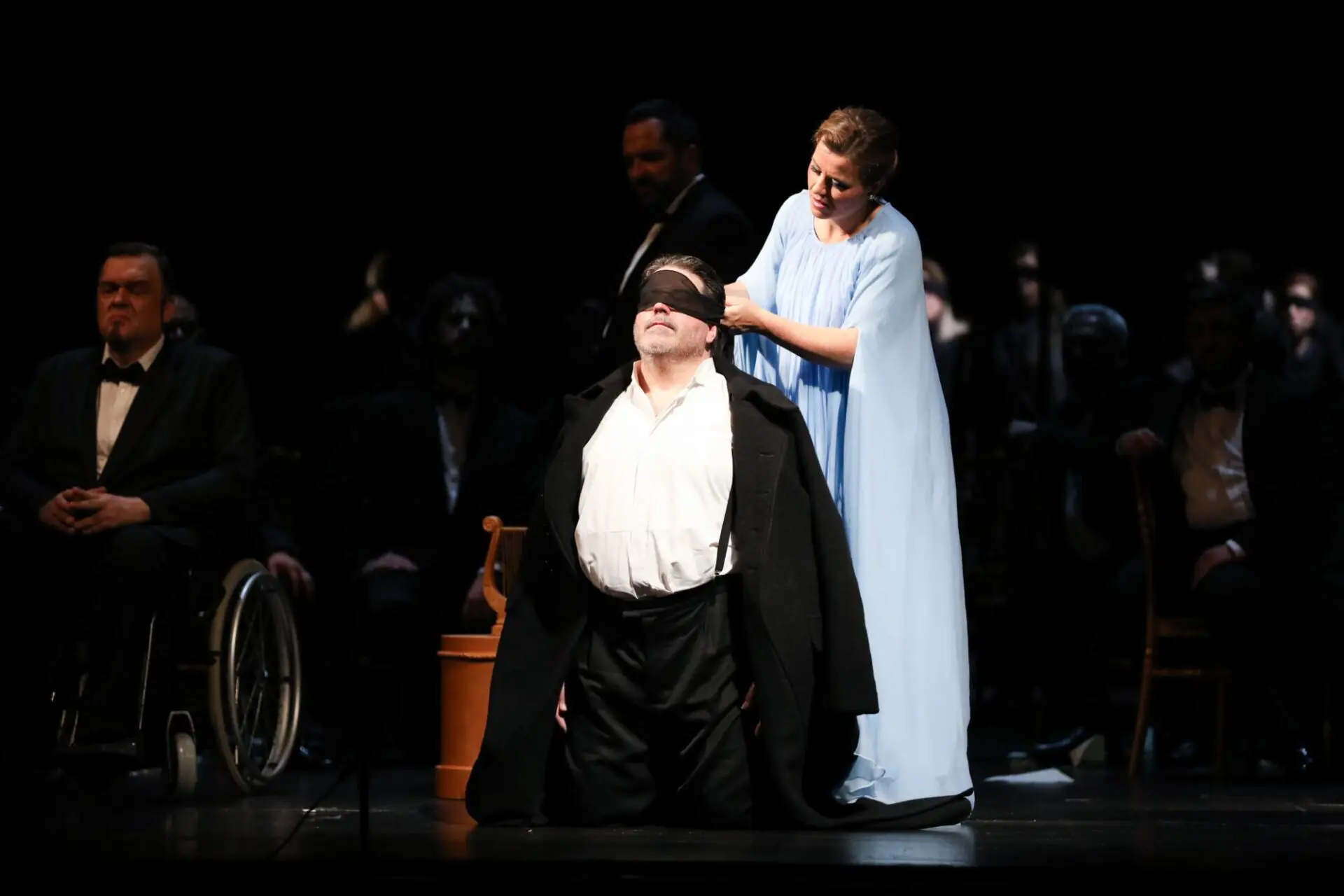
The seductive chaos of the Venusberg and the unyielding morality of the Wartburg court are the two irreconcilable worlds tearing at the hero of Richard Wagner’s Tannhäuser. The Croatian National Theatre’s spring 2026 co-production with the Slovenian National Theatre Maribor of Wagner’s Second Dresden Version – captured live in Zagreb on May 18th and available on demand on OperaVision via YouTube until December 19, 2026 – grapples with the opera’s core ideological throughline: the eternal battle between the unrestrained, carnal pleasures of the flesh and the austere, sacred elevation of the soul.
In Wagner’s original design, this friction is traditionally resolved through divine mercy interceding through a woman’s pure sacrifice. However, director Frank Van Laecke pushes a more secular, modern interpretation: it is neither the church nor a martyr’s love that truly redeems Tannhäuser, but his self-absorption in the transcendent power of his own music.
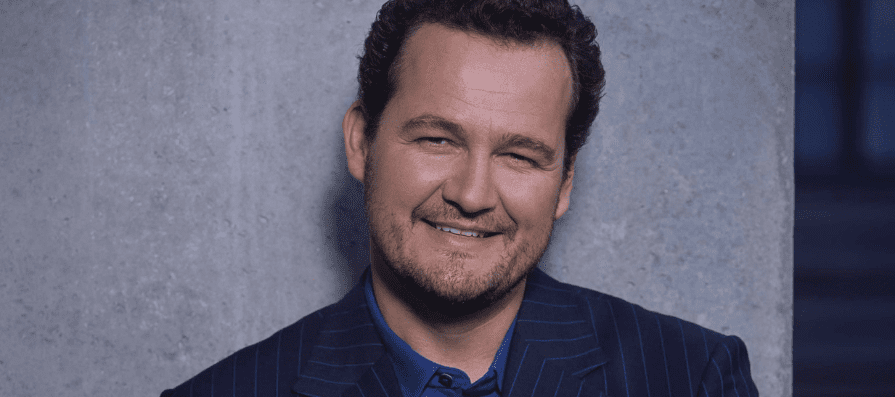
Eric Laporte anchors the evening in the gruelling title role. His appearance in the double-cast run marks the latest peak in the Canadian tenor’s vocal evolution. He initially built his international reputation as a lyric tenor, making his professional European debut in 2000 as a bright-voiced Tamino in Mozart’s Die Zauberflöte at the Salzburger Landestheater. As his instrument gradually gained weight and steel, Laporte successfully moved into heavier French and Italian lyric-dramatic, spinto roles such as Don José, Pinkerton and Des Grieux. This steady vocal maturation included forays into such Jugendlicher Heldentenor roles as Max, Erik and Lohengrin, which ultimately paved the way for his transition into a fully realized Heldentenor.
As Tannhäuser, Laporte charts the Minnesinger’s descent with real theatrical grit, delivering a performance that reveals vulnerabilities alongside genuine vocal triumphs. One minor nuisance is his inconsistent handling of the ü-umlaut. For every flawlessly placed vowel, such as in “übergroß” (Act One), “Büßer” and “Übermütigen” (Act Three), there is a noticeably flattened counterpart, as heard in “verkünde” (Act One) and “Sünde” (Act Three). Though problematic vowels occasionally tarnish Laporte’s “Rome Narrative,” his performance remains a theatrical tour de force, peppered with ringing high A-flats and As.
Evelin Novak’s rendering of Elisabeth’s signature entrance aria, “Dich, teure Halle,” is otherwise appealing, but she falls into an odd vowel modification on the high F-sharp of “hehr.” Her pronunciation collapses into a diphthong resembling the sound “hoy,” breaking the internal rhyme with “mehr.” However, Novak’s rendering of Elisabeth’s third act prayer, “Allmächt’ge Jungfrau,” is marked by a lovely, spinning legato line.
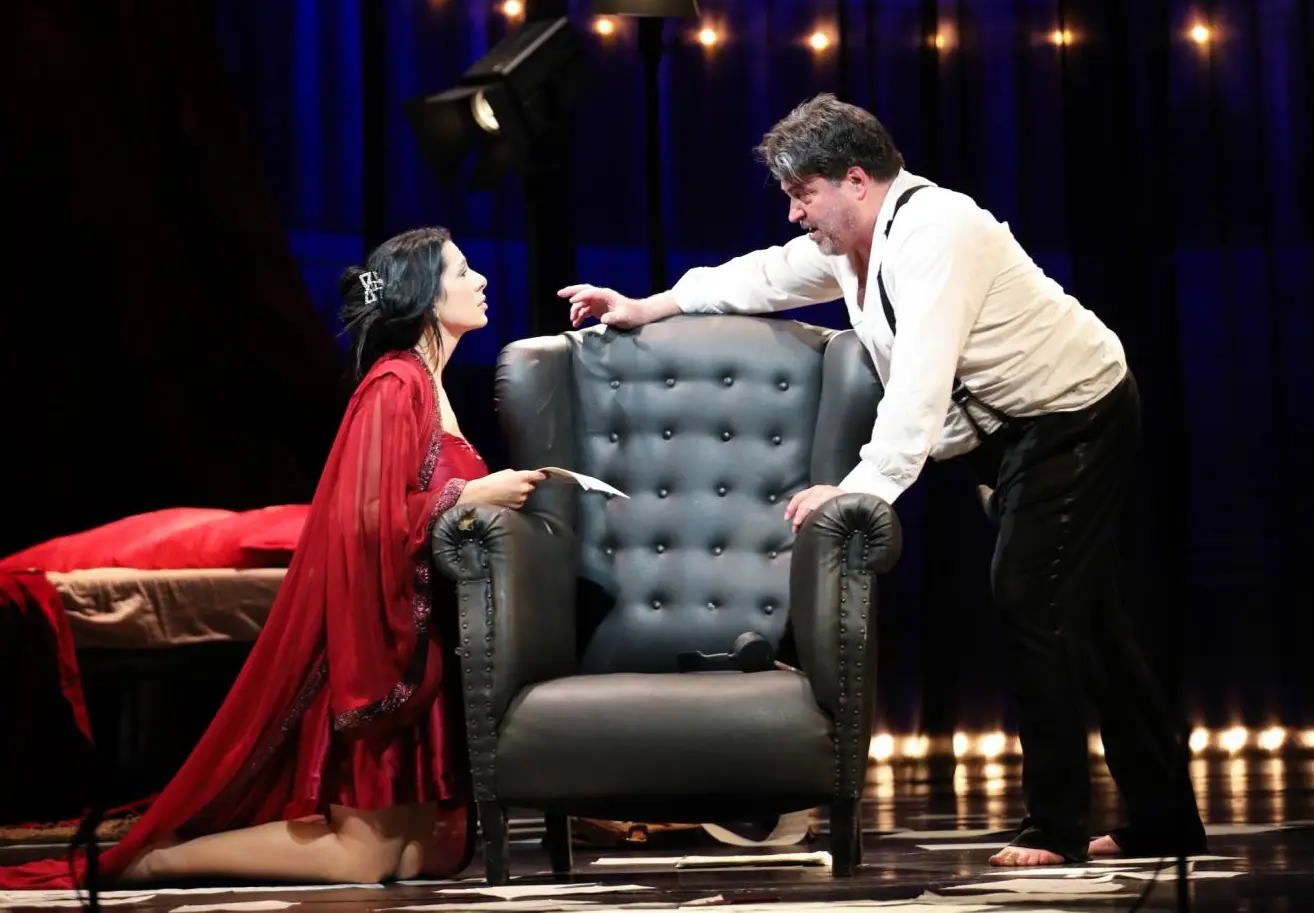
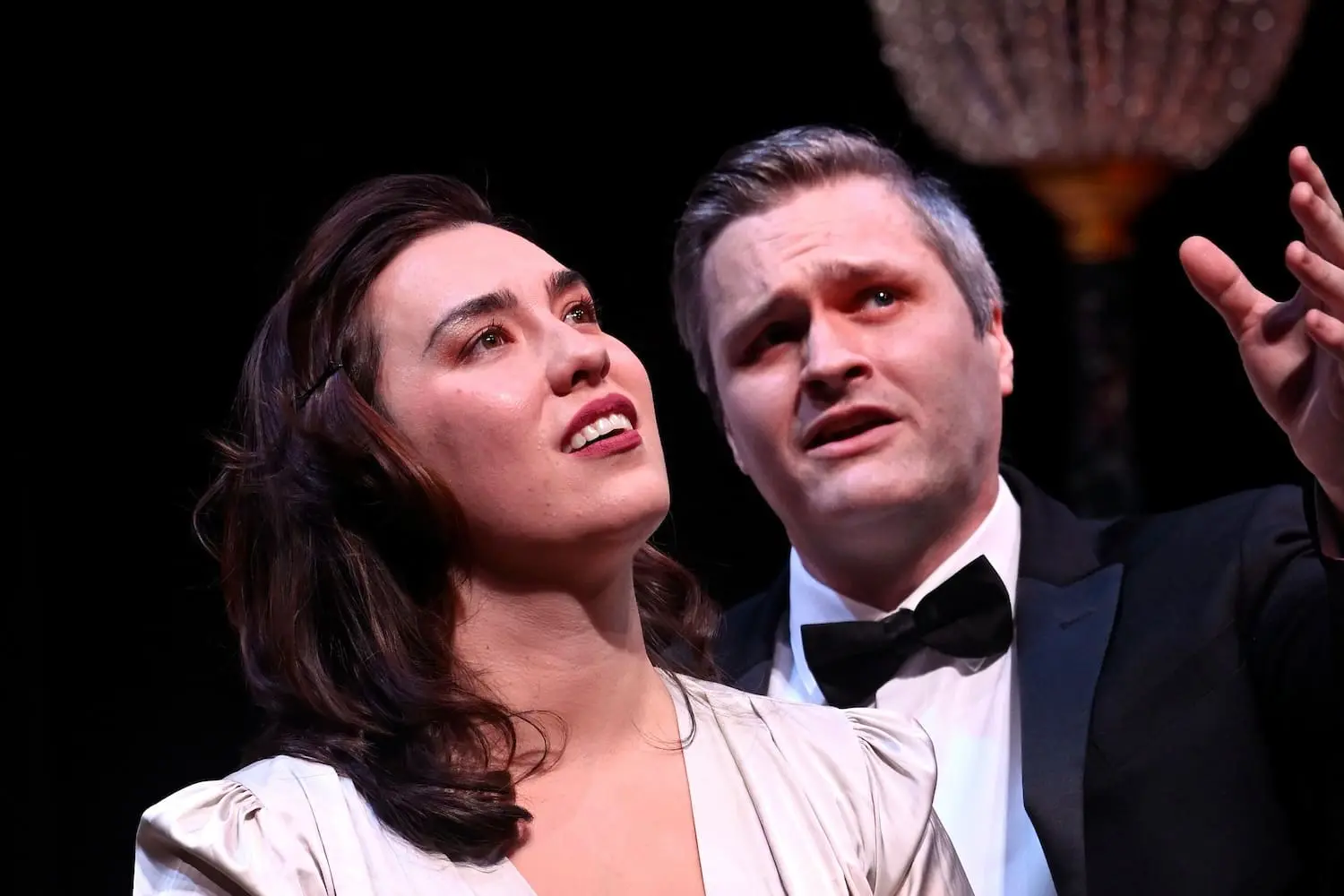
Photo Credit: Mara Bratoš
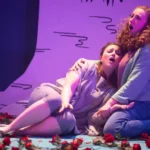
Sofija Petrović as Venus faces off against Eric Laporte’s title character in Tannhäuser
As Wolfram, baritone Ljubomir Puškarić brings a sturdy dramatic presence to the stage. But how much more magical would “O du, mein holder Abendstern” have sounded had he begun with a delicate, nuanced piano and capped it off with a floating pianissimo? As Venus, Sofija Petrović is a portrait of sultry allure. Her rich, dark-hued mezzo-soprano delivers plenty of old-school dramatic weight.
Ozren Bilušić launches into Biterolf’s martial solo with the word “Heraus” oddly mispronounced as “Sheraus.” Meanwhile, Sorin Coliban delivers Landgrave Hermann’s Act Two address with a commanding, full-bodied tone despite having to play the character in a wheelchair, and Petra Cik is a bright, clear-toned Young Shepherd.
The production, updated to modern dress, completely discards traditional, mythical tropes. There is no Venusberg grotto, only set designer Philippe Miesch’s comfy armchair and bed. In fact, the production opens with an almost four-minute unaccompanied mime during which a groggy, post-coital Tannhäuser pours himself a stiff one, then pores over his manuscript paper scattered over the floor. He dons headphones, and in full-on artistic narcissist mode begins to get off on his music (the overture). Good luck finding any frolicking sirens on stage – though they’re heard offstage – and good luck finding a harp when Venus sings “Mein Sänger, auf! Auf, und ergreife die Harfe!” in Act One.
And forget about some leafy, blooming papal rod. At the opera’s end, Tannhäuser is settled in a comfy armchair, headphones strapped over his ears, back in self-narcissistic mode, mainlining the soaring theme of his Pilgrims’ Chorus, sung here with great enthusiasm by Luka Vukšić’s young, blindfolded pilgrims – the Croatian National Theatre Zagreb Opera Chorus. The self-absorbed protagonist’s redemption is achieved strictly through his ultimate, egotistical retreat into his music.
Srba Dinić led the Croatian National Theatre Zagreb Opera Orchestra in a nicely paced account, though occasionally the winds did not set in together. In his 1852 essay “On the Performance of ‘Tannhäuser,’” Wagner stipulates that during the trombones’ fortissimo statement of the Pilgrims’ melody in the Overture, the accompanying instruments (save the tuba and drums) must play the first beat of the bar fortissimo and beats two and three with decreasing force. It’s too late for Dinić to incorporate that, but Simon Krečič can insist on it when he leads this production in Maribor in October and Ljubljana in January, with Laporte reprising the titular role.
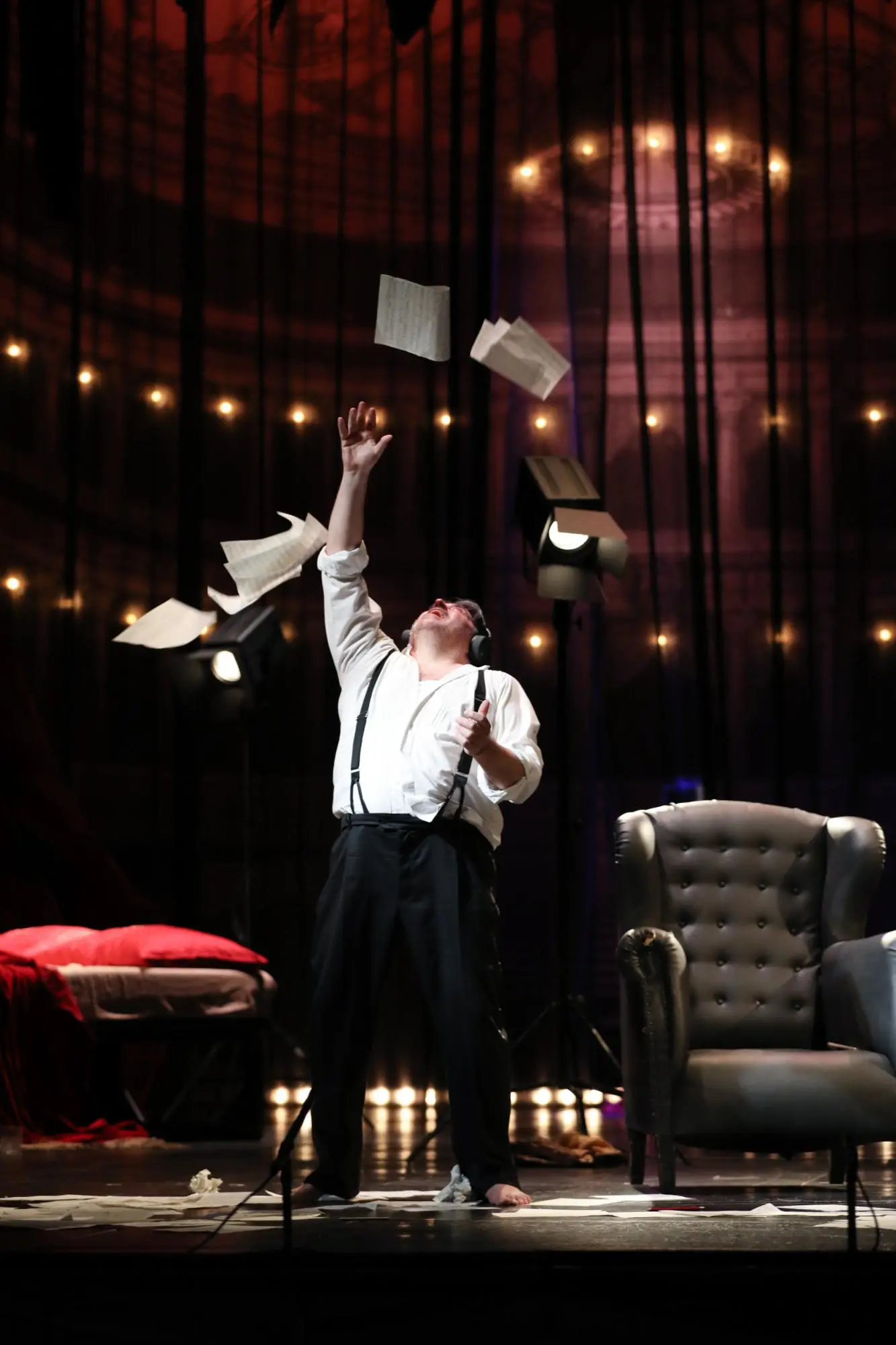
Photo Credit: Mara Bratoš
In this production, Tannhäuser’s redemption is achieved through “egotistical retreat into his own music"
Opera Canada depends on the generous contributions of its supporters to bring readers outstanding, in-depth coverage of opera in Canada and beyond. Please consider subscribing or donating today.