
 Jun 24 - 28 2026
 Brigadoon Alan Jay Lerner & Frederick Loewe
Nuova Vocal Arts
The Orange Hub Theatre Jun 27 - 28 2026Orpheus in the UnderworldOffenbach
Toronto City Opera
Trinity St. Paul's Jun 27 2026Ruth: A Musical Drama Ronald Beckett
Arcady Ensemble
St. James United Church Jun 27 2026 Elektra Strauss
San Francisco Opera
War Memorial Opera House Jun 28 2026 Opera 303 Various
The Redwood Theatre
Redwood Theatre Jul 02 - 04 2026BRAVA: A Cabaret of Devotions Various
Toronto Fringe Festival
Soulpepper Theatre’s Kevin & Roger Garland Cabaret Jul 02 - 04 2026 Coming Home – The Musical Play Various
The Guild
The Guild Jul 02 - 06 2026 The Wounds of Love and Other Gifts Bruce Dow
Toronto Fringe Festival
Theatre Pass Muraille Jul 04 2026 Górecki Immersive Various
Brott Music Festival
Church of the Ascension Jul 06 - 07 2026BRAVA: A Cabaret of Devotions Various
Toronto Fringe Festival
Soulpepper Theatre’s Kevin & Roger Garland Cabaret
No event found!

Brigadoon Alan Jay Lerner & Frederick Loewe
Nuova Vocal Arts
Orpheus in the UnderworldOffenbach
Toronto City Opera
Ruth: A Musical Drama Ronald Beckett
Arcady Ensemble
Elektra Strauss
San Francisco Opera
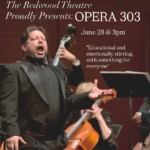
Opera 303 Various
The Redwood Theatre

BRAVA: A Cabaret of Devotions Various
Toronto Fringe Festival

Coming Home – The Musical Play Various
The Guild

The Wounds of Love and Other Gifts Bruce Dow
Toronto Fringe Festival
Górecki Immersive Various
Brott Music Festival
BRAVA: A Cabaret of Devotions Various
Toronto Fringe Festival
St. Matthews Passion Bach
Deutsche Oper Berlin
Canadian(s): Joel Allison (bass)
Text taken from Deutsche Oper Berlin website
ABOUT THE PERFORMANCE
On the work
Bach’s St Matthew Passion (1729) was originally a work designed for performance in St Thomas’s, Leipzig, as a religious ritual for the congregation during the Good Friday liturgy. On the death of Bach this vast and epic composition ceased to feature in the annual ecclesiastical calendar. A century was to pass before the work resurfaced in public consciousness, triggered by Felix Mendelssohn Bartholdy’s legendary “Rediscovery” with the newly formed “Berliner Sing-Akademie”, which also opened a new page of Berlin culture. In 1829 this gathering of the faithful to sing the Passion and celebrate the values expressed within coincided with the movement to foster a national German identity. The emergence of a form of artistic/religious expression coined by an autonomous Berlin citizenry appears closely associated with performances of the St Matthew Passion, and to this day Bach Passions continue to feature prominently on the programmes of large choirs and choruses.
On the production
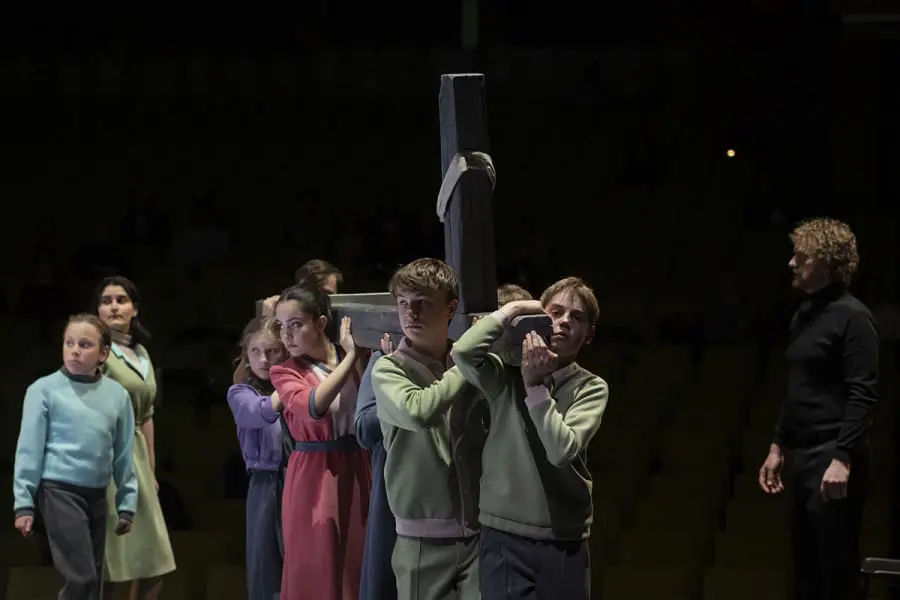
In his staging of the St Matthew Passion director Benedikt von Peter is interested in the extent to which the suffering of Christ can be considered meaningful to a diverse society in which the Christian religion is becoming less and less relevant. How can we grasp the core motif of suffering in today’s world? How much distance to the subject is created at a performance of the piece in a secular venue such as an opera house? And what kind of community is possible?
In his directorial work in musical theatre over recent years, Benedikt von Peter has attracted attention above all with some striking uses of performance space, focusing on the “architecture of a work”, which he seeks to extend from the composition to both stage and auditorium. A St Matthew Passion already written for two choirs by Bach is extended by von Peter over the entire auditorium and main stage. Four orchestras, assorted sections of the Deutsche Oper chorus and a number of Berlin choral societies are spread throughout the hall. The audience – some seated on the stage looking backwards into the auditorium – are encouraged to join in with the singing, with this dual-performative structure producing a sensation of community within the secular setting of the opera house. At the centre of these proceedings the staged action of the Gospel text is played out: children and teenagers narrate the story and provide portrayals of agony, suffering and death – in close proximity to the audience and dovetailing with the musical interpretations of the soloists. A conventional frontal perspective on a picture-frame stage is dispensed with in favour of a religious rite performed together by adults and children, by lay choral singers and professional artists, each with his or her own individual perspective on a 2,000-year-old text and its history of cultural impact.
CAST
Conductor Alessandro De Marchi
Director Benedikt von Peter
Set design Natascha von Steiger
Costume design Lene Schwind
Video Bert Zander
Light Roland Edrich
Chorus Master Jeremy Bines
Chorus Master Children’s Chorus Christian Lindhorst
Director of the Children’s Chorus of the Aalto-Theatre Essen Patrick Jaskolka
Dramaturge Dorothea Hartmann
Evangelist Kieran Carrel
Jesus Padraic Rowan
Bass Joel Allison
Tenor Kangyoon Shine Lee
Petrus Michael Bachtadze
Pilatus / Judas Artur Garbas
Soprano Siobhan Stagg
Alto Annika Schlicht
A two-faced witness Annika Schlicht
A two-faced witness Kieran Carrel
archpriest Michael Bachtadze
1st maidservant Siobhan Stagg
2nd maidservant Annika Schlicht
Pontifex I Artur Garbas
Pontifex II Michael Bachtadze
Chorus Chor der Deutschen Oper Berlin
Chorus Kinderchor der Deutschen Oper Berlin
Chorus Kinderchor des Aalto-Theaters Essen
Orchestra Orchester der Deutschen Oper Berlin