
 Jun 24 - 28 2026
 Brigadoon Alan Jay Lerner & Frederick Loewe
Nuova Vocal Arts
The Orange Hub Theatre Jun 27 - 28 2026Orpheus in the UnderworldOffenbach
Toronto City Opera
Trinity St. Paul's Jun 27 2026Ruth: A Musical Drama Ronald Beckett
Arcady Ensemble
St. James United Church Jun 27 2026 Elektra Strauss
San Francisco Opera
War Memorial Opera House Jun 28 2026 Opera 303 Various
The Redwood Theatre
Redwood Theatre Jul 02 - 04 2026BRAVA: A Cabaret of Devotions Various
Toronto Fringe Festival
Soulpepper Theatre’s Kevin & Roger Garland Cabaret Jul 02 - 04 2026 Coming Home – The Musical Play Various
The Guild
The Guild Jul 02 - 06 2026 The Wounds of Love and Other Gifts Bruce Dow
Toronto Fringe Festival
Theatre Pass Muraille Jul 04 2026 Górecki Immersive Various
Brott Music Festival
Church of the Ascension Jul 06 - 07 2026BRAVA: A Cabaret of Devotions Various
Toronto Fringe Festival
Soulpepper Theatre’s Kevin & Roger Garland Cabaret
No event found!

Brigadoon Alan Jay Lerner & Frederick Loewe
Nuova Vocal Arts

Orpheus in the UnderworldOffenbach
Toronto City Opera

Ruth: A Musical Drama Ronald Beckett
Arcady Ensemble
Elektra Strauss
San Francisco Opera

Opera 303 Various
The Redwood Theatre

BRAVA: A Cabaret of Devotions Various
Toronto Fringe Festival

Coming Home – The Musical Play Various
The Guild

The Wounds of Love and Other Gifts Bruce Dow
Toronto Fringe Festival

Górecki Immersive Various
Brott Music Festival
BRAVA: A Cabaret of Devotions Various
Toronto Fringe Festival
Apocolypse Bach
Opera2Day
Text from the Opera2Day website:
Canadians:Georgia Burashko
The angry citizens of Münster call for the death of the leaders of the newly conquered Anabaptists, including ‘King’ Jan van Leiden. The Catholic Bishop Von Waldeck has their corpses hung in cages from the tower of St. Lambertus Church.
Carpenter Heinrich Gresbeck is brought before the bishop. He fled the besieged city and made a model showing how the city could be reconquered. The bishop is unsure what to do with Gresbeck, who remained in the enemy camp almost until the end. Gresbeck begs to be allowed to write an account of all the events, it will prove his innocence.
We go back in time with Gresbeck. Outside the walls of Münster we see a rebellious group around merchant Bernhard Knipperdollinck. He is incensed: the bishop has banned the popular preacher Bernhard Rothmann from preaching in the city. Rothmann appears and says the tide will turn. Audience members in the group are two Dutchmen, including Jan van Leiden.
The two Dutchmen return to Leiden. There, Jan and his wife Marijtje run a pub where bawdy entertainment is presented. We see how actors, dressed as a hypocritical bishop and an innocent girl, make fun of Catholic confession. Our guest is Dieuwer Brouwers Daughter. She talks about the ideas of her husband Jan Matthijsz, who feels designated as a prophet and predicts that the end times will come. A heavenly city will arise on earth. Jan van Leiden realizes that Rothmann in Münster needs to hear this. Münster is that heavenly city! Marijtje can already see the mood brewing: her husband will once again set out to improve the world elsewhere instead of at home.
In Münster, the protest group of Rothmann and Knipperdollinck has achieved success. They managed to drive the Catholic troops out of the city. The group from Leiden has joined them. They celebrate the victory. Jan Matthijsz, the man who provided everything, is enthusiastically honored. People share their possessions, chained nuns are freed and an iconoclasm is imminent. The mood changes when Jan Matthijsz preaches that all are damned. But Rothmann reminds Jan Matthijsz of his own words: whoever is baptized again is one of the elect. The people fanatically unite in the idea of a purifying baptism.
The Catholics besiege the city. Jan Matthijsz, convinced that he is the hand of God, makes a lunge – alone. He is shot dead immediately.
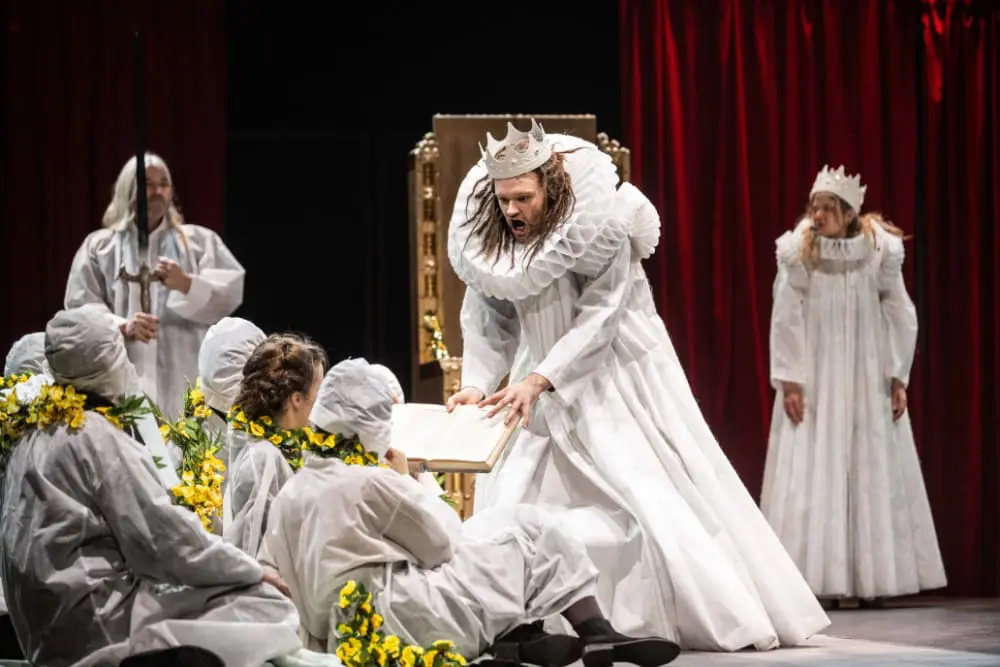
The people are kept satisfied with bread and circuses. The blind seer Dusentschuer is brought before the people. He had a vision in which God appointed Jan van Leiden as king, with Dieuwer as queen. Jan says he dreamed this too. The coronation celebration can begin, but is disrupted by an envoy from the bishop who issues an ultimatum. Jan says that God has already told him another time: the Lord will return to earth with his followers in Münster at Easter. The envoy is chased away.
Jan encourages the people to declare war on the pagan enemy. Women must be at the forefront of this struggle. John introduces polygamy in order to create the army of 144,000 – the number of chosen ones spoken of in the Bible.
PAUSE
SECOND PART
Months later. The toppings are suffocating, the food is running out. Neither the Messiah nor outside auxiliaries showed up. Jan wonders whether God supports his followers. He tells Rothmann that they will have to unleash the final battle themselves. A handcuffed woman, Elisabeth Wandscherer, is brought in. She refuses to be forced to marry. Knipperdollinck wants to punish her; Dieuwer advocates compassion. King John combines both wishes: he takes her as his wife, at the age of seventeen. Dieuwer points out to Jan how far he has become from the original ideals they shared in Leiden. Jan points out her hypocrisy to Dieuwer: after all, she enjoys her privileged life as queen. After an argument, Dieuwer is left alone and considers her fate.
In a letter to the bishop, Gresbeck describes the dire hunger in the city and asks him to relieve the city.
King John does everything he can to keep the people at his side. With violence, but also by boosting the mood. He organizes a parody mass. The Catholic Mass, in which the ‘real’ flesh and blood of Christ is consumed, is ridiculed. In a pagan sacrificial ritual, all citizens bring the last edibles in the city to the altar. Knipperdollinck steals the show with a real ‘Lamb of God’. However, when he unveils his lavish dish, the mood changes. Jan forces the Münsterans to continue celebrating. He realizes that the apocalypse has indeed come, but that it is they themselves who will perish. Jan sinks into depression. Rothmann and Dieuwer devise a plan to escape the city together. Many civilians also flee the city in despair, receiving fire from both the city and enemy troops. Gresbeck manages to reach the episcopal troops alive. He tells them how to retake the city.
The bishop enters the conquered city. He talks to the still depressed ‘king’ Jan. Jan has ruined him and the city, says the bishop. Jan sees it differently: the bishop is famous for his recapture. And Jan can make the bishop rich. All he has to do is exhibit the Anabaptist king in a cage and sell tickets for it. Jan is taken away. The bishop tells the people that anyone who reports an Anabaptist will himself be spared. The Münsterans start pointing at each other. But they realize: everyone was complicit.
In prison, Jan receives the bishop’s chaplain for a final confession. Jan says he deserves to be killed ten times. However, the chaplain makes Jan think more deeply about his own words and actions.
On Domplein we hear the angry crowd. The Anabaptist leaders are taken away in chains on their way to execution. The bishop has (cynically) accepted Jan’s suggestion: the corpses will be exhibited in cages. Gresbeck is released and fobbed off with a tip. With his report he managed to save the day.