
 Apr 15 - 19 2026
Pelléas et Mélisande Debussy
Opera Atelier
Koerner Hall at the TELUS Centre for Performance and Learning Apr 17 - 19 2026A Night in Venice Strauss
Toronto Operetta Theatre
Jane Mallett Theatre Apr 17 - 19 2026The Fox Roan Shankaruk
Opera Unbound
Annex Apr 18 - 19 2026The Barber of Seville Rossini
Calgary Opera
Southern Alberta Jubilee Auditorium Apr 18 2026The Marriage of FigaroMozart
Manitoba Opera
Centennial Concert Hall Apr 19 2026She Holds Up the Stars Eliot Britton
Red Sky Performance & Toronto Symphony Orchestra
Roy Thomson Hall Apr 22 2026Orpheus & Eurydice Gluck
Pacific Opera Victoria
Royal Theatre Apr 22 2026The Marriage of FigaroMozart
Manitoba Opera
Centennial Concert Hall Apr 22 - 23 2026Cavalleria Rusticana Mascagni
Alberta Vocal Arts
Apr 24 2026The Barber of Seville Rossini
Calgary Opera
Southern Alberta Jubilee Auditorium
No event found!
Pelléas et Mélisande Debussy
Opera Atelier

A Night in Venice Strauss
Toronto Operetta Theatre

The Fox Roan Shankaruk
Opera Unbound

The Barber of Seville Rossini
Calgary Opera

The Marriage of FigaroMozart
Manitoba Opera
She Holds Up the Stars Eliot Britton
Red Sky Performance & Toronto Symphony Orchestra
Orpheus & Eurydice Gluck
Pacific Opera Victoria
The Marriage of FigaroMozart
Manitoba Opera
Cavalleria Rusticana Mascagni
Alberta Vocal Arts
The Barber of Seville Rossini
Calgary Opera
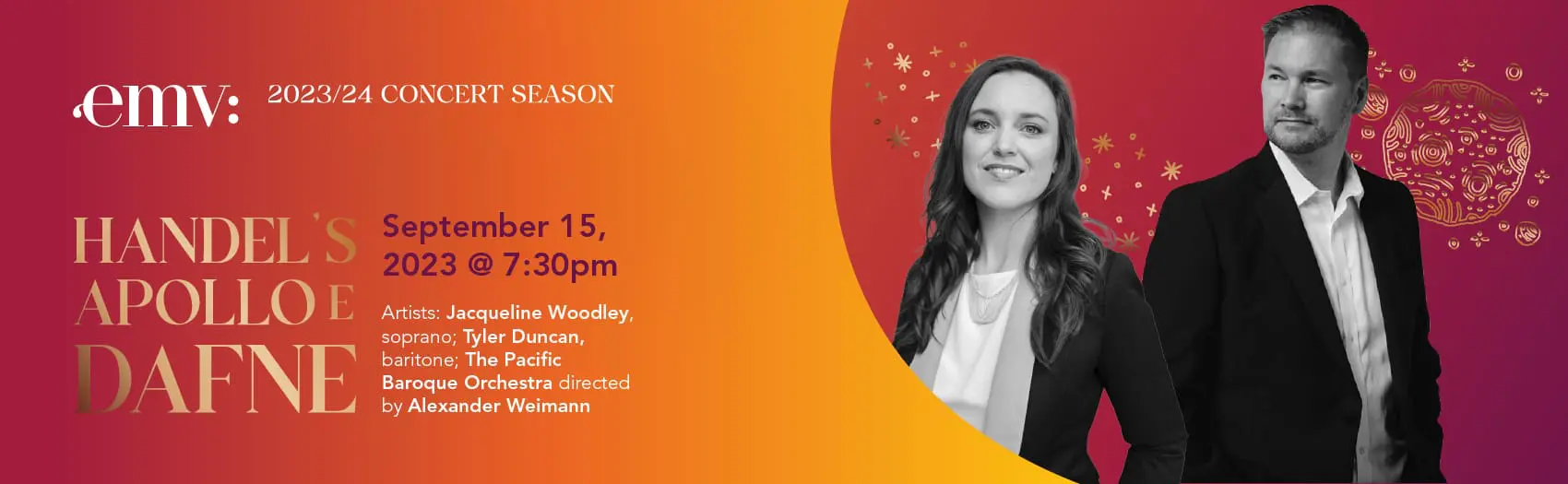
Apollo e Dafne Handel
Early Music Vancouver Summer Festival
Text is from the Early Music Vancouver website.
Jacqueline Woodley, soprano; Tyler Duncan, baritone; Pacific Baroque Orchestra directed by Alexander Weimann
In Apollo e Dafne, Handel retells the ancient story of a boastful god’s frustrated love and a determined nymph’s unbending resistance. This dramatic cantata, completed after Handel’s return from Italy, exudes the fresh vitality and self-assurance of a newly famous composer at his homecoming and hints at the future glories of his opera career. Alongside this colourful early work, the Pacific Baroque Orchestra presents Vivaldi’s Bassoon Concerto in B-flat major (“La Notte”) featuring bassonist Nathan Helgeson and Handel’s Overture to Agrippina.
This concert is generously sponsored by Delma Hemming & Vincent and Zelie Tan
PROGRAMME
George Frideric Handel (1685-1759)
Ouverture from Agrippina, HWV 6
Antonio Vivaldi (1678-1741)
Bassoon Concerto in B-flat major (“La Notte”), RV 501
Largo – Andante molto
Presto (Fantasmi)
Presto
Gli Istromenti sempre pianissimo (Il Sonno)
Allegro (Sorge l’Aurora)
George Frideric Handel
Apollo e Dafne (La terra è liberata), HWV 122
PROGRAMME NOTES
From 1738 to 1818, visitors to London’s Vauxhall gardens flocked to see Louis Roubiliac’s marble statue of George Frideric Handel, who had by that time won his share of laurels as England’s musical hero. The “laurels” are metaphorical in this case, because Roubiliac’s Handel is dressed not in classical regalia but in comfortable contemporary dress: casually leaning on a stack of his own musical scores, he sports a soft cloth cap, a simple shirt open at the collar, a loose robe and slippers—a composer at work in his own home. Despite this homely depiction, to be represented by a life-sized marble statue was a rare and perhaps unprecedented honour for a living composer, one usually reserved for rulers and military heroes. This contrast is brought out by the one deliberate anachronism introduced by Roubiliac in his portrait of Handel: the ancient Greek lyre that the composer is plucking with his right hand. The instrument suggests a resemblance to the mythical musician Orpheus, or even—as the inlaid face and radiating sunbeams on the lyre would suggest—to the Greek sun-god Apollo himself.