For their fall chamber opera program, Glenn Gould School at the Royal Conservatory of Music selected an unusual double bill: The Telephone by American composer and librettist Gian Carlo Menotti and Baby Kintyre, a Canadian piece originally written for radio by composer and librettist Dean Burry.
Staged in Mazzoleni Concert Hall instead of the larger Koerner Hall, director Liza Balkan tried to unify the two works by incorporating the larger cast of the second piece silently into the first, so that the entire evening became part of the same company’s presentation, with the two characters in Menotti’s duologue just part of a larger ensemble of performers presenting a radio play (“Did you miss your train?” in The Telephone became “Did you miss your cue?”)
Although this concept didn’t work as successfully for all performers, it provided a framing device for the evening, and Balkan is to be commended for her very strong work with the young cast. She had obviously done advance work with them examining the ways in which the pieces were still relevant, and she brought a level of comfort and naturalness to the students’ performances which was particularly effective in the intimate environment at Mazzoleni Hall.
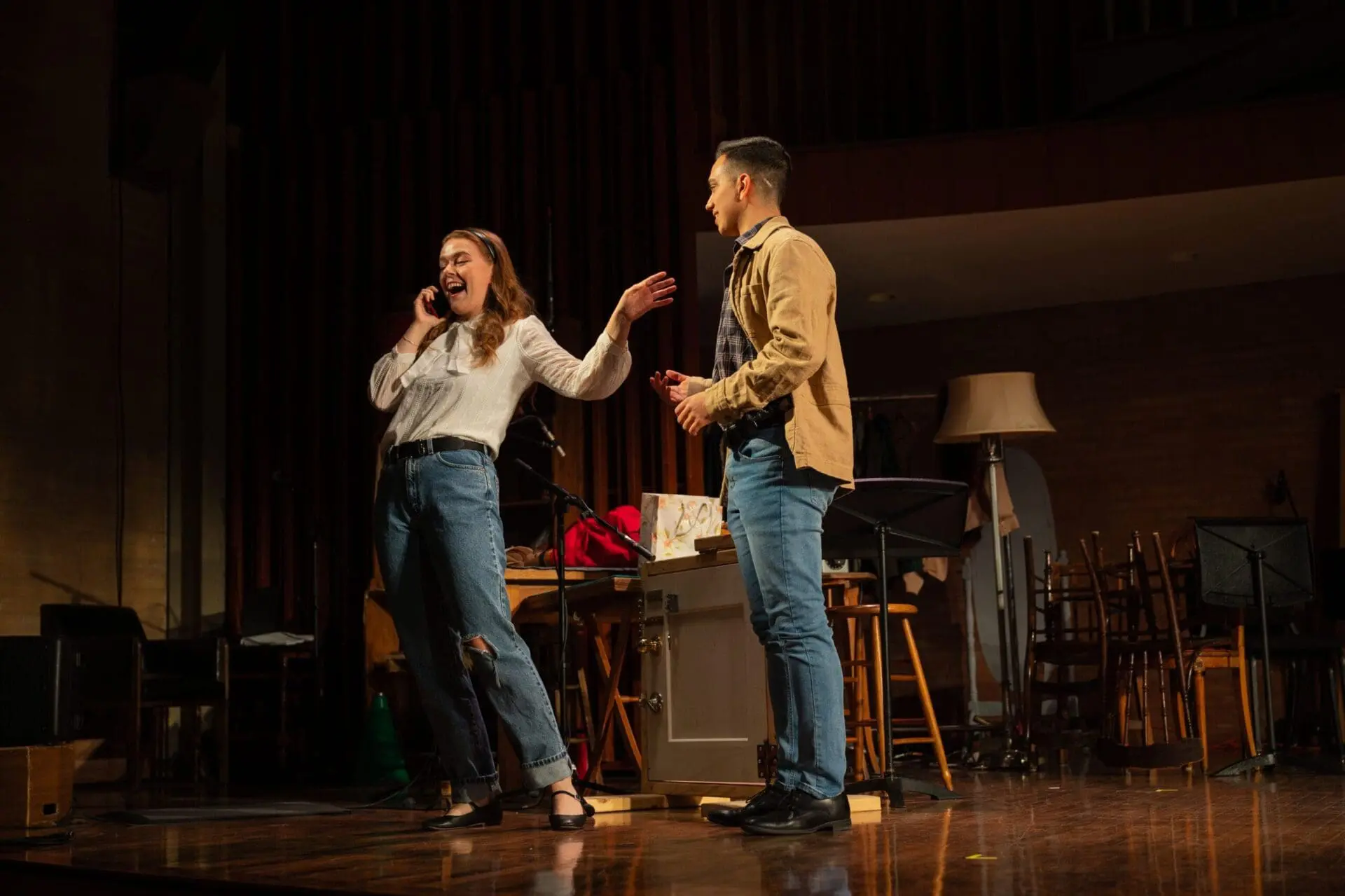
Menotti wrote The Telephone as a short “curtain-raiser” for The Medium, a longer – and darker – opera; they were first performed together in 1947. It tells a simple story in which Ben (here named Matt for the performer) tries desperately to propose to his beloved Lucy (now Lyssa), but his efforts are continually interrupted by the ringing of her telephone and her ensuing conversations. In the end, he resorts to the telephone himself to propose to her, and she happily accepts.
Alyssa Bartholomew sang beautifully. She has a lovely lyric soprano, and her coloratura passages in the opening aria (“Hello? Hello! Oh, Margaret, it’s you.”) were beautifully incorporated into her reading of the piece so that they felt well-earned. Unfortunately, she often stepped out of Sarah Mansikka’s lighting design, which might have said more about the technical limitations in the hall than it did about either the singer or the designer. Matthew Black was also good as her timid boyfriend. A lot of his role is spent silently waiting for Lyssa’s telephone calls to finish, and he had a very strong, natural presence onstage that commanded attention without distracting from her work. He also has a beautifully resonant and relaxed baritone timbre. Both singers showed immense promise.

Photo Credit: Gaetz Photography
His wife (Charlotte Anderson) is on the phone with contractor Bob (Jeffrey Liu) when he makes his discovery in Baby Kintyre
Baby Kintyre takes its premise from a 2007 Toronto news story regarding the discovery of a mummified infant during the renovation of a Riverdale house. Burry, who was present at the performance I attended and introduced the work, said that he became fascinated by the story when he heard a radio interview by two CBC reporters as he was driving home from the cottage. The reporters had found a woman who had lived in that house as a child around the time when the baby must have died, and they were building possible theories around the identity of the infant. Burry immediately approached the two reporters to inquire about turning their story into an opera, and his Baby Kintyre premiered on CBC in 2009. The piece has rarely been performed onstage.
Burry’s chamber opera, scored for string quartet, double bass, clarinet/saxophone and piano, is beautifully atmospheric. The score is lyrical and builds to a haunting climax set on top of an arrangement of “Amazing Grace.” Music is used effectively to depict various characters, which must have been essential for radio performance. Here, Balkan has staged the piece as a radio play, with the singers working in front of prop microphones and other performers creating live sound effects that mirror the drama and build tension. The onstage sound effects were supplemented by recorded audio clips – possibly from the original CBC piece – that added depth and resonance.
As an ensemble opera, there were fewer opportunities for individual performers to stand out, but some singers deserved special mention. Jeffrey Liu, as the contractor who makes the discovery, has a clear, ringing tone and coped well with the high tessitura of the tenor role. Gabriel Klassen demonstrated natural stage presence and an agile light baritone, and Leandra Dahm, as the child Rita, should be commended for her performance, which was simple and never lapsed into the caricature possible when an adult is performing as a child.
Conductor Jennifer Tung led the two pieces from stage left. Her preparation of the singers must have been exceptional, since they could only have seen her peripherally during the actual performance, and she provided both pieces with a strong sense of momentum and a good feel for the overall shape of the evening.
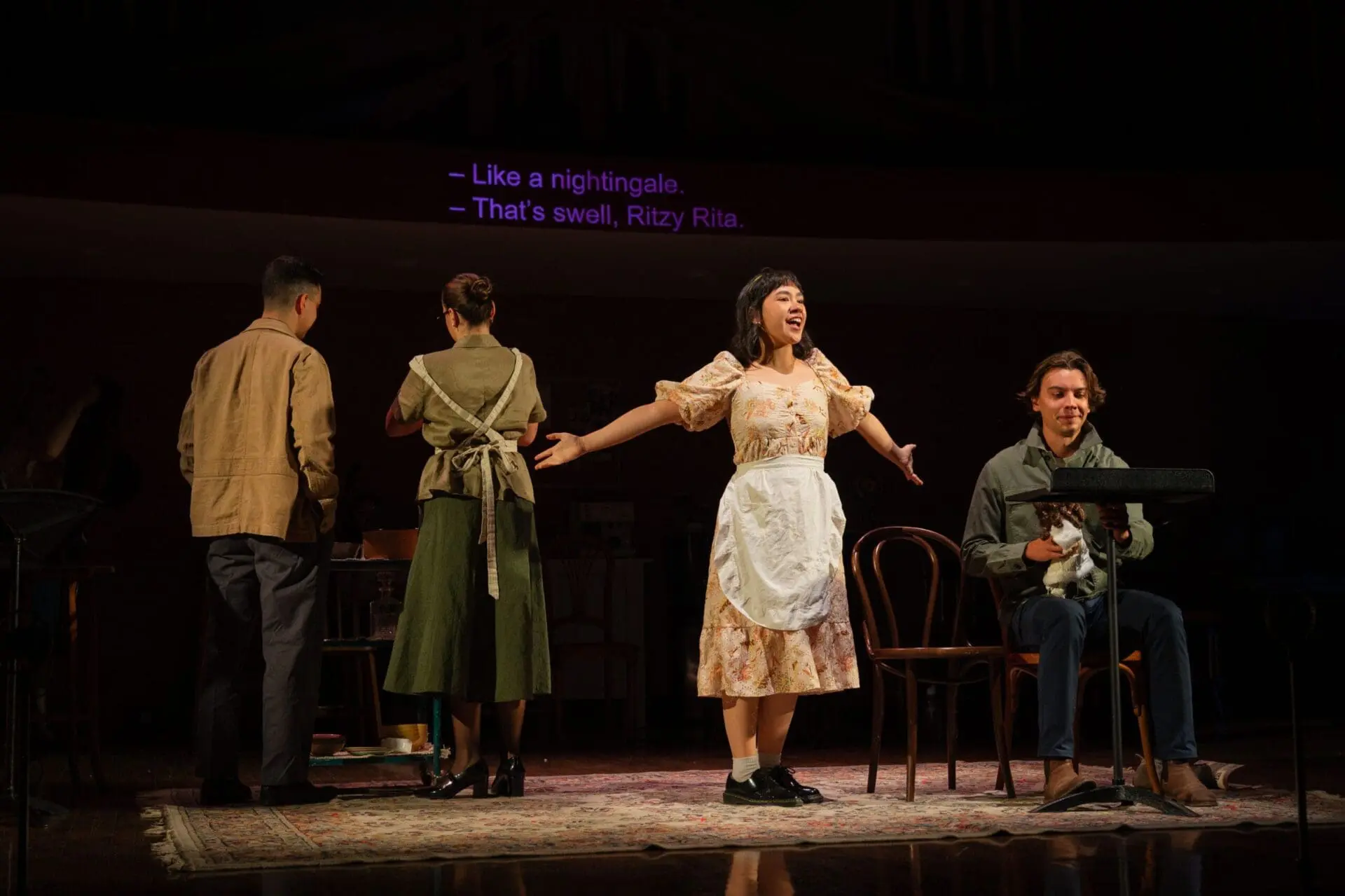
Photo Credit: Gaetz Photography
The child Rita (Leandra Dahm) meets new boarder George (Gabriel Klassen) as her uncle and aunt (Matthew Black and Alannah Beauparlant, facing upstage) discuss him
Opera Canada depends on the generous contributions of its supporters to bring readers outstanding, in-depth coverage of opera in Canada and beyond. Please consider subscribing or donating today.