Manitoba Underground Opera (MUO) re-surfaced this summer with Rossini’s Le comte Ory, a compact, gender-bending re-imagining of the nearly 200-year old comic opera written for the Opéra national de Paris in 1828, and based on Eugène Scribe and Charles-Gaspard Delestre-Poirson’s French libretto.
MUO, the indomitable troupe that has weathered many a storm – literally – since it was founded in 2008 by executive director Brendan McKeen returned to Club 200, notably Canada’s longest running gay bar, where it staged last fall’s epic, nine-performance run of Offenbach’s The Tales of Hoffman. Its original plan to perform this year’s lone mainstage production, teeming with lust and lechery, al fresco at the historic St. Boniface Cathedral became kiboshed only four nail-biting weeks before curtain, re-affirming this modest-sized Prairie company’s backbone of steel.
Kudos to Winnipeg-based librettist/bass-baritone Max Fingerote for his Herculean task of compressing the original, roughly 150-minute opera into a whirlwind 70 (plus a 20-minute intermission); as well as infusing its (now) English libretto with contemporary vernacular including plenty of “oh wows,” as well as the odd, albeit still shocking in the typically rareified opera hall, “F-bomb.”
These artistic choices further underscored Saturday matinee’s performance with populist appeal, as did its modern day setting and costumes – not to mention Rossini’s rich bounty of glorious, intricately scored bel canto arias, mostly still intact – thus making it more accessible and even arguably palatable for 21st-century sensibilities than its original 1200s Crusades timeframe of “holy wars.”
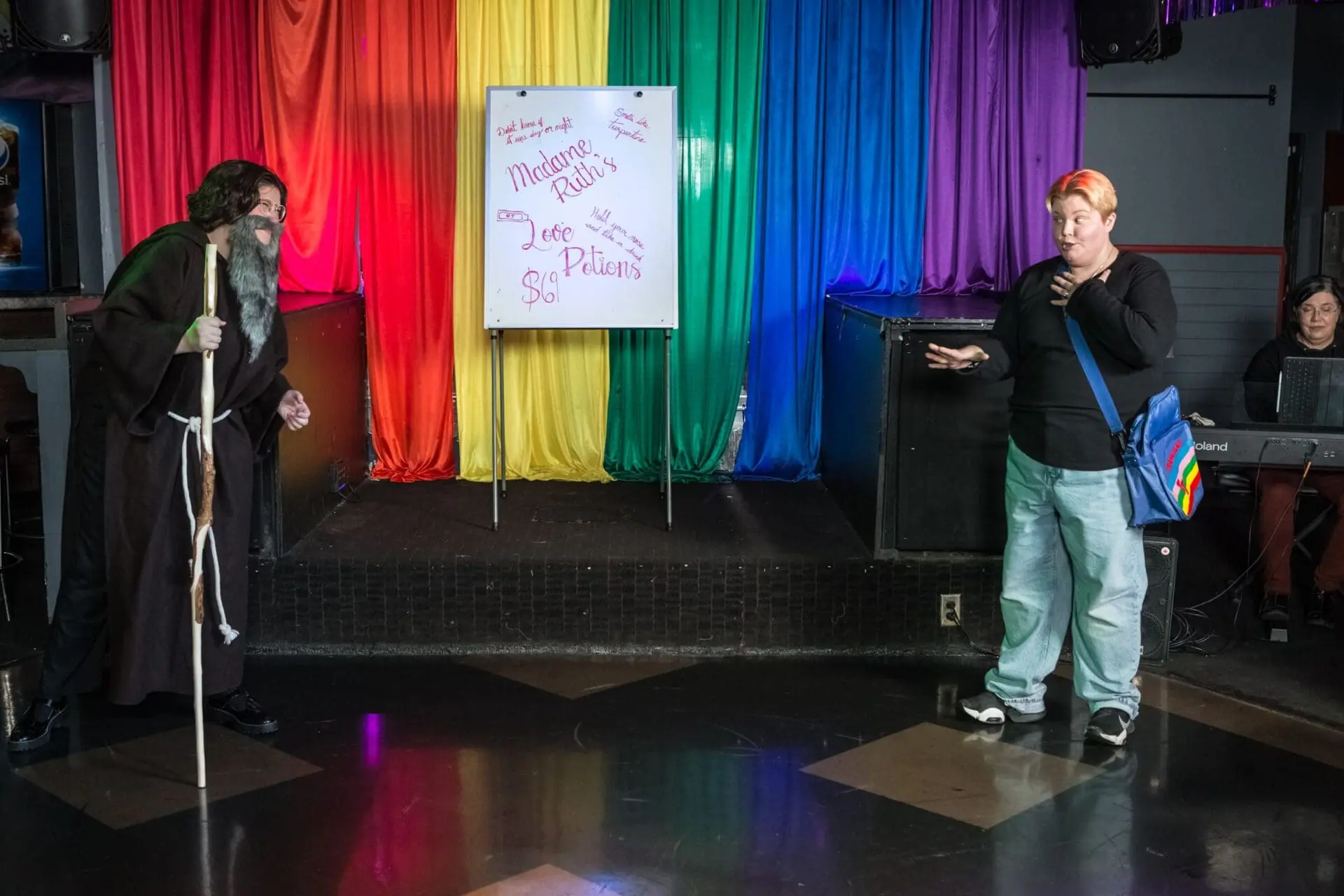
Another noteworthy change is the amalgamation of Ory’s friend Raimond and his more generically monikered Tutor, now conflated into a single role, i.e. Roberto, performed admirably by Stephen Haiko-Pena. His booming bass-baritone enthralled, just as it did portraying The Four Villains during last year’s Hoffman, first trumpeting the arrival of a “hermit,” AKA the crafty Ory in disguise, to the women desperately awaiting the return of their husbands from battle.
However the production’s most significant alteration is having its protagonist Ory now morphed into Countess (mezzo-soprano Keely McPeek), creating a fascinating “love is love” sub-text of same-sex attraction, as both she and her page, the trouser role of Isolier (performed with dramatic flair by mezzo-soprano Geneva Halverson), vie for the affections of Countess Adele (soprano Grace Budoloski).
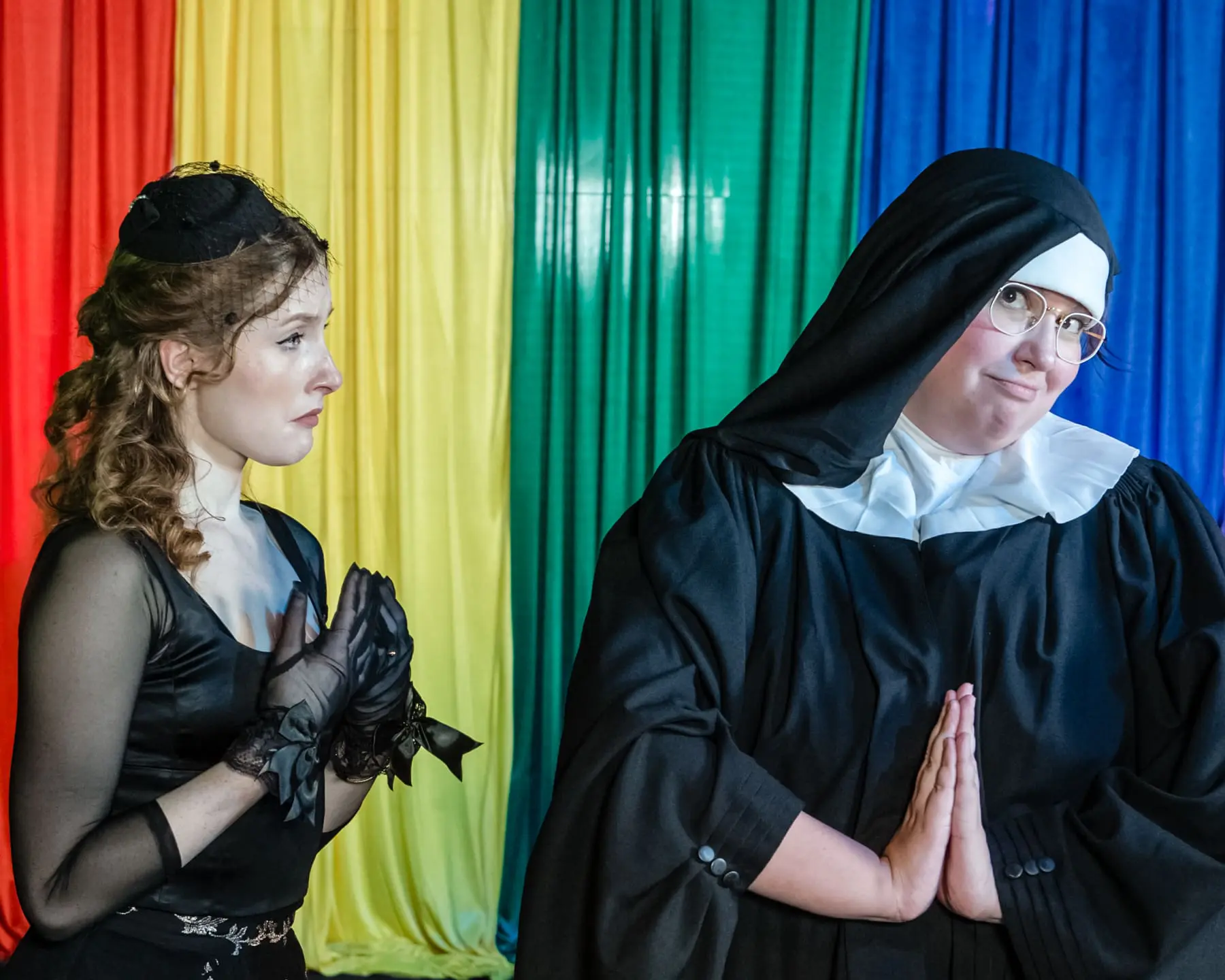
Photo Credit: Paul McKeen
Grace Budoloski (Adele) and Keely McPeek (Ory, this time in disguise as a nun) in MUO’s Count Ory
The already intricate plotline pumped up further by additional gender swapping is truthfully enough to make one’s head spin – even for opera – but stage director Matthew Paris-Irvine thankfully maintains taut rein on the show’s multiple moving parts and meta-layers. He also remains tightly focused – gone are several of the larger chorus numbers, including the wine-soaked drinking scene at the top of the second act with the “14 pilgrims” – on the show’s individual relationships, which adds further cohesive narrative glue.
Clever stage business and unscripted visual details, including Adele’s long suffering assistant Ragonde (mezzo-soprano Joanna Loepp-Thiessen) furiously popping “meds” as her stress levels begin to soar and several of the lovesick women mooning for their men while holding stuffed teddy bears for comfort, inject both all-too-real humour and pathos into their performances.
The eight-member, streamlined chorus moves effectively between the club’s barstools, steps and tables as they respond to the action and deliver satisfying, antiphonal harmonies. Music director/collaborative pianist Shannon Hiebert, a fixture in MUO shows, returns with flawless keyboard acompaniment. The choice to have a lone “orchestra member” rather than a slightly larger, multi-instrumental chamber ensemble neatly solves pesky balance issues in the smaller venue that had arisen in prior MUO productions.
Budoloski, who dazzled as Gretel in last summer’s MUO production of Hansel and Gretel as well as one of The Four Servants in Hoffman, once again lit up the stage with coquettish charm as Countess Adele. Her crystal clear soprano and effortless colouratura – including nailing her stratospheric high E-flats –sparkled as much as her rhinestone stiletto heels as she flounced about the stage and pouted over having to live “like a widow.” Her mercurial portrayal was spot on.
McPeek likewise crafted a believable Countess Ory madly in love/lust with Adele, her more melifluous vocals on full display as she promises “Good fortune smiles upon you,” and blending seamlessly with Budoloski during their duets. A special nod to this singing-actor’s innate knack for comedy including slapstick buffoonery, as Ory first appears as a weirdly bearded “hermit” and later as the seemingly pious “Sister Colette” seeking refuge from the galestorms of “Ory.”
With its skeletal stripping of the opera’s original libretto matched by a galloping narrative arc (and despite several missed golden opportunities to highlight more pointedly real-life’s potentially gender-fluid gradations of love), MUO poses a timely question of just how far an opera can be revised and/or redacted to still make it sing in a social-media driven era of sound bytes and snappy chats.
The 17-year old company, however, has honed its reputation on creative risk-taking, with its latest offering produced in tandem with this year’s child-friendly Neighbourhood Opera Tour of Jack and the Beanstalk. The family work is being performed through early September in a variety of rural and urban communities, notably including several First Nations throughout Northern Manitoba for a inaugural time, and is another lynchpin in that ever-growing legacy.
Opera Canada depends on the generous contributions of its supporters to bring readers outstanding, in-depth coverage of opera in Canada and beyond. Please consider subscribing or donating today.