Inspired by a pandemic-era road trip, Take This Waltz is the idiosyncratic, multidisciplinary love child of renowned bass-baritone Daniel Okulitch and Ne.Sans Opera & Dance’s artistic director Idan Cohen. A hybrid form embodying opera, dance and chamber music with strong cinematic overtones, the creators may well have invented a whole new genre – let’s call it cohenlieder. True to its highway origins, it is a kind of travelogue through Leonard Cohen’s oeuvre.
The production debuted at the same Chutzpah! Festival in Vancouver in 2022 where this iteration was presented in partnership with Vancouver Opera. It was preceded by 2012’s Chelsea Hotel, a Cohen musical of sorts, and the Cohen-approved piece of dance-theatre called Dance Me, created by Les Ballets Jazz de Montréal. While one can draw parallels to these precedents, Take this Waltz is unique in its casting of an opera star as a Cohenesque everyman, who is joined on his musical journey by dancer Ted Littlemore as a spiritual companion / expression of the singer’s inner self.
Cohen’s songs are about interior dramas of the heart and soul instead of exteriorized grand Romantic themes, so there is a huge difference in scale here in a genre that could also be named opera intime. But it mostly worked, as Okulitch’s rich bass-baritone – that sounded at times like black velvet melting – carried the show.
And perhaps naming its kind is less important than enjoying the ride. Indeed, it was both a visual and musical pleasure to watch the kinetic interaction between dancer and singer who matched each other in their rich articulations of body and voice. They were accompanied on stage by live chamber music, well played by Taras Luka on accordion, Llowyn Ball on violin and Doug Gorkoff on cello with a spare yet evocative spirit.
Although there were suggestions of storylines, most of the interpretations of Cohen’s work arrived at a kind of universality, exploring the themes of love and death. The props and set design (by Amir Ofek) were simple but effective: a table, a chair, a suitcase, a bottle of wine and two glasses (revealed during “Treaty”), and later doctor’s and patient’s gowns donned in “One of Us Cannot be Wrong” (“I showed my heart to the doctor / He said I’d just have to quit”) and the x-rayed image of a heart. Lighting design by Itai Erdal and the suggestion of whiteface makeup on the mute Littlemore lent the feel of a silent film. Musical arrangement by Adrian Dolan and the work of dramaturg Raïna von Waldenburg helped transform the evening into one of Cohenesque metatheatre.
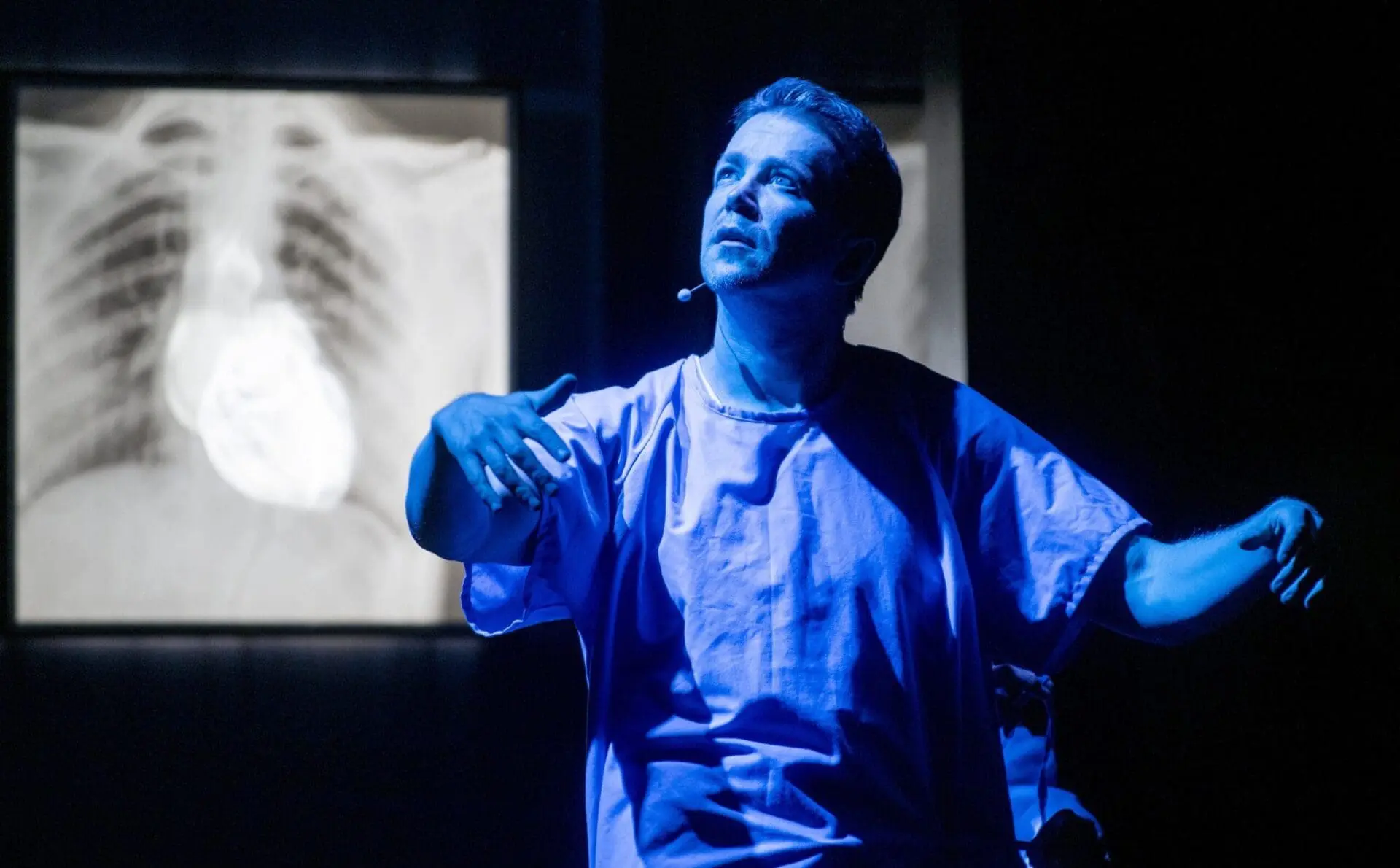
Photo Credit: Chris Randle
Ne.Sans Opera & Dance may have created a whole new genre in Take This Waltz – “let’s call it cohenlieder”
Transmuting the unique alchemy of Leonard Cohen songs into operatic form is no small feat. Okulitch shared, in a post-show talk-back, that selecting the right songs that were melodic enough and not quasi monotone with only a few notes or chords was a tricky process. Of the ten songs performed in the 55-minute production, the ones that worked best from an operatic perspective were “A Singer Must Die,” with its dramatic crescendos and timely lyrics (“Your vision is right, my vision is wrong / I’m sorry for smudging the air with my song”) and, oddly enough, the often overdone “Hallelujah,” which was saved by some lovely harmonic riffs and an almost improvised feeling chorus that improved the song with subtle understatement.
Sadly – and full disclosure this is one of my favourite Cohen songs that I have performed from Baghdad to Beirut – there was no budget for an arrangement of “Dance Me to the End of Love.” Instead, that song was interpreted choreographically by Littlemore who performed a technically challenging music-box ballerina-style dance inspired by something Okulitch found on YouTube conceived by a Mexican Cohen fan. (https://www.youtube.com/watch?v=SuhuvNIVg_s)
The final scene continued the cinematic theme – perhaps unwittingly channeling the end of Midnight Cowboy – with Littlemore and Okulitch holding each other on a bus as the sound of a heart monitor flatlined.
With the current state of the world making every Cohen lyric even more meaningful (in particular the lovely “Treaty”: “I do not care who takes this bloody hill … I wish there was a treaty / Between your love and mine”), this production also included a very moving addendum from “The Partisan.”
“Oh, the wind, the wind is blowing / Through the graves the wind is blowing / Freedom soon will come / Then we’ll come from the shadows.”

Photo Credit: Chris Randle
Daniel Okulitch’s rich bass-baritone carried the show
Opera Canada depends on the generous contributions of its supporters to bring readers outstanding, in-depth coverage of opera in Canada and beyond. Please consider subscribing or donating today.