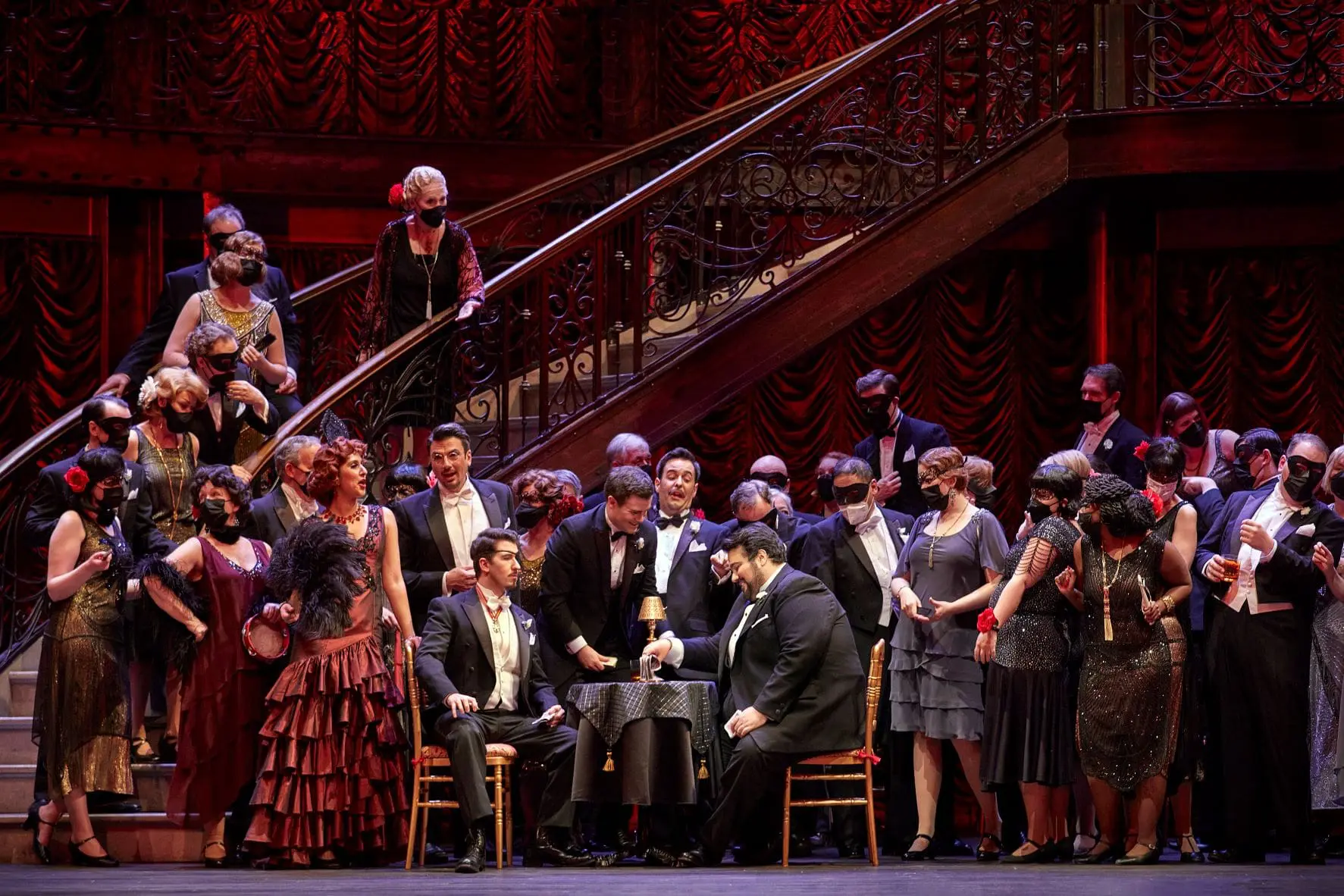
The journey to see Nebula Peformances production of La Tragédie de Carmen was as memorable and unexpected as the opera itself.
I rarely travel to the outer reaches of South Vancouver, and especially not to the intersection of Oak and 74th Avenue, a semi-industrial area by the river, which I’ve always imagined would be the ideal spot for an abduction. While I wasn’t actually kidnapped by the fellow that drove me there in a white van, I was completely captured by both the charming new theatre space and the talented team of young singers who, under the deft direction of David Walsh, brought new life to Peter Brook’s adaptation of Bizet’s classic.
The brainchild of pianist/impresario/wunderkind, Wenwen Du, a former student of Walsh’s at the Vancouver School of Music, the Nebula Performances theatre, offices and rehearsal space is carved out of a former warehouse for bathroom supplies across from a distillery. The site is owned by producer Alice Chee, Wenwen’s godmother, and designed by her engineer husband and company technical director Lynol Amero. In contrast to the traditional Canadian cultural model, it’s run purely on private funding.
On the night I attended, the faint drone of a bass line from a nearby bhangra rave floated up from the river park, and the spirit of Bertolt Brecht hovered nearby. Could this area under the Oak Street bridge become Vancouver’s long awaited new arts precinct? I certainly hope so.
But it was the spirit of Prosper Mérimée that dominated Saturday’s performance along with just a touch of West Side Story. Walsh’s version of Peter Brook’s adaptation of Bizet’s opera – based on Mérimée’s novel of the same name – premiered in 2019 in Minneapolis, where he teaches opera at the University of Minnesota. Walsh, who saw the original 1982 production by Brook in Paris, took the 90-minute distillation of Bizet’s opera, ground down to the essential tragic love story between Carmen and Don José, and set it in an inner-city high school. The initial production was aimed at a teenage audience, but the Vancouver version appealed to a wide range of ages in the sold-out, intimate 50-seat theatre on Saturday.
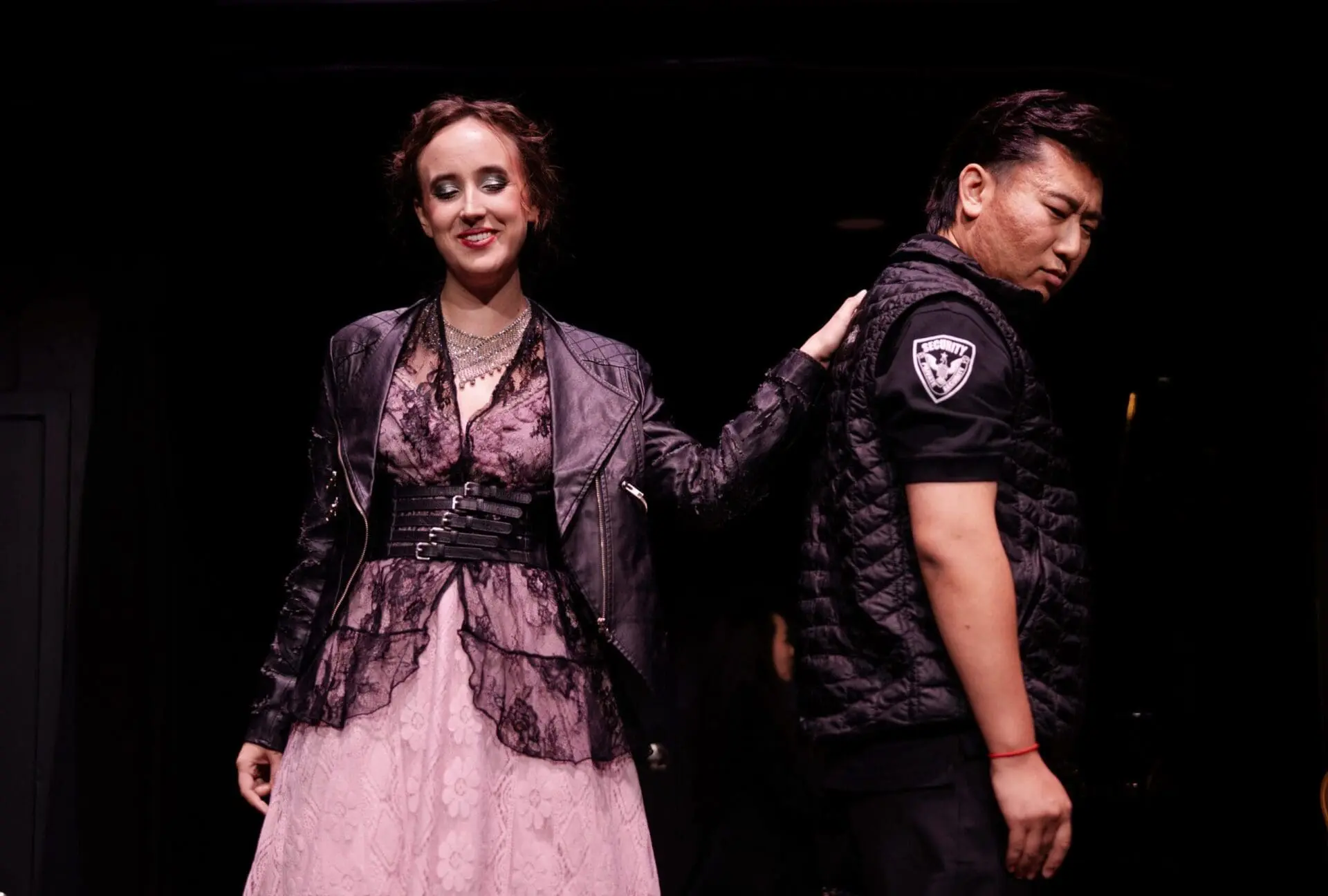
Walsh, a Canadian who has made his name internationally working with the likes of the Scottish Opera and the Royal Opera House, has created some original English libretto that, together with the set, costumes and young cast, infused the opera with a fresh and contemporary relevance. Instead of a cigarette factory in Spain, Brook has reimagined the setting as an American inner city high school, with Don José as an immigrant security guard. As students walk through a weapons scanner, he falls hard for a teenage Carmen.

Photo Credit: James Yang
Geoffrey Schellenberg as the Toreador Escamillo, here reimagined as a high school football star
As played by Taryn Plater, one of three Equity performers in a production that leans heavily on UBC opera graduates, the audience fell hard for her as well. Her strong yet lyrical mezzo-soprano and excellent acting chops seduced patrons and Don José, played with great feeling and nuance by Wanshuai Yu, with equal aplomb. But Tamar Simon’s Micaëla was commensurately as strong as her rival, and the clear vibrant tone of the Armenian-Canadian soprano infused the role with an appropriate purity of spirit.
The new English libretto works well, adding layered meaning to Don José’s anguish when his superior Zuniga (well played by Matthew Görlitz) suspends him from his job for setting Carmen free, telling him, “Go back where you come from!” The character of Garcia, Carmen’s husband, who appears in the novel but not in Bizet’s opera and was reappropriated by Brook, also appears in Walsh’s production but with new libretto. As played with gangsta cool by Ming-Xuan Chung, when he encounters an agitated Don José, he tells him, “Beat it before you end up face down in a dumpster!”
The toreador Escamillo has been transformed by Walsh into a high school football star, and as played by Geoffrey Schellenberg creates genuine chemistry with Plater’s Carmen. Walsh has reclaimed the characters of Frasquita and Mercédeès, and he has them scrolling through Tinder to great effect as they fantasize about their romantic fortunes.
The staging in the small but beautiful theatre never missed a beat, with some lovely touches like a young dark haired gypsy flower girl (played with elegant presence by Riya Bist) acting as a kind of goddess of fate. In a Walsh-conceived scene, she presides over a kind of secret wedding ceremony and exchange of blood and rings between Carmen and Don José that was reminiscent of Tony and Maria’s poignant moment in the drugstore, or even of Romeo and Juliet.
A projector offered simple but powerful images on a screen above the stage, such as a close-up of a rose, disintegrating into forlorn petals like Carmen’s love for Don José, or gangland-style graffiti on a wall, while an industrial door was effectively used for dramatic exits and entrances.
Throughout, musical director Wenwen Du’s exquisite piano playing (she is the accompanist for English tenor Ian Bostridge) grounded the production in the beauty of Bizet’s score. Like the entire opera, less really was more and one barely missed the orchestra. And like the burgeoning company’s name, this is certainly a place that births new stars.
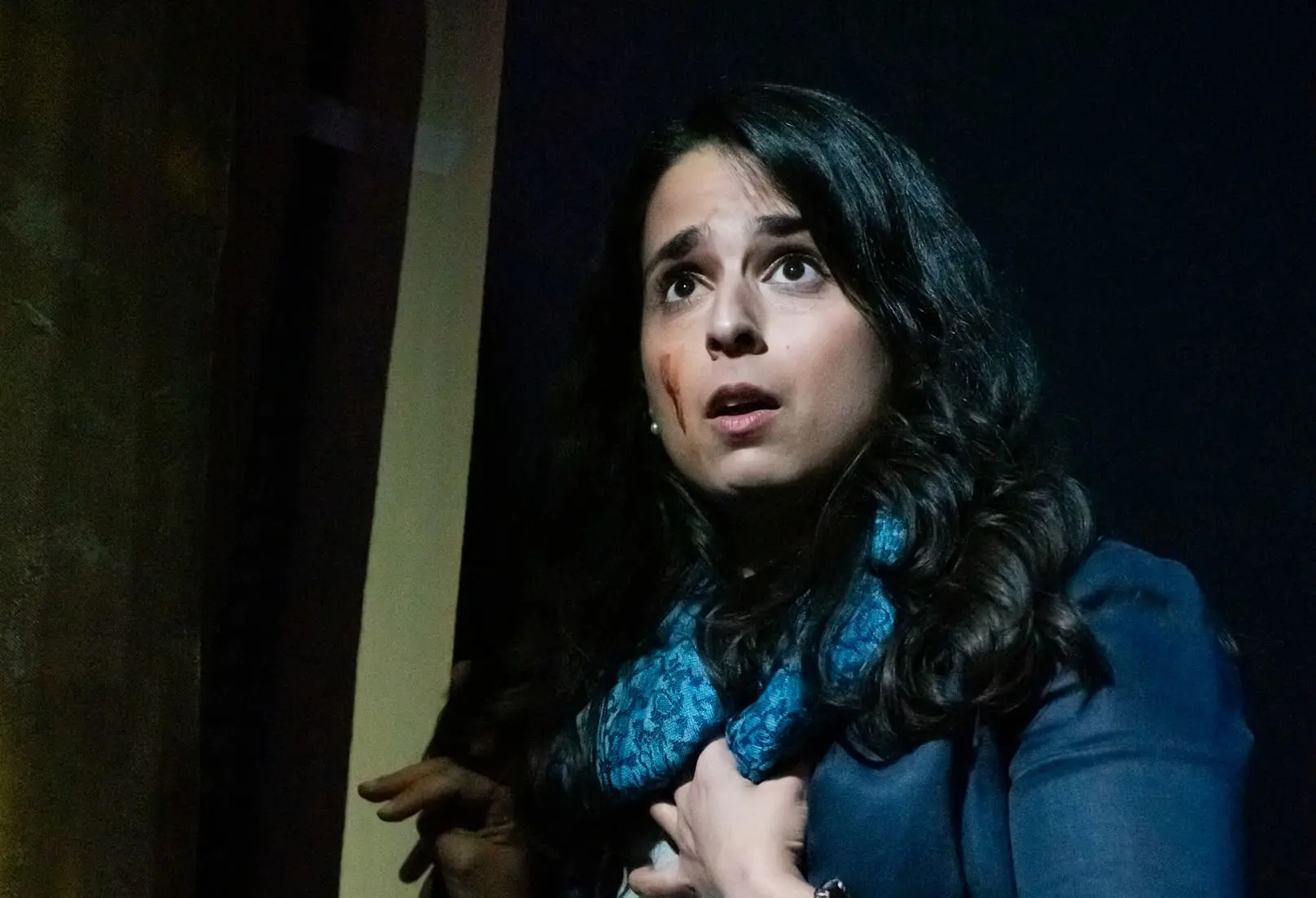
Photo Credit: James Yang
Tamara Simon’s Micaëla “infused the role with an appropriate purity of spirit”
Opera Canada depends on the generous contributions of its supporters to bring readers outstanding, in-depth coverage of opera in Canada and beyond. Please consider subscribing or donating today.