They’re the OG of OGs, the prototypical dysfunctional family. Their rap sheets include disobedience, pride, blame-shifting, jealousy, anger and murder, for which they were banished and handed lifetime sentences of toil, suffering and transience, their time on condemned row concluding with them kissing the dust from whence they came.
Yes, of course, the original gangstas here are four individuals found in the biblical Book of Genesis: Adam, Eve, and two of their sons: Cain and Abel. Perfect fodder for an opera, don’t you think?
Rudi Stephan certainly did. Using a libretto drawn from Otto Borngräber’s 1908 eponymous play, Stephan completed his two-act opera in 1914, his lone stage work the culmination of a five-year labour of love. Liberally based on the Genesis creation narrative, Borngräber’s hyper-charged storyline includes the extra-biblical addition of Kajin’s (Cain) and Chabel’s (Abel) lust for their mother and the incest between Chabel and Chawa (Eve). Little wonder the play was banned in conservative Bavaria in 1912.
Stephan’s Die ersten Menschen was scheduled to be premiered in 1915, but that planned premiere was shelved due to The Great War. The premiere finally took place at Oper Frankfurt in 1920, five years after the composer, aged 28, had fallen in action (he took a Russian bullet to the head) near Tarnopol on the Eastern Front.
Purposely designed to shock audiences musically and morally, Die ersten Menschen belongs to the Austro-Germanic operatic Zeitgeist of the time. Like Salome and Elektra, its music is intense, dramatic and dissonant, though not strictly atonal. Stephan’s chromaticism aims to out-Reger his contemporary, Max Reger. After its Frankfurt premiere, the opera was heard in an abridged version in Münster, Darmstadt and Lübeck in 1924, 1925 and 1926 respectively, then fell dormant until 1954 when it played in Hagen. A concert performance at the Konzerthaus Berlin in 1998 formed the basis for its first-ever recording.
With such a patchy CV, Die ersten Menschen was ripe for the picking, and it has received a flurry of stagings this decade, first at the Dutch National Opera in 2021 and then in 2023 at the Oper Frankfurt with stage direction by Tobias Kratzer. That production was recognized as Opernwelt magazine’s “Rediscovery of the Year” in 2023. This 2025 Frankfurt revival reunited their original cast of Andreas Bauer Kanabas (Adahm), Ian Koziara (Chabel), and Canadians Ambur Braid (Chawa) and Iain MacNeil (Kajin). Nina Brazier managed the revival’s staging.
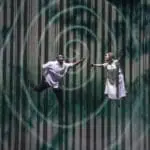
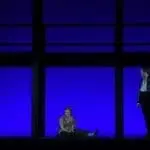
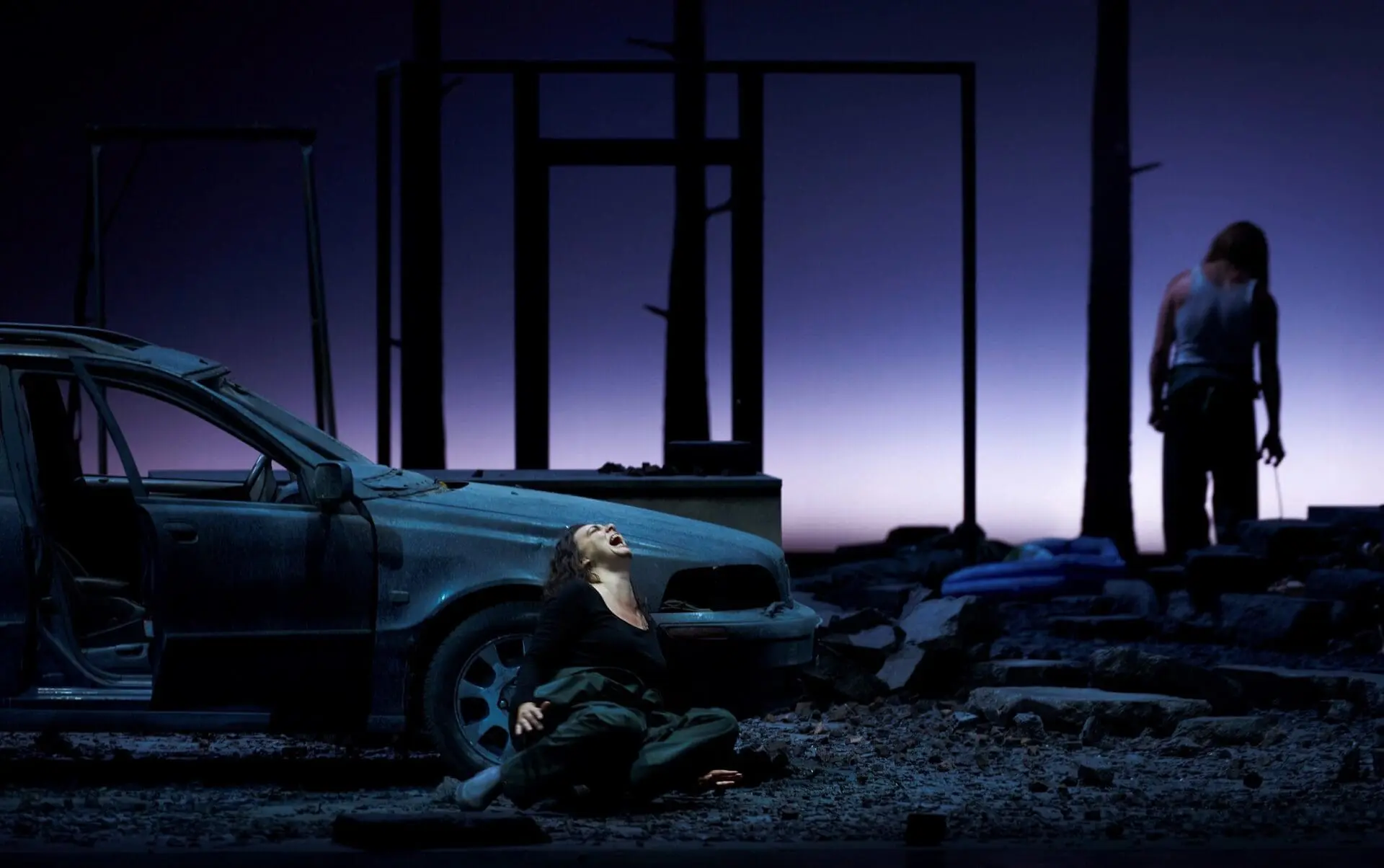
Kratzer and his frequent co-creator, set and costume designer Rainer Sellmaier, updated the action to a dystopian future framed by nuclear Armageddon. The family now lives in a bunker decked out as a modern-day kitchen/living room with an adjoining pantry. An access ladder allows for entries and exits through the bunker’s ceiling. Hazmat suits with masks are worn outdoors amidst the blackened, soot-covered debris that includes the family’s burnt-out four-door sedan which, amazingly enough after years of nuclear winter, has a functioning battery that powers the dome lights when the doors are opened.
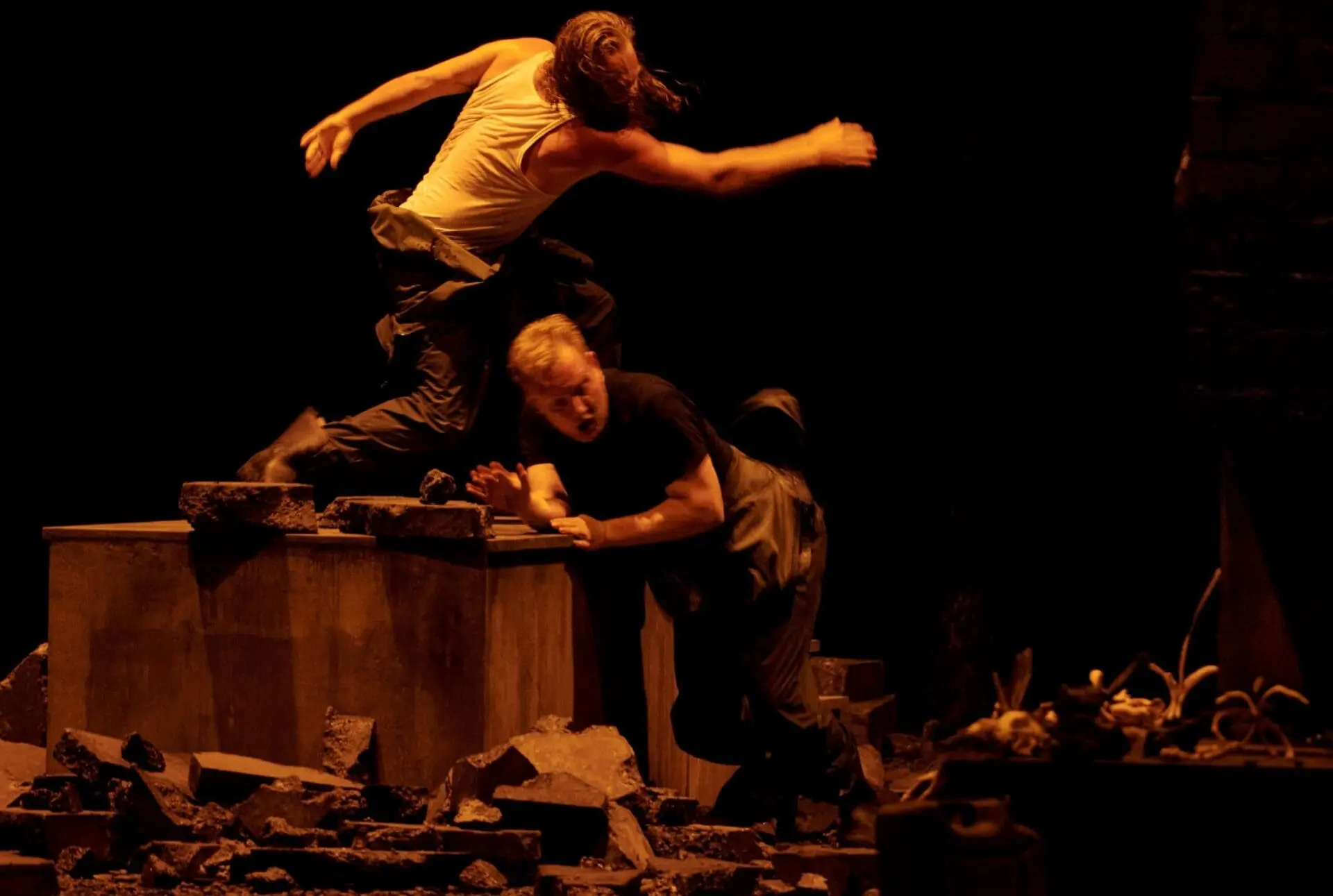
Photo Credit: Matthias Baus
In a fit of jealous rage, Ian MacNeil’s Kajin (top) attacks Ian Koziara’s Chabel
Kanabas’s bass voice was supple yet firm in his opening dialogue with Chawa. He exhibited no sign of any vocal fatigue after having given an intelligent portrayal of the venerable elderly monk Pimen in Boris Godunov two days earlier.
Braid was heard to great effect in her second act prayer, “Allmächtiger!” She captured Chawa’s various moods from her passionate and desperate yearning for bygone days with Adahm in her vehement accusation, “Lügengott, du hast mich betrogen” (“God of lies, you betrayed me”), all the while handling the scene’s two-octave range with aplomb. Braid’s performance of Chawa makes one’s mouth water at the prospect of her upcoming role as Katerina in Shostakovich’s Lady Macbeth of Mtsensk at the Komische Oper Berlin.
MacNeil’s Kajin was a slacker dude sporting voluminous, shoulder-length auburn locks, track pants and white flip flops while arguing about life and work with Adahm. In his opening scene, MacNeil produced Kajin’s top notes with full-throated ease. Kajin’s murder of Chabel, seven loud hammer blows to the head (seven being a biblical number of completion), performed upstage with MacNeil’s back to the audience blocking patrons’ sightlines, was blood-chilling.
Tenor Ian Koziara was a standout as Chabel, floating up to a falsetto high C on the line “heilig ist Gott” (“holy is God”), softly accompanied by an electronic Content Cambiare 312 organ in the pit at the end of Act One. The incest scene, in which Chabel and Chawa disappeared into the sedan that moments later began to rock gently from side-to-side, elicited giggles from some in the packed audience.
At the 118-minute mark, just when you begin to wonder how and why these four individuals were the only ones to survive that nuclear sizzle, OF’s cast of supernumeraries popped up from various traps and populated the stage, just in time to conclude the two-hour opera. Indeed, human hope springs eternal.
The persuasive, well-paced account was led by Takeshi Moriuchi, deftly deputizing for the original conductor who withdrew from the revival for personal reasons. Moriuchi drew out a full-bodied sound from the orchestra replete with a Schiedmayer celesta, all the while keeping a perfect pit/stage balance.
Opera Canada depends on the generous contributions of its supporters to bring readers outstanding, in-depth coverage of opera in Canada and beyond. Please consider subscribing or donating today.