Toronto is in the grip of FIFA madness; honking cars and red- and white-clad soccer fans fill the streets. I needed respite from the frenetic mood of the opening game and found it when I stepped into Theatre Passe Muraille. I was drawn into the dream-like atmosphere of Opera 5’s Parḗlios, the world premiere of a Canadian English-language opera by composer Cecilia Livingston and librettist Duncan McFarlane.
Somehow, the word “opera” seems too narrow a title for something that combines elements of opera, dance, installation and oratorio to create a daring work about humanity’s relationship to each other and the environment. The title Parḗlios comes from the Greek term for “sun dog,” and this performance explores a group of travelers whose journey with Sol is a double-edged sword. Like the wanderers onstage, we are challenged to explore whether our experience on earth is a natural illusion like a “sun dog” or whether we follow meteorological folklore and think of this natural phenomenon as a symbol indicating divine protection, alignment and hope? Either interpretation works in this story.
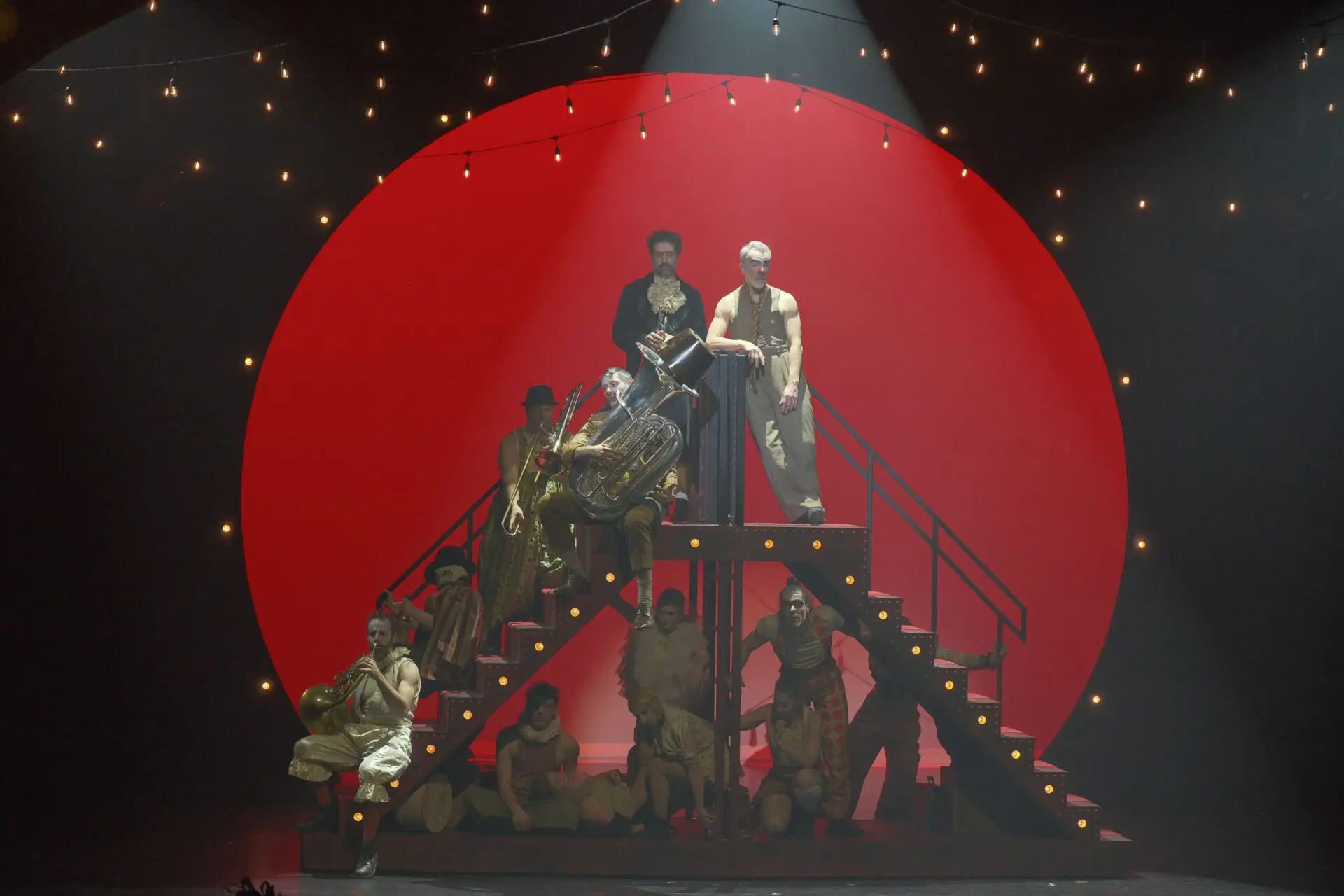
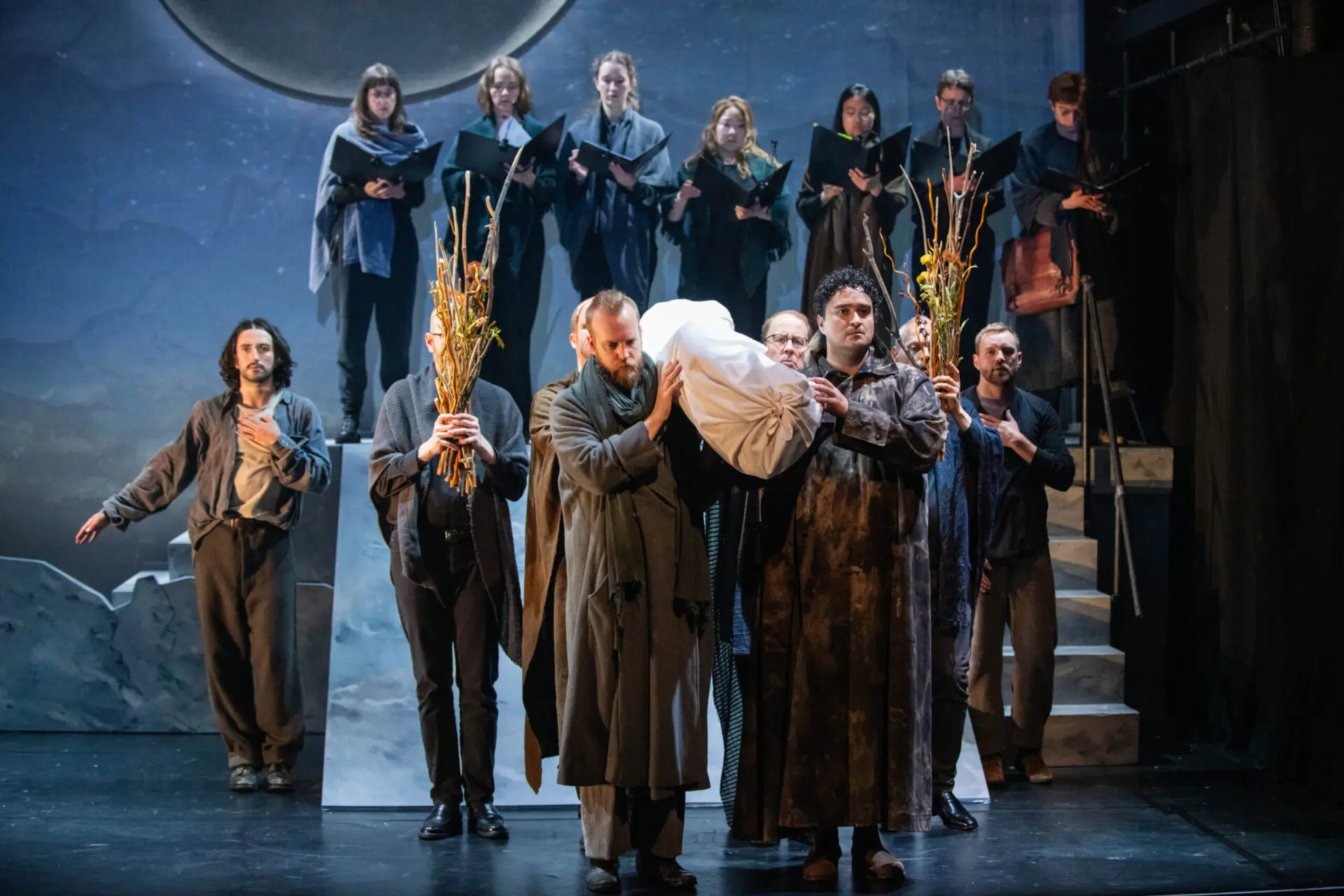
The centrality of the sun in the plot is boldly depicted by Nathan Bruce’s brilliant projection design and Carlyn Rahusaar Routledge’s elegantly simple set design, consisting of a sloped platform and stairs. Within the projected circle, Nathan Bruce’s radiant design tells a story in itself, making the sun another character in this enigmatic tale. The circle morphs into several images, such an eye, a map, a solar flare, even Leonardo de Vinci’s Vitruvian man, but it is also a space used to project Duncan McFarlane’s Latin and Greek excerpts and Aristotelian teleology. Does the audience understand these quotes? Perhaps the deeper question is are we called to fully understand everything onstage or is it hubris to assume we comprehend all the complexities of this work? Like Icarus, are we risking flying too close to the sun?
The music itself is a fascinating entwinement of chorus, soloists and percussion. The ten-person choir, led by tenor Robert Busiakiewicz, was ethereal. Various vocalizations, including whispering and chanting, and complex harmonies and layered words added to the intriguing score. Always keeping on pitch, the choir’s exquisite phrasing and tonalities were accompanied by the TorQ percussion ensemble featuring Richard Burrows, Adam Campbell, Jamie Drake and Daniel Morphy. The accompaniment was so polished, fluid and sensitive that listeners could easily forget that they were listening to one family of instruments and not a complete chamber orchestra. Led by music director Evan Mitchell, the exactness needed in this work was truly mind boggling. Mitchell precisely counted his way through the score while also helping create dynamics and tempo which made the percussion sound otherworldly.
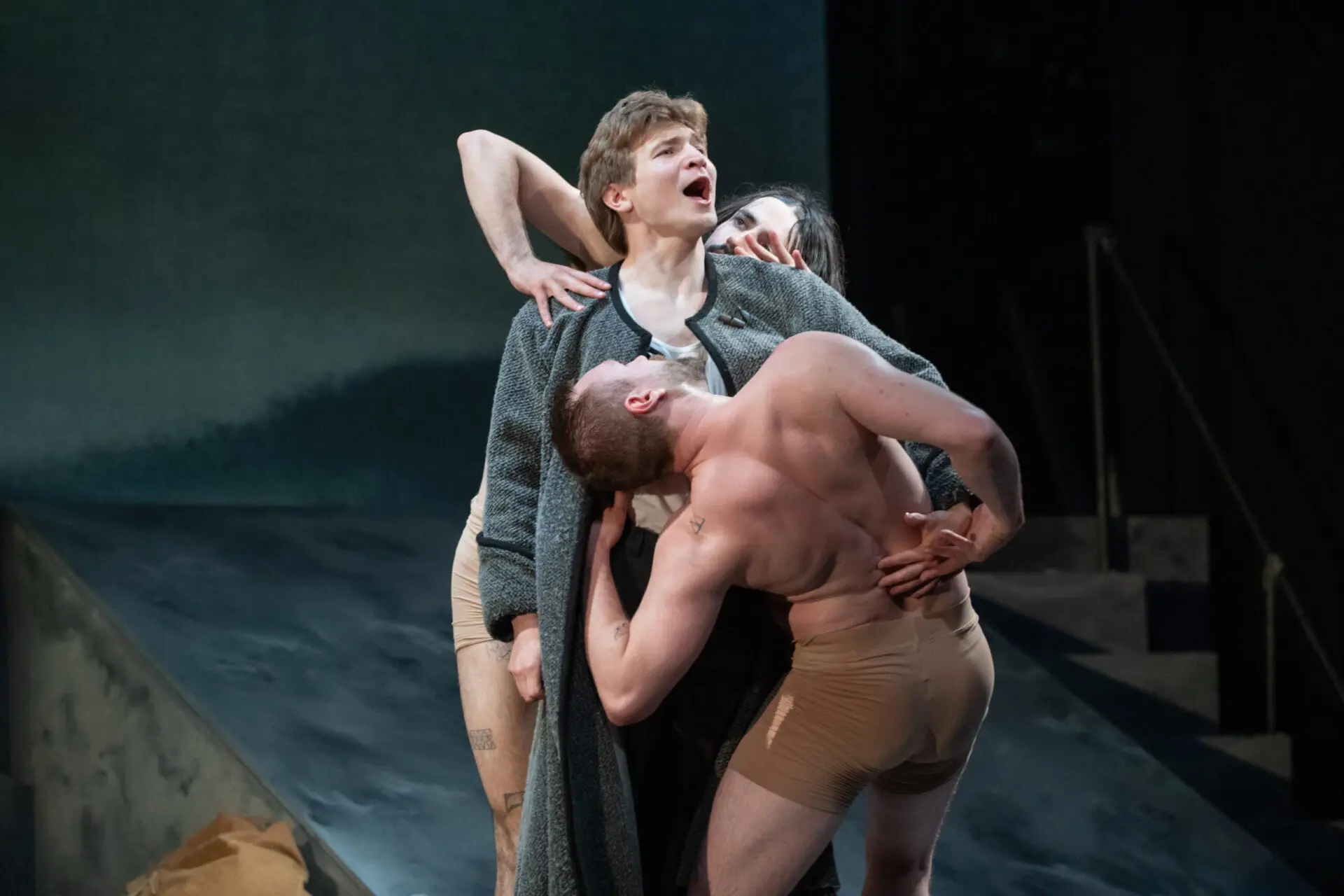
Photo Credit: Emily Ding Photography
Countertenor Brenden Lengsfield, as Memory, surrounded by dancers Sully Malaeb Proulx (behind) and Jarrett Siddall
The soloists were equally compelling. As Wanderer, soprano Len Crino was a confident stage presence whose strong projection demonstrated his comfort and experience with modern opera. Countertenor Brenden Lengsfeld’s depiction of his character, Memory, produced some glorious tones and also displayed his background as a gymnast – singing beautifully while doing some very physical dancing with the two male dancers. As Witness, tenor Ryan Nauta was a commanding presence and has a voice that sensitively interpreted Livingston’s nuances in her through-composed score. As Guide, Aaron Dimoff had a stand-alone piece made beautiful by his rich low timbre, his clear interpretation of the lyrics and the soothing marimba accompaniment. As the supernumerary child, Keira Beasley once again showed that she is an Opera 5 fan favourite. At no point did she exhibit any hesitation, despite being blindfolded onstage, being held high by dancers, and navigating scenes with adults much larger than herself.
The dancing was mesmerizing. Sully Malaeb Proulx (Helios) and Jarrett Siddall (Boreas) interpreted the stunning choreography by Jennifer Nichols with strong, physical dancing and striking poses. They worked on multiple levels, embracing the organic directing, also by Nichols. Dancer Miyeko Ferguson danced with a strength and sensitivity that became powerful storytelling in its own right. Together, the dancers drove the narrative and added another layer to this beautiful work.
Siobhan Sleath’s sophisticated lighting design added stark beauty to this dystopian world. Chris Faris’s costume designs, with layerings of earthy tones, created an ambience of an arid land. Nauta’s flowing cloak was particularly striking visually.
Livingston’s score is as poetically complex as McFarlane’s libretto. The intertwining of words and percussion is highly symbiotic and requires intelligent listening. As Livingston and McFarlane took the audience through the travellers' difficult journey from winter to summer, listeners were left with perhaps more questions than answers. No familiar tunes were hummed on the way out. But what the audience did take away was a unique and beautifully crafted story, told by Canadian artists who plucked listeners from a frenetic world and led them to meditate on an exquisitely rendered mystical journey.
Opera Canada depends on the generous contributions of its supporters to bring readers outstanding, in-depth coverage of opera in Canada and beyond. Please consider subscribing or donating today.