I had high hopes for Vancouver Opera’s season opener Rigoletto. This is director Glynis Leyshon’s second production of the Verdi classic at Vancouver Opera, and the same production (with a slightly different cast) was well reviewed in Victoria when it opened in April at Pacific Opera Victoria.
And what a timely, hyper relevant moment to produce an opera about the abuse of power and exploitation of women! While Verdi had to battle Austrian censors (Austria at the time controlled most of Northern Italy) to produce his version of Victor Hugo’s five-act play Le roi s’amuse about a corrupt, womanizing king (based on Francis I of France), the opera was a hit and became a rallying cry for Italian nationalists. The slogan “Viva Verdi,” an acronym for Viva Vittorio Emanuele Re D'Italia ("Long live Victor Emmanuel II, King of Italy") referring to the then king of Sardinia and future king of Italy, was scrawled across walls everywhere. And the final scene of Rigoletto – where he realizes that the venal duke is alive and well and still unaccountable for his actions – is arguably one of the most political moments in a Verdi opera.
While Leyshon set her 2009 Vancouver Opera Production in a kind of circus, this time she has traded 16th-century Mantua for a gentlemen’s club in Victorian London – 1865, to be exact. In a pre-recorded interview aired at a pre-show talk, Leyshon explained that she chose the era because it was one that local audiences could relate to, saying “It gives us an opportunity to feel close to the seat of power and empire – a patrimony that I think we can all relate to and still is immediate.” Although with hindsight, a 2001-era Mar-a-Lago setting might have been even more immediate.
Still the London’s gentlemen’s club worked well and even made me think of Prince Andrew for a moment. The sumptuous set featured a larger-than-life portrait of Queen Victoria, which when lowered revealed a painting of an orgy, a neat visual cue to the hypocrisy and secret indulgences of the elite of that era (and the current). And the emergence of the club’s denizens in black cloaks and eerie white face masks recalled Kubrick’s Eyes Wide Shut. The foggy riverside scenes on the Thames, where hired assassin Sparafucile (well played by Nathan Berg) and his prostitute sister Maddalena ply their trade are evocative in a Jack the Ripperish sort of way.
But ultimately, the transposition to Victorian London turns sanctimonious and dull – some of the worst qualities of the era – where, with better acting and direction, it could have been dark and dynamic. Sadly, this was a very Vancouver Verdi, where the company hit all the right performative notes: land acknowledgement at the beginning, check; establishment of the Duke as an evil exploiter of women, check; but lacked the necessary passion so essential in a Verdi opera.
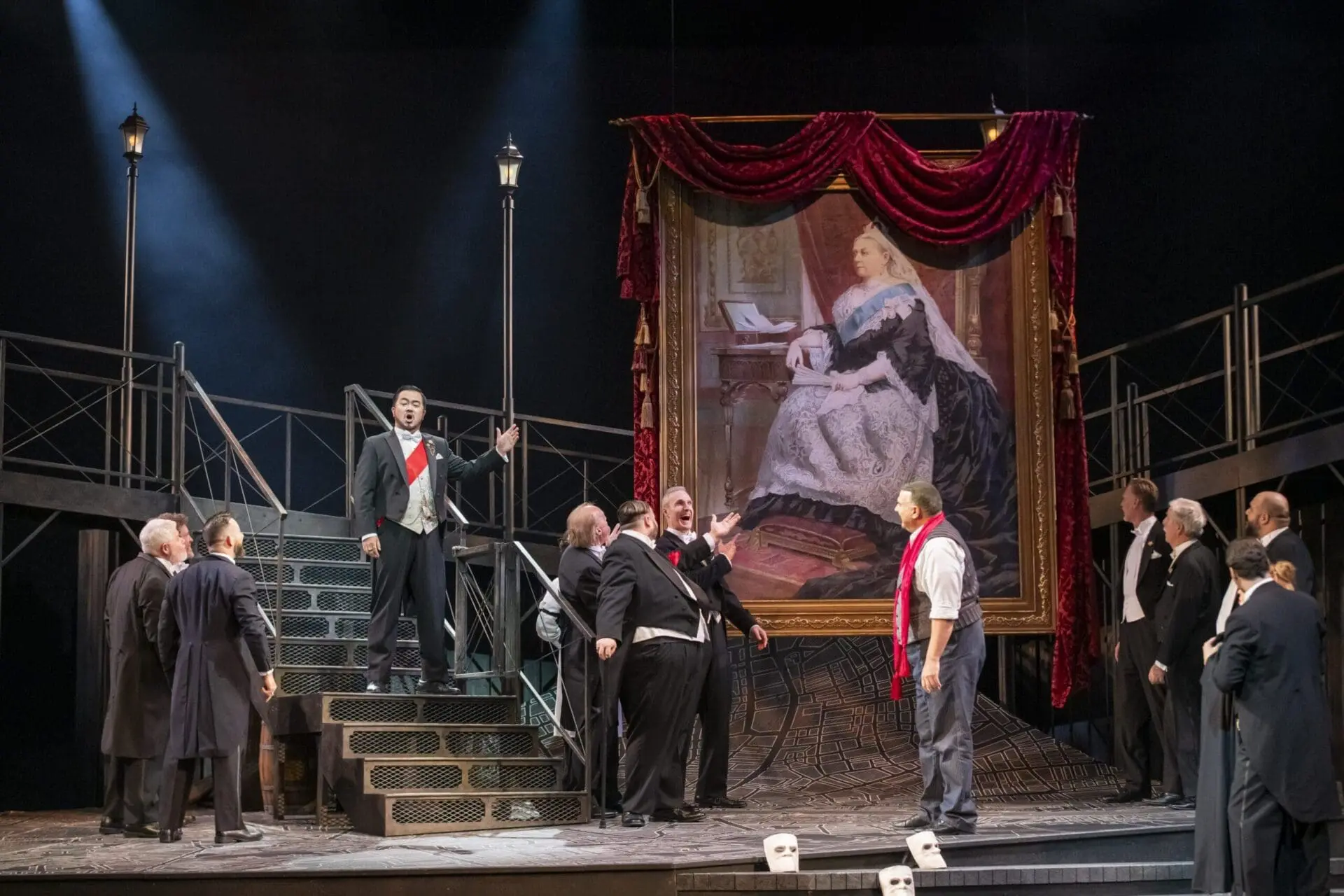
Photo Credit: Emily Cooper
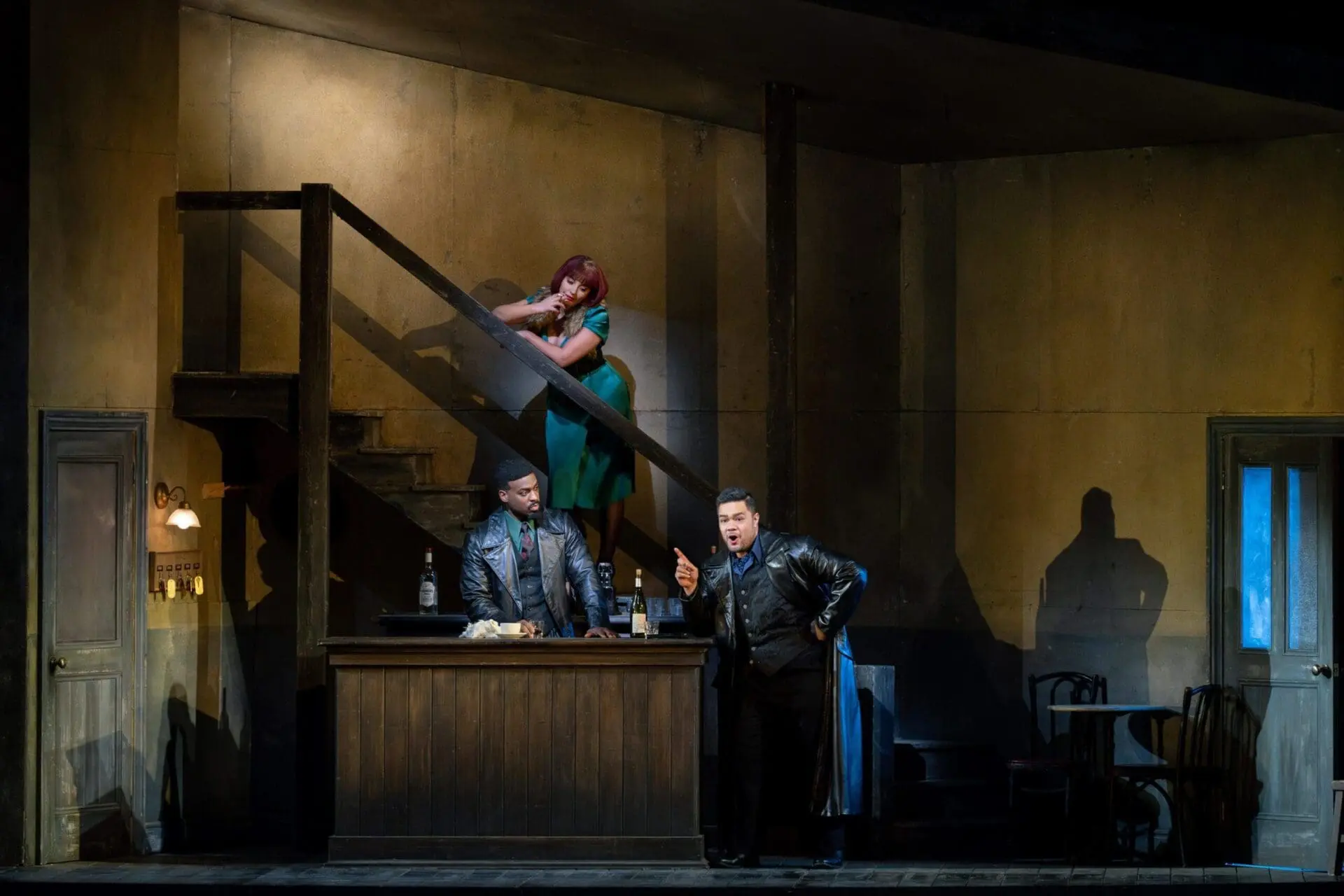
The Victorian “gentleman’s” club setting for Vancouver Opera’s Rigoletto with Yongzhao Yu as the Duke on the staircase
The exception was the stellar Michael Chioldi, the internationally celebrated American baritone happily making his Vancouver Opera debut as Rigoletto, a role he has performed 150 times in several different productions, including a widely acclaimed one at the Met in 2022.
To say he embodied the character would be an understatement. Chioldi was Rigoletto, switching from sarcasm to terror in the first act when Count Monterone (played powerfully by Neil Craighead) cursed him, to rage at the courtiers who abducted his daughter in “Cortigiani, vil razza dannata” and sliding effortlessly into heartfelt pleading. His stellar work continued through to the final scene, when Rigoletto’s glee at his “revenge” shifts to the terrible realization that the duke is still alive and his daughter is dying.
Chioldi’s wide dramatic span was matched by his vocal range. His voice was alternately robust, especially in Dio! Mia Gilda!,” and more tender in his “Piange fanciulla.”
Unfortunately, the much-anticipated performance of Gilda by up-and-coming Canadian soprano Sarah Dufresne was a disappointing contrast to Chioldi’s Rigoletto. Although she had some moments of clarion tone in “Mio Padre,” in the technically challenging aria “Caro Nome” she fell flat on the high notes and seemed vocally strained, as if singing from her throat.
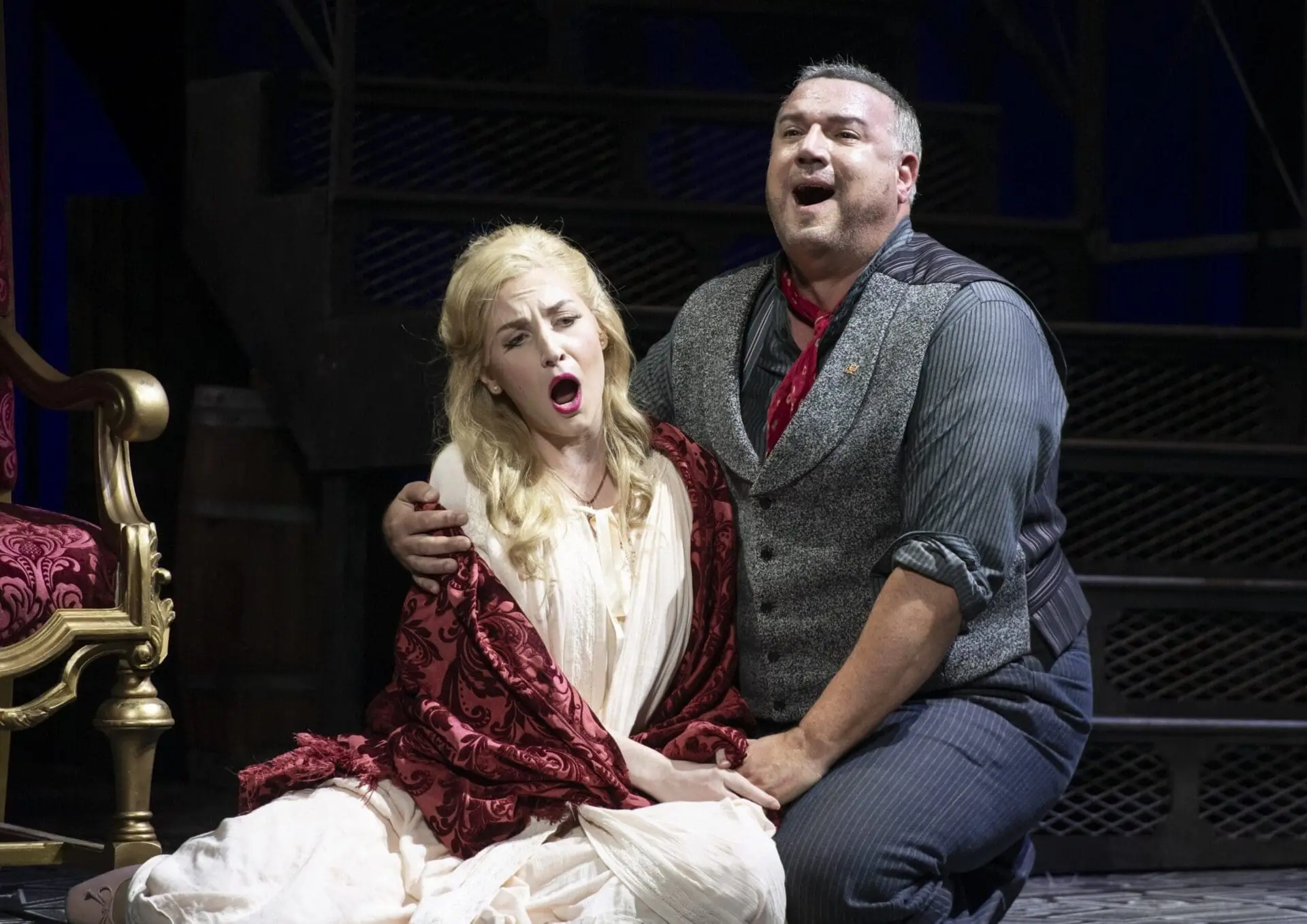
Dramatically, her Gilda was equally flat. She had no agency and seemed to exist as a mere symbol of innocence betrayed. The chemistry between her and an equally lackluster Duke of Mantua (played by Yongzhao Yu with very little emotional engagement and none of the charismatic appeal of his character) was non-existent – although it was present in the Duke’s scenes with Maddalena (played with great vivacity by Emma Parkinson).
The cast did manage to come together admirably in “Bella figlia dell' amore.”
The chorus of “gentlemen” worked well together, although they seemed more slapstick than menacing, and the Vancouver Opera Orchestra was in fine form, easily mastering the often tricky, textured and nuanced score with agility and style.
But this Rigoletto was less about revolutionary passion than a kind of soggy sentimentalism and sanctimony unsuited to Verdi, if all too common in Vancouver.
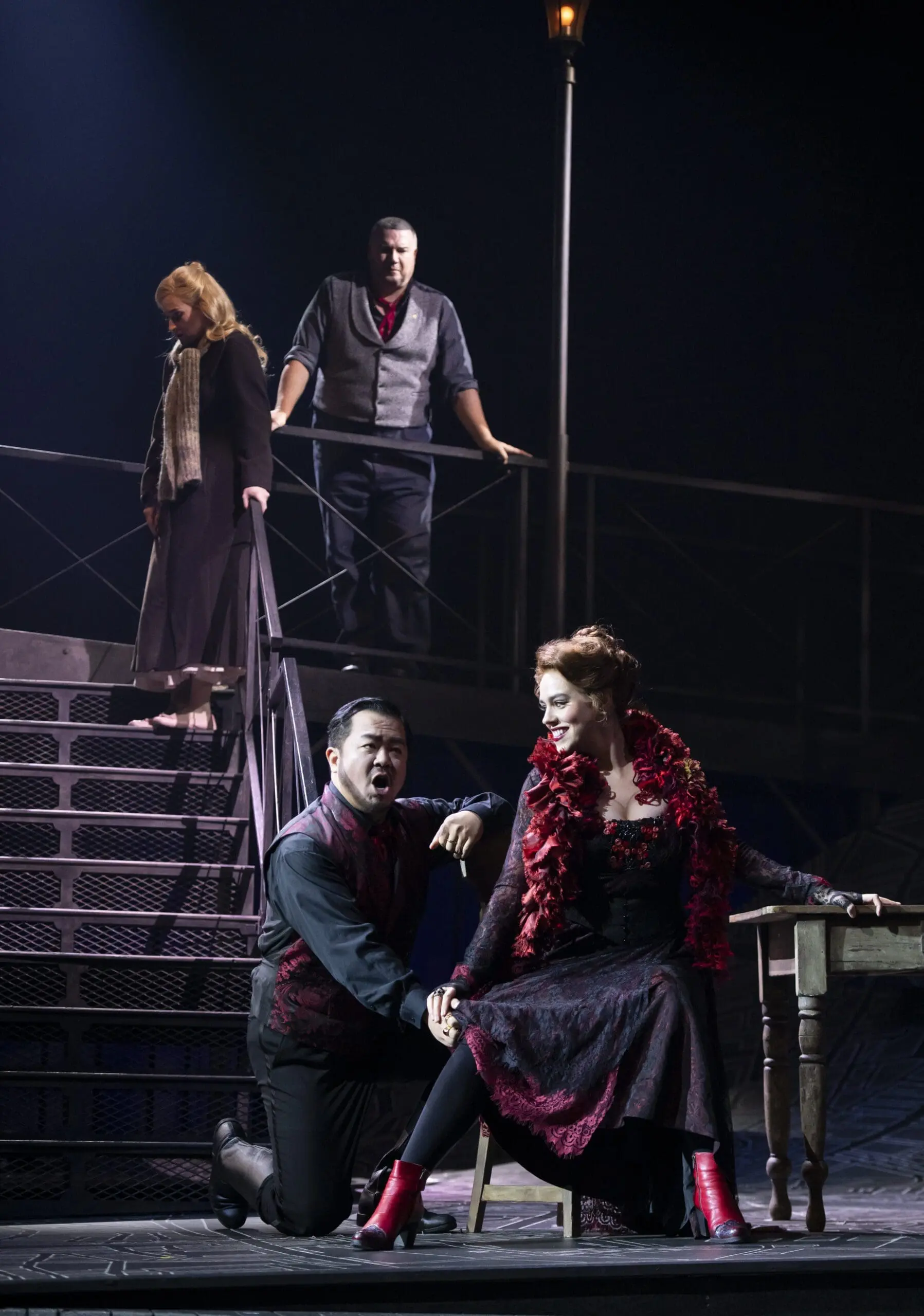
Photo Credit: Emily Cooper
“Bella figlia dell’amore,” performed (clockwise from top left) by Sarah Dufresne, Michael Chioldi, Yongzhao Yu and Emma Parkinson
Opera Canada depends on the generous contributions of its supporters to bring readers outstanding, in-depth coverage of opera in Canada and beyond. Please consider subscribing or donating today.