Opera Atelier opened their 40th season at the Elgin Theatre with Mozart’s The Magic Flute. It’s a remount of the 1991 production, directed by Marshall Pynkoski, as revised in 2013. It’s sung in Andrew Porter’s venerable but highly singable English translation.
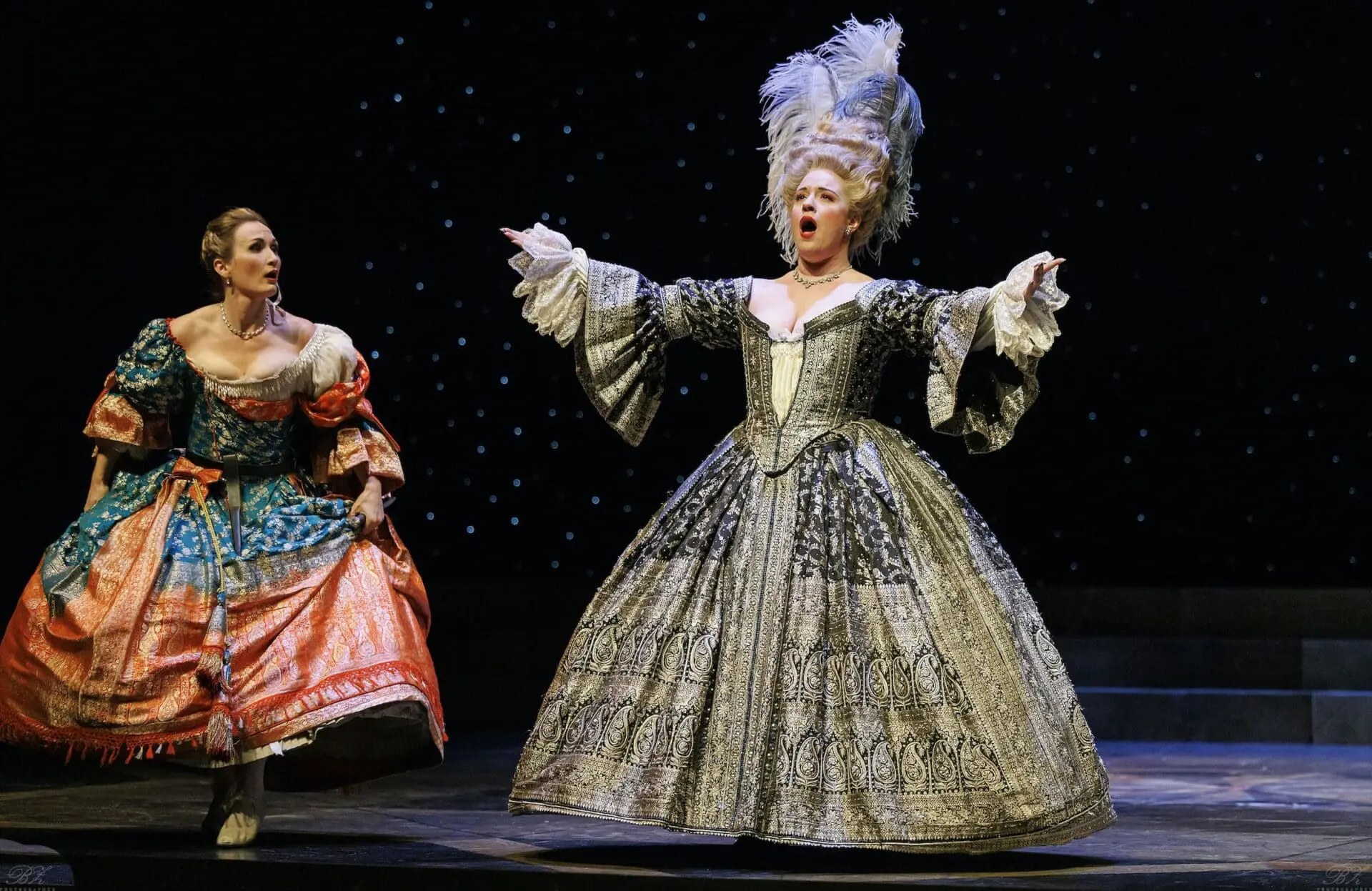
The look is very typical Opera Atelier: painted flats, brightly coloured 18th-century costumes, the use of baroque dance (though quite sparingly in this production) and, of course, the venerable dragon in the opening scene.
There’s no production concept as such. It’s all very by the book, although the dialogue is more extensive than one usually gets, especially in the first act, and there are quite heavy cuts, especially in the second act, which came in at about an hour – 20 minutes shorter than Simon Rattle’s recording. Much of the Monostatos action is (mercifully) cut, and the trials are considerably truncated (which is pretty normal). More oddly, since it has an impact on the drama, the “old Papagena” scene is completely gone, and the ending seems very compressed. No sooner have the Queen and the Night and her followers appeared than they are gone again and the curtain is going up on a brightly lit triumphal ending which merges into farewell waves. There were no curtain calls.
Bottom line, it’s a colourful, straightforwardly enjoyable production that maybe overdoes the dialogue a bit at the expense of the music and the dramatic balance, but frankly, that won’t bother most audience members.
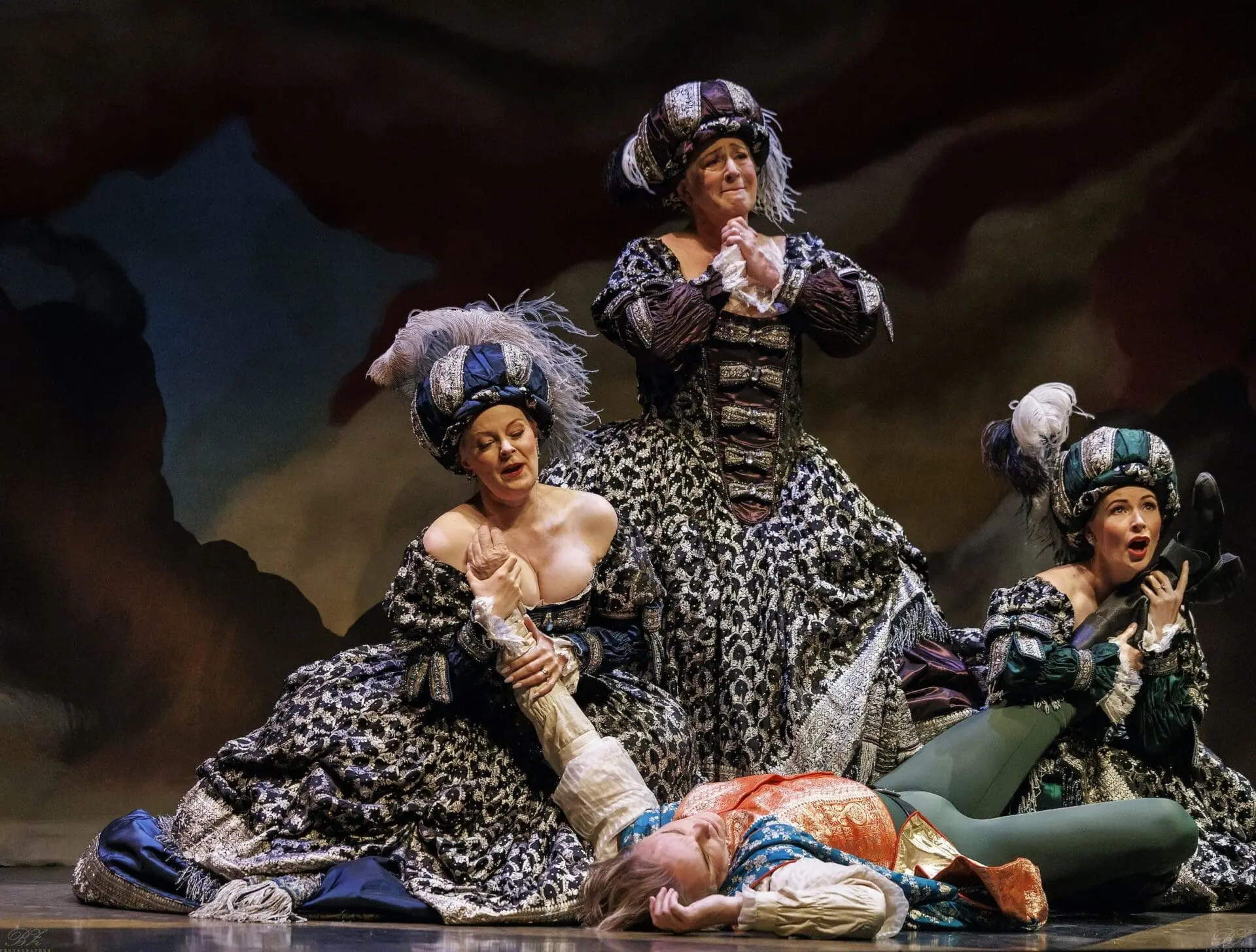
Photo Credit: Bruce Zinger
Tamino (Colin Ainsworth) surrounded by Carla Huhtanen, Laura Pudwell and Danielle MacMillan as the Three Ladies
Vocally, it’s excellent. Meghan Lindsay and Colin Ainsworth are nicely balanced as the two youngsters and work well together. Steven Hegedus is a vocally imposing Sarastro with solid low notes. Carla Huhtanen, Danielle MacMillan and Laura Pudwell make a nicely balanced Three Ladies and have a really good comic timing. Douglas Williams, as Papageno, is vocally solid and puts in a very committed and quite funny physical performance. Karine White matches him well in her very brief moment on stage – basically just the “Pa… pa…” duet. Blaise Rantoanina, as Monastatos, has a pleasing light tenor and gets into things physically in a spirited way too.
The vocal star, though, is clearly Rainelle Krause as the Queen of the Night. She seems to make a living singing this role in top-tier houses and is therefore something of a “get” for OA. “Endless Night” in Act One was very good, but “Hell’s vengeance,” the famous second act aria, was as good as I’ve ever heard. Her coloratura was powerful and pinpoint, and as the applause died down she reappeared and reprised the most spectacular section with additional stratospheric high notes.
The dancers made their quite brief appearances during the temple scenes before and after the intermission and did their usual thing. The Nathaniel Dett Chorale provided the chorus and were fine whether on stage or singing from the boxes at stage left. Tafelmusik provided idiomatic orchestral accompaniment, though the restricted size of the Elgin’s pit meant the brass was out of the pit at stage right, which somewhat unbalanced the sound (at least from where I was sitting). I’m not sure over-prominent valveless brass is an asset. David Fallis, conducting, managed the stage/orchestra balance well and let the singers shine.
This is a production that has endured, with tweaks, for 34 years, and it stands up pretty well. This time around, it’s a very strong cast. One could make a case that The Magic Flute in English is an ideal first opera, especially for young people – it was mine at ENO fifty years ago! I would not hesitate to take a beginner to this show, but there’s still plenty there for the veterans.
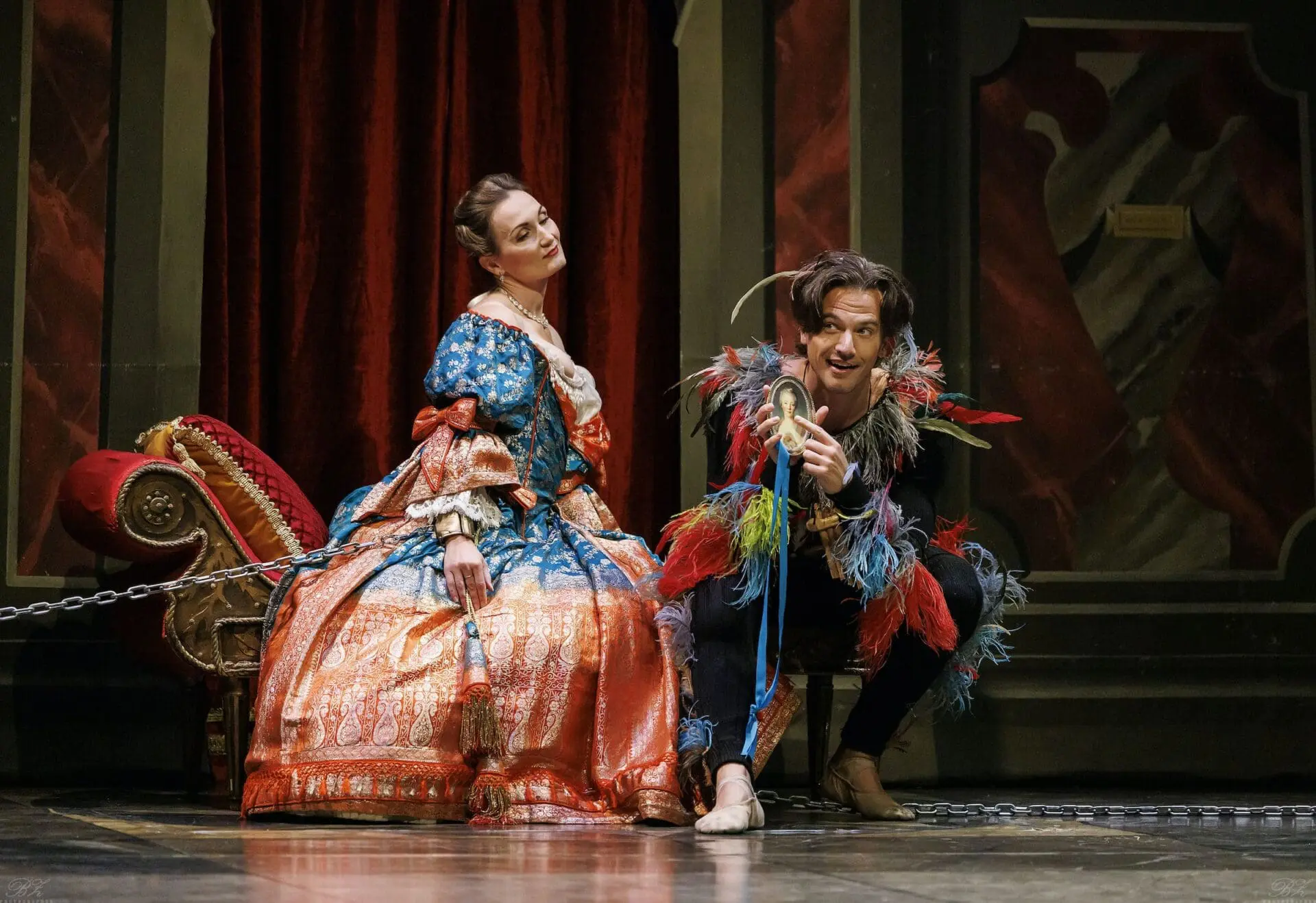
Photo Credit: Bruce Zinger
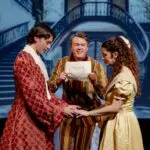
Pamina (Meghan Lindsay) and Papageno (Douglas Williams) in Opera Atelier’s The Magic Flute
Opera Canada depends on the generous contributions of its supporters to bring readers outstanding, in-depth coverage of opera in Canada and beyond. Please consider subscribing or donating today.