Wallis Giunta gives us a glimpse into her new Viennese life, and an insider’s look into what’s happening at the Volksoper
CHANGE IS IN THE WIND HERE IN THE CITY OF Music. I sense it in the brisk step and quick smile of my colleagues at the Vienna Volksoper, my new artistic home. I feel it when chatting with the many expat families I meet at the park, while bringing my one-year-old to burn off some of his abundant energy. I see it in the bold programming of each of the countless world-class institutions that make this city, in my opinion, the beating heart of the international classical music scene. To put it plainly, Vienna feels like an embarrassment of cultural riches, and although is has always historically been so, it is evolving post-pandemic and drawing in creatives from around the world to become more than the sum of its parts: a true melting pot.
My journey to Vienna started in March 2021, with a call from the ever-vibrant Dutch stage director, Lotte de Beer. She was preparing for her then-impending Artistic Directorship at the Volksoper, marking the turn of a (very) new leaf for the 124-year-old opera house. She asked me to join her new soloist ensemble, and stressed her aim of creating a true artistic family, while taking the company into the future with fundamental changes to its current modus operandi. I was all in, and officially joined the Volksoper in September of 2022.
[popup_trigger id=”26633″ tag=”button” classes=”signupbutton” do_default]CONTINUE READING FOR FREE WITH REGISTRATION[/popup_trigger]
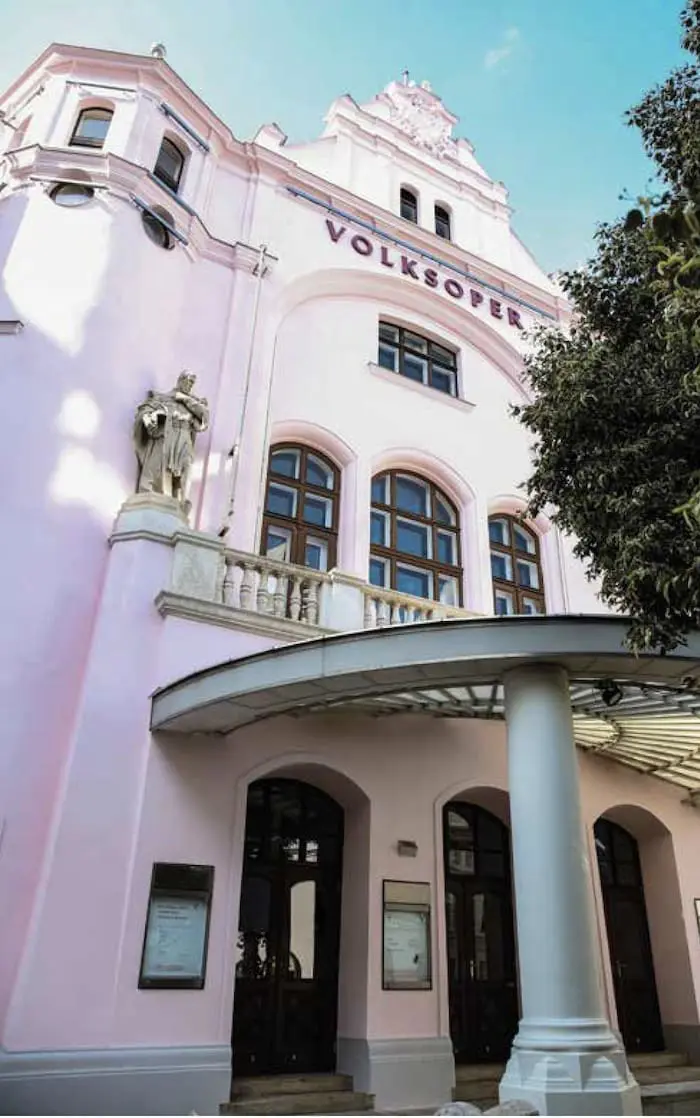
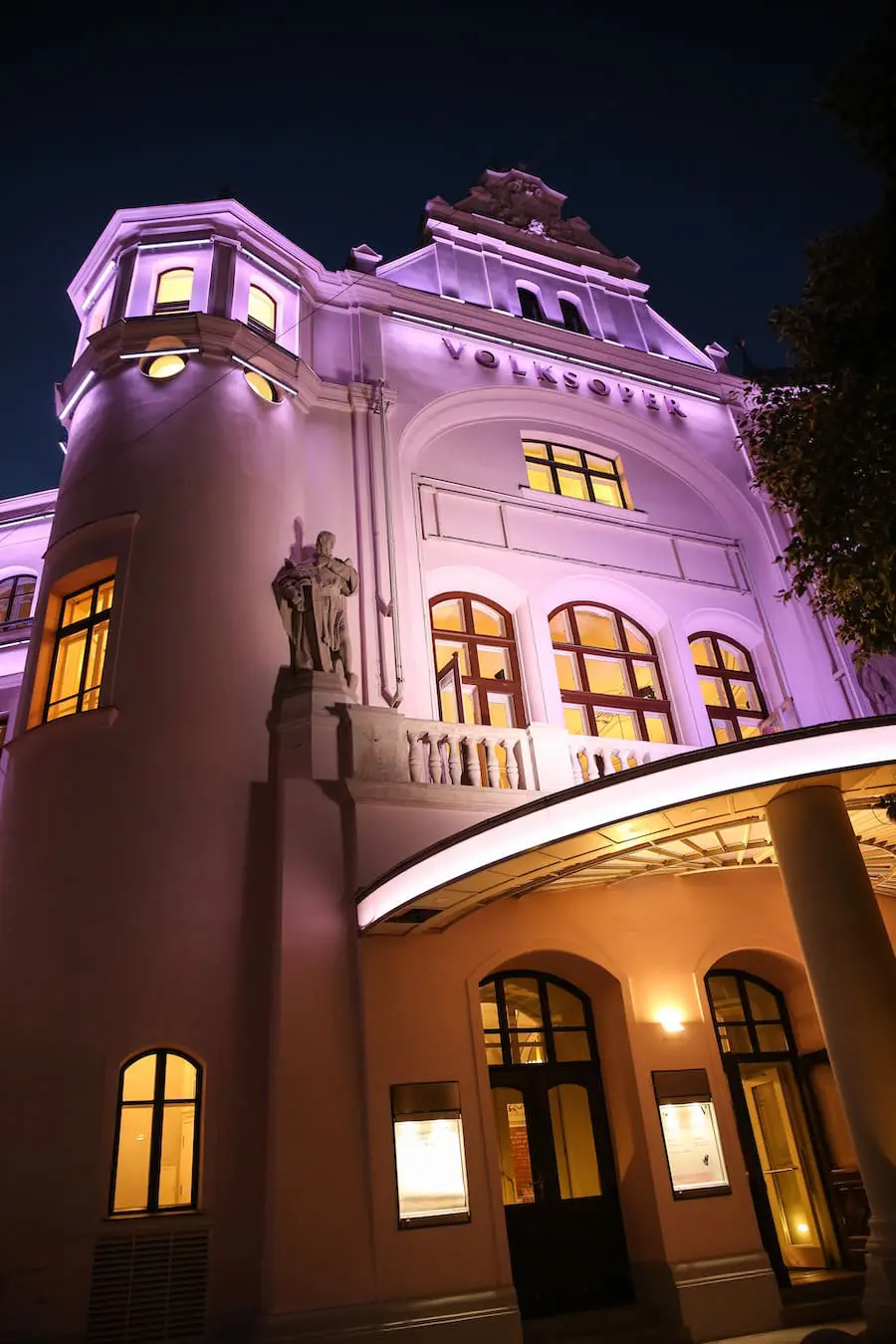
The main entrance of the Volksoper building
© BARBARA PÁLFFY/VOLKSOPER WIEN
I have worked with Lotte before, on new productions in Leipzig (2018) and Düsseldorf (2020), and have developed a friendship and connection with her rooted in our shared experiences as working mothers in this demanding industry. On my first day at the Volksoper, I expected her usual sunny welcome and warm hug, but was not prepared for what felt like a radically affirming and empowering full-company meeting, where she laid out her manifesto for our collective work together. She spoke of the need for mutual respect at all levels, of dismantling hierarchies and barriers, of zero tolerance for discrimination, racism, sexual harassment, and abuse of power. She introduced every new company member, from the canteen to the management office, encouraged us to help each other, reach out when in need, and bring our full hearts and questioning minds to our work on stage and off. I have never been given such explicit permission to be true to myself in this industry. One is usually welcomed at new companies, whether as a guest or an ensemble member, with varying degrees of warmth or distant formality, but never before have I stood in one room with the entire company, shoulder to shoulder, and been told that our most important job was to love, support and empower each other so that we may all thrive and grow.
In the weeks since, I’ve felt that positive current carry me through each day, making wonderful connections with colleagues, and finding the most buoyant of support nets when I need help. And Lotte has been walking the walk: she attends every rehearsal she can, shows up at foyer concerts on her 20-minute break during stage rehearsals, gives out hugs and beaming smiles like it’s her #1 job, and has so far managed to stage direct an inventive new production of Tchaikovsky’s Iolanta, combined with excerpts of his Nutcracker, to rave reviews. The rest of her management team take their cue from her. The vibe is kind, fun, flexible and patient, underlined with a deep understanding that we are all human. Artistically, the biggest change at the Volksoper under the new management is the shift from performing all repertoire in German to restoring original languages, as well as offering surtitles in English for German repertoire. It’s a departure from the way the company has been run since its inception, and indicative of our new path. I’m reminded of Barrie Kosky’s inspiring development of the Komische Oper in Berlin, where one can see Wagner on a Tuesday, a raunchy musical on a Friday, and an unknown baroque opera on a Sunday afternoon, all done with impeccable class and the wink of an eye. That kind of versatility and depth has always excited me, and I’m clearly seeing the Volksoper move in that direction. I also admire that Lotte is easing audiences into it, somewhat, and inviting them to evolve with the company. Developing our audience is a major priority, and in her own words: “To bring people together, to seduce them with beauty and utopia, to entertain…a Volksoper (People’s Opera) in the truest sense of the word, that is the dream”. So yes, this iconic opera house is certainly feeling a new and fair wind beneath its wings, and I’m incredibly grateful to be on the inside experiencing this exciting time for opera in Vienna.
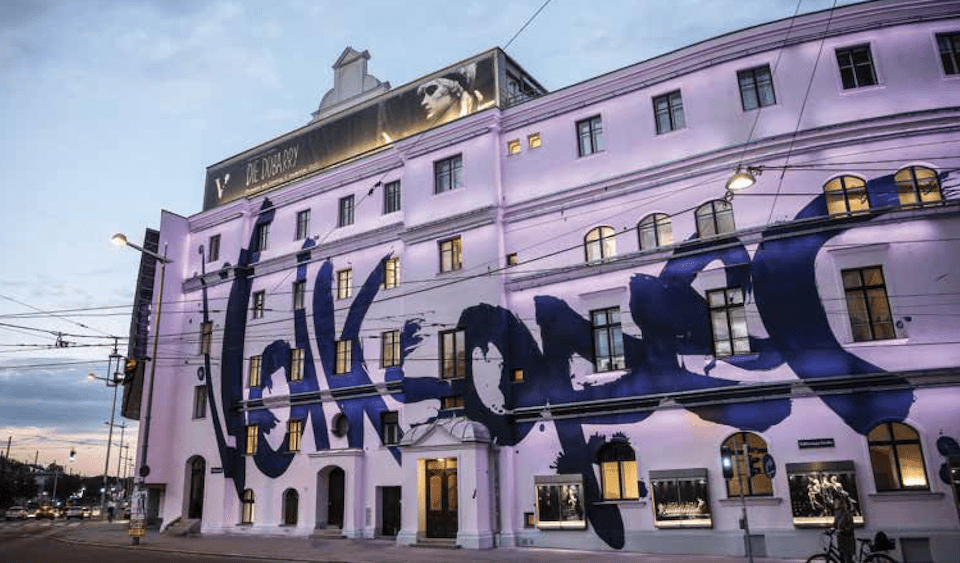
For those on the outside looking in, our Viennese public, the biggest change at our opera house would be the fresh coat of rosy, pink paint on the exterior, with the word “Volksoper” scrawled across the facade in four story tall, indigo blue graffiti. It is bold, but friendly—captivating, but somewhat polarizing, as all good art should be. More importantly, to acknowledge and work to combat climate change (and the current energy crisis), a new, energy-saving LED concept was developed for the entire stage lighting rig, and a photovoltaic system is being installed on the roof, reducing overall house energy consumption by 25%. The option of digital sheet music is being explored to save on paper costs, and the entire company fleet (mainly the trucks and vans moving sets, props and costumes from external facilities to the main house) has been converted to electric vehicles. Vienna’s Burgtheater, one of the largest and most important theatres in Europe, has undertaken many of the same changes, including the photovoltaic roof system. The Theater an der Josefstadt and Wiener Volkstheater have both made changes to limit their energy consumption, such as reducing spotlight use during rehearsals, reducing exterior facade lighting, limiting use of advertising screens, etc. They’re also exploring the possibility of solar panels on the flat roofs of their buildings, hoping to make the conversion as quickly as possible. This climate-conscious approach is also a driving principle of the city’s green public transit system, with an extensive fleet of highly affordable bikes and electric cars available for rent by the hour. The low price point is designed to discourage urban car ownership, and it’s working.
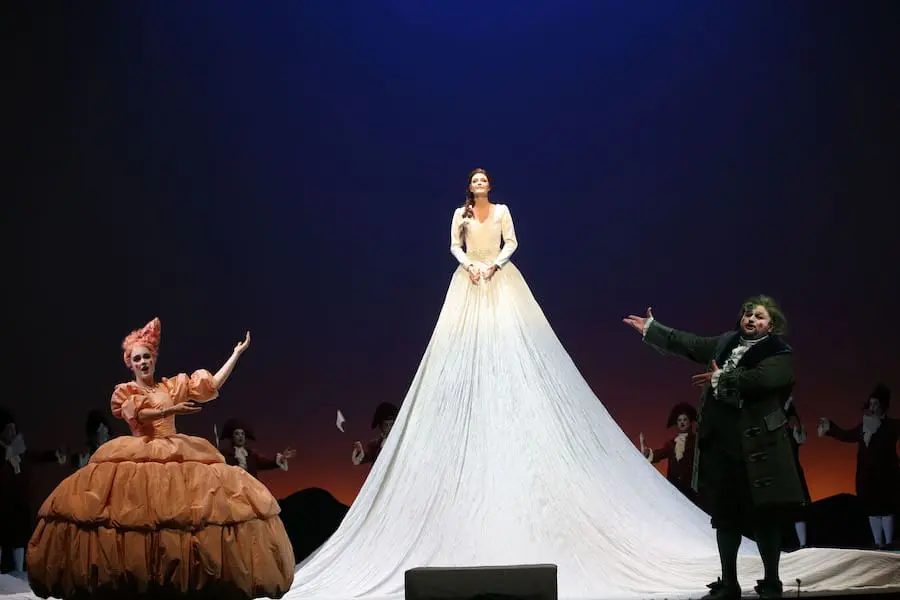
Wallis Giunta in the title role of Rossini‘s La Cenerentola at the Volksoper
© BARBARA PÁLFFY/VOLKSOPER WIEN
The city is quickly recovering its vibe postpandemic, with (nearly) full opera houses, and teeming crowds to consume the buffet of cultural delights available. My little family has barely scratched the surface of what’s on offer in our few months living here so far. We’ve spent most of our free time outdoors in green spaces where our wee one can roam free. We find Vienna to be an incredible place to live for performing artists, and especially ones with small children. The infrastructure for kids is off-the-charts: quality free childcare is available to everyone, nice restaurants have built-in play areas, we are spoiled for choice with fantastic urban parks on every corner, and we enjoy some of the best health and dental care in the world. Underlining it all is a deep societal acceptance of the needs of families with young children. Mind you, income tax and social security contributions are quite high, but you get what you pay for, right? Three fantastic state-funded opera houses, at the very least!
© BARBARA PÁLFFY/VOLKSOPER WIEN
If you speak about Vienna or the Viennese outside of Austria, you often hear that the people are a bit unwelcoming…unfriendly even. We’d heard this in conversation before moving here, and read various blogs and articles stating the same. For us, personally, that’s not been the case, and we’ve felt very welcome. But it merits mention that we are white, of European descent and speak decent German. In this predominantly white, Catholic society, I can easily imagine a person of a different racial background having a challenging experience. In some ways, the culture here is quite progressive (walk signs at intersections in the city centre display same-sex couples crossing the street holding hands, and the City of Vienna website has a page for the LGBTQIA+ community listing resources, events and safe spaces, stating “Vienna is a modern and diverse metropolis. Here you can love whoever you want. And that’s a good thing.”), but the needle is moving more slowly to combat racism. It’s apparent that institutional racism goes largely unchecked (with the Volksoper now striving to be an exception), and the mentality toward immigrants and racial minorities can be highly problematic—especially coming from the older Austrian population. There is, encouragingly, a strong societal counterpoise from younger generations, with Austrian NGO ZARA (Zivilcourage und Anti-Rassismus-Arbeit) working since 1999 to educate, advocate and provide support for minorities, and monitor racism in Austrian culture. In contrast to North American culture, where racism and bigotry are arguably just as rampant, I find here there can be a lack of awareness of what actually constitutes racism that I rarely find in western culture. I hope to see that change, and quickly, in our time here. I will be no bystander. In this city of nearly 2 million, we already feel immersed in the tightly knit musical community.
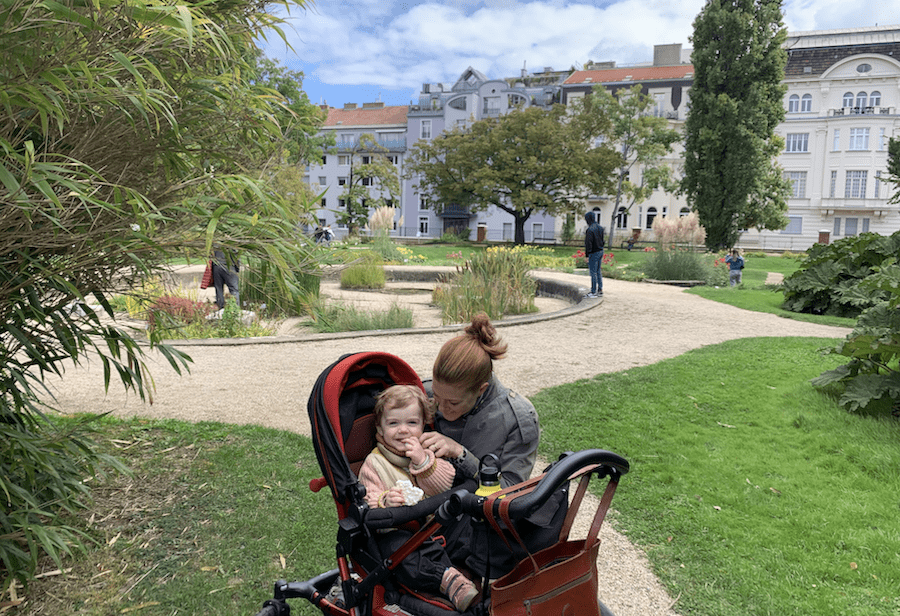
Wallis on a usual walking exploration of Vienna with her son, Geordie, at the Garden of the Belvedere Palace
© ALEX BANFIELD
Between the Staatsoper, Volksoper and Theater an der Wien, someone I know well (or several someones) can be seen onstage any night of the week. One of my best friends was finishing a run of Miss Saigon at the Raimund Theater when we moved here, and gave us a fantastic introduction to the city as a fellow artistic “Ausländer”. Another dear friend is coming in a few months to sing Figaro to my Cherubino, and I am beside myself with glee. We recently saw fellow Canadian and longtime Vienna resident, Michael Schade, give a beautiful recital just outside the city. He and his wife, Dee, have gone above and beyond to make us feel welcome here, and he continues to introduce us to his wide network of local artists and friends. Just the other day, we were at the kids park (can you sense a theme here?) and started speaking to the grandmother of a child playing alongside our son. They were from the UK, and when she asked us what we do, we discovered that her son-in-law, the child’s father, was also an opera singer, and one whom I’d even crossed paths with. We’ve bumped into countless other singers out and about, including one of my oldest friends, Philippe Sly, whom I grew up singing with in Ottawa, and who happened to be standing in front of me waiting to pay at a shop one day. It was incredibly serendipitous. Or was it? Vienna feels like it must have one of the highest rates of opera singers per-capita of all the cities in the world. We are in fine company, indeed.
*this text was originally published in the winter 2022/23 print version of Opera Canada magazine